Season’s Greetings

As 2018 draws to a close we look back on a very busy year across our films, events and campaigns activity. We started production on a new documentary film; we purchased rights to screen an historic documentary from 1970; we had a busy year for our campaigns From to Pink to Prevention and Five Percent; finally, we produced a number of events for our Attlee Nation and MLK Global projects.
FILMS
 We purchased public performance rights for FROM MONTGOMERY TO MEMPHIS – a rarely-seen documentary tracing Martin Luther King’s life and accomplishments from the 1955 bus boycott to his 1968 assassination. Throughout 2018 we hosted a number of public and educational screenings of this extraordinary film in London, Oxford, Liverpool and Manchester, in the 50th anniversary year of the assassination of Dr. King.
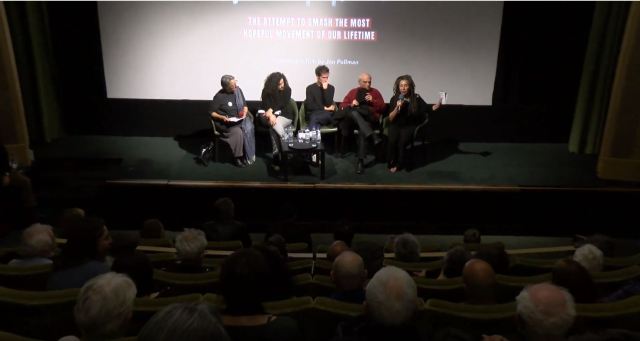
A highlight was our June 2018 event at Bloomsbury Baptist Church, where King himself preached in 1961, followed by first-class panel for the Q&A (video link) with theologian David Muir; Dionne Gravesande TPNS board member and co-leads on MLK Global; Richard Reddie biographer of MLK; Neil Jameson CBE Founder and Executive Director of Citizens UK; Selina Stone Lecturer in Political Theology at St Mellitus College; Eleasah Louis PhD Student at Canterbury Christ Church University
KING ASSASSINATION PROJECT (WORKING TITLE)
In June we began filming on our ‘King Assassination Project’. The film will look at more than 40 years of controversy surrounding the case. More importantly – and uniquely –offers an opportunity to put the case that King’s assassination was a direct result of the threat posed from his latter years activity (1965-68) as he led the civil rights movement into anti-Vietnam War and Economic Justice coalition building.
We are indebted to the support of our friends and colleagues at Sands Films Studios, our production partners on this film, along with a number of major donors who have underwritten the first phase of production.
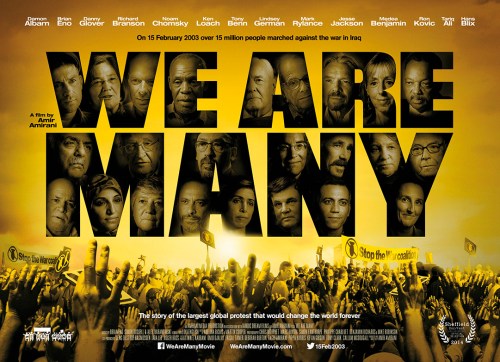
OTHER FILM NEWS We Are Many was screened in September as part of a Tipping Point film programme at The World Transformed, which runs parallel to Labour Party Conference. And our Christmas cinema documentary Open Bethlehem about life in Bethlehem over five Christmases now has an abridged version of 30 mins https://www.openbethlehem.org/ob_abridged. It remains one of the best Xmas films you will ever see. https://vimeo.com/ondemand/openbethlehem


CAMPAIGNS
FIVE PERCENT
 Throughout 2018 we made a number of submissions on the subject of UK aid and policy-making through the prism of conflict and runaway global military spending; we took 5% materials for meetings at Labour Conference; we made headway with chapter writing on a book outlining our arguments; we made a short video on the links between EU and Israel on defence and security.
Iraq, Yemen and Syria – and the Jamal Khashoggi murder – illustrate the terrible conflict of interests in UK foreign policymaking. The UK is both a top arms manufacturer and seller, as well having one of the highest military spending budgets. At the same time, the UK sees itself as leading the way on international development and this includes the ‘mopping up’ in conflict/post conflict regions, where UK forces / arms sales have played a direct role in causing that same humanitarian need. War remains a highly profitable activity for arms companies such as BAE or Lockheed. We argue that runaway global military spending is an international development campaign waiting to happen.
Submissions. December 2017 Written Submission to Labour Party Expert Panel on Int’l Development led by Shadow Secretary Int’l Development Kate Osamor MP . June 2018 Written Submission to Labour’s National Policy Forum on SDG 16 – peaceful societies needs to go much further than presently constituted. June 2018 Labour’s National Policy Forum Submission as a signatory with other organizations.
In September we attended Labour Party Conference in order to share our proposal with MPs and organizations and this winter we are finalizing text for a Five Percent ‘Beginners Guide’ book which we will publish in early 2019.
Israel /Palestine & 5%: While many UK development NGOs work in Palestine, they are unaware of the deep military ties that the UK and EU have with Israel. Jeff Halper (Israeli Committee against House Demolitions) is a 5% supporter and in this video he speaks about this issue.
FROM PINK TO PREVENTION

In 2018 we mounted an ambitious exhibition by our co-founder Diana Ward; we continued to lobby MPs and Ministers for the UK to stay within EU Chemical regulations after Brexit; we held our annual meeting with leading UK breast cancer research and fundraising charity Breast Cancer Now to argue the long overdue need for them to recognize and act on the scientific evidence linking environmental and occupational links to breast cancer. Finally, we took FPTP campaign materials to Labour Conference.
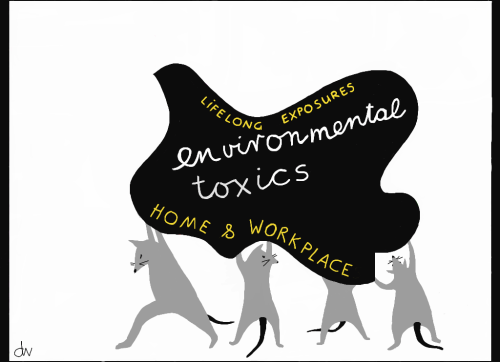
Every day of our lives, from pre-birth to death, we eat, drink, breathe and handle countless numbers of synthetic chemicals. We wear them, we rub them onto our skin and hair, we wash ourselves, our children, our pets, our cars and clothes in them. We sit, sleep, drive, walk and run both in and on them. We spray them on our gardens, our worktops, and into the air in our living and work spaces. We clean our cars, houses, teeth and tools with them. We decorate ourselves and our homes with them. We write, paint and play with them. This lifelong low-level exposure to hormone disruptors and carcinogens has a health impact.

Throughout 2018, as part of the Brexit debate, we have been part of the lobby to ensure the UK stays inside the EU Chemical Regulatory regime known as REACH. Helen Hayes MP has been incredibly supportive of our work on this. She hosted our Westminster Portculllis House event ‘Brexit and Breast Cancer’, and submitted a Written Parliamentary Question on this same issue to Secretary of State for the environment Michael Gove on behalf of From Pink to Prevention .In February, we met again with senior staff at Breast Cancer Now to keep the pressure up for them to acknowledge the overwhelming scientific evidence that links environmental and occupational risk to breast cancer and to carry this information in all their public-facing information materials. In September, we took FPTP information packs to Labour Conference to share with some of the Labour Party members who sit on the APPG for Breast Cancer.
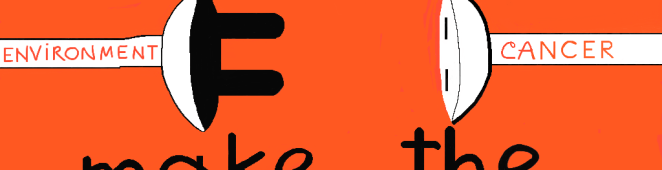
In October, UNISON hosted a new exhibition of 25 original cartoon works by our friend and colleague Diana Ward whose artwork is a unique way into the subject and it reflects on the decades of scientific evidence linking environmental and occupational risk factors to breast cancer. As a writer, artist and activist, Di’s main interest since 1993 has been the politics and prevention of breast cancer. A number of exciting new potential partnerships were explored as a result of the exhibition. The full exhibition is here https://frompinktoprevention.org/resources/make-the-connection-exhibition/
MAKE APARTHEID HISTORY
In 2018 we marked the 70th anniversary of the NAKBA in May with our Brian Eno MAH video and filming a number of NAKBA events for MAH partners; in July we made a short video to commemorate Mandela 100; in November we re-shared our 2017 Balfour Declaration film.
 Israel was founded 70 years ago on 14th May 1948. Palestinians commemorate the next day, 15th May, as their ‘Nakba’ – day of catastrophe. This Arabic term refers to the mass expulsion of Palestinian Arabs from British Mandate Palestine during Israel’s creation (1947-49) when between 750,000 and one million Palestinians were expelled and made refugees by Zionist paramilitaries, and subsequently Israeli forces, during Israel’s creation in 1947-49. As Israel marked its 70 years, the violence continues. As it ‘celebrated the Trump administration’s opening of the US Embassy in Jerusalem, IDF forces massacred 62 Palestinians in Gaza, bringing the death count since Israel began firing on the Great Return March to at least 110. More than 12,000 have been injured; many so severely that they will require the amputation of limbs.’ (PSC).
 In May our Make Apartheid History campaign marked the 70th anniversary of the founding of Israel by sharing our video interview with MAH supporter (and Stop the War President) Brian Eno, where he talks about ‘being born on the same day as the founding of Israel; in July we made a short video to mark Mandela 100 and the anniversaries of three inter-linked movements that spanned the 20th and into the 21st century: Civil Rights, Anti-Apartheid and Palestine Freedom Struggles. In November we re-shared our popular Balfour Declaration a short film made for November 2017 centenary and exploring Settler Colonialism to help understand more about why apartheid applies to Israel.
EVENTS
ATTLEE NATION
We took our theatre performance of ‘In Clem’s Own Words’ to a packed audience at the The World Transformed Festival, held in Liverpool in September. Readers: Adjoa Andoh, Francis Beckett, Paul Mason, Richard Attlee, Kika Markham and Owen Jones.
 “Attlee’s political genius was to give people a sense of hope, a clear route map out of depression, war and austerity towards the social and economic justice they craved. His government rebuilt Britain, and the next government needs the political courage to do the same – including giving working people a voice so we can help build a more equal, more democratic country. We must not miss the chance again.” Frances O’Grady, Gen Sec TUC
“Charity is a cold grey loveless thing. If a rich man wants to help the poor, he should pay his taxes gladly, not dole out money at a whim” Clement Attlee
 Our theatre performance in September breathed life into a man to whom we all owe so much – Attlee was a quiet revolutionary, in politics to ‘do’ something, not ‘be’ something. To know Attlee better is to know what can be achieved today. It played to a full theatre space (300) and both cast and audience reactions were very positive. This event came in the 70th anniversary of the founding of the NHS – the jewel in the crown of the Attlee administration. https://attleenation.org/2018/10/01/in-clems-own-words-at-twt-2018-highlights/
Our first Attlee Nation event ‘Attlee Remembered’ was a mini-festival hosted in October 2017 marking 50 years since Attlee’s death on 8 October 1967. Attlee Nation argues that if we know what was achieved in the recent past, it might help build confidence to ensure that the next 70 years are just as ambitious. We need to prize and protect the notion of ‘generosity to the future’ so powerfully embodied in the Attlee administration.Here is one of our festival speakers Ken Loach on the importance of Attlee and knowing our history .
MLK GLOBAL
To mark the 50th anniversary of MLK’s assassination in April 2018, our MLK Global project held screenings; produced several foundational articles; launched in the USA and founded a UK working group.
 Alongside our work with the 1970 film From Montgomery to Memphis and the production of an in-house King documentary, we continue to develop and widen interest in our MLK Global project which aims to take MLK’s analysis on the triple evils of poverty, racism and militarism and convert them into a 21st century int’l campaign with King’s own Economic Bill of Rights as the ‘manifesto’ underpinning the call.
In January we launched our Solidarity Statement; in April, our partners in the United States, KINETICS, produced our first video action. ‘Where do we go from here?’ was launched on April 4th for both USA and international audiences alike, with a focus on reaching out to leading progressive African American faith leaders. Full video gallery here https://btpbase.org/mlkglobal/
Two long read articles were written for the April commemoration
https://mlkglobal.org/2018/04/03/if-you-think-you-know-martin-luther-king-think-again/
https://mlkglobal.org/2018/04/21/dr-king-an-early-advocate-of-global-solidarity/
 We organised 50th anniversary screenings in February, April, June and September – all with Q&A’s and as we end the year, we are formulating a working group to take the work forward, building on those signatories to our Solidarity Statement. This work will look especially at for a campaign to end poverty, racism and militarism in our lifetime, and to do this through an updated version of Dr. King’s Economic Bill of Rights.
WITH SPECIAL THANKS TO….
All our work is made possible through restricted grants and unrestricted donations.
On behalf of our management committee and workers, our thanks to all our project funders: The Ratcliff Foundation, Polden-Puckham Charitable Foundation, Amiel and Melburn Trust.
And to our dedicated major donors and all our individual regular givers – you also sustain our work for which we offer our special thanks.
To find out more about how you can help our work, please email
Deborah@tippingpointnorthsouth.org
Find us at
www.tippingpointnorthsouth.org
Facebook and Twitter






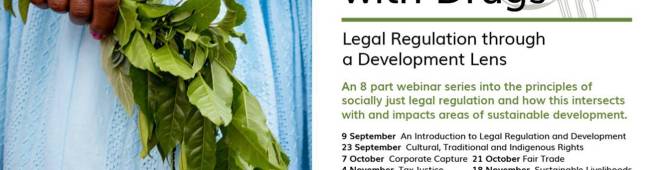
 We are delighted to be sharing news of an 8-part international webinar series, co-organised by our friends and colleagues at Health Poverty Action. It will explore why drug policy reform is vital for sustainable development.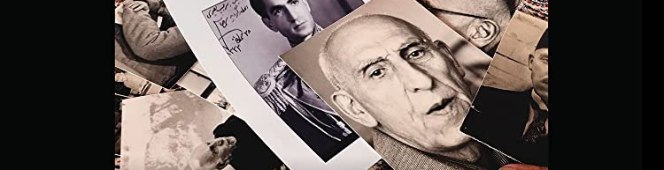












 Tipping Point North South