A much needed boost for climate hope: the First Conference on Transitioning Away from Fossil Fuels

A much needed boost for climate hope: the First Conference on Transitioning Away from Fossil Fuels

Dear friends, colleagues and supporters,

As the Guardian reported (1st May) “hope is contagious and science is king… At world-first Santa Marta climate meeting, delegates say it was ‘euphoric’ to finally be focusing on concrete solutions.” Key among them, the significant and much needed steps taken forward on support for the implementation of a Fossil Fuel Non-Proliferation Treaty.

Below is our round-up of the historic Santa Marta Conference, with special attention to our issue – military spending. 

TPNS was accredited to the conference as a virtual attendee, was a member of the content and demands working group and made a 2 page submission on the War Machine and Arms Industry as part of the civil society consultation seeking responses to ‘barriers’ and ‘solutions’. The TPNS submission included the call for ‘the creation of a working group to investigate routes by which nations can agree on the universal, equitable redirection of military spending to support Global Just Transition Fund’.

The summary below illustrates the extent to which the Santa Marta Conference has proven to be a turning point for the inclusion of military spending as a legitimate source to tap for climate finance. It has given a major boost to all of us who have been long advocating that runaway military spending belongs alongside debt cancellation, trade justice and tax justice in climate finance discussions.

But this is just the starting point from which we need to move rapidly on to the much wider, much needed global debate on what exactly constitutes ‘defence’ in the face of global boiling and why the climate emergency demands we transform our understanding of it.

Onwards.

Deb & Ho-Chih

Continue reading

The Double Dividend: How Reducing Military Spending Can Finance a Just Transition

The Double Dividend: How Reducing Military Spending Can Finance a Just Transition

Launched at the Santa Marta Conference in Colombia. The Double Dividend from the Women’s International League for Peace and Freedom (WILPF) and Fossil Fuel Treaty Initiative makes the case that reducing military expenditure is one of the most significant – and most politically avoided – levers available to finance a just global transition away from fossil fuels.

MEDIA RELEASE https://www.fossilfueltreaty.org/double-dividend-pr

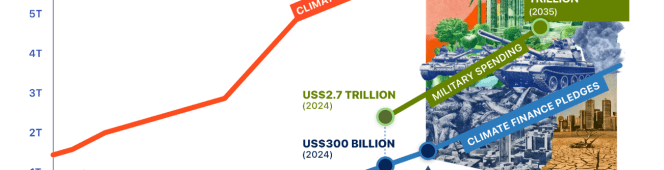
The Double Dividend: How Reducing Military Spending Can Finance a Just Transition examines the deep structural links between militarism, fossil fuel dependence and the climate crisis.  It highlights that global military spending reached a record US$2.7 trillion spending by 100 countries in 2024.  In 2025, this number rose to US$2.88 trillion and could reach US$4.7 to US$6.6 trillion by 2035.  Spending by the largest militaries was 30 times greater than the climate finance currently being directed towards the world’s most vulnerable nations.   

The Double Dividend report maps the financing gap for a global just transition alongside military spending, examining the latter’s impact on human security, emissions, ecological destruction and international cooperation. It outlines ways in which military spending can be reduced and reallocated towards spending for climate justice and peace and recommendations for governments and civil society on how that can be achieved including via a Fossil Fuel Treaty. 

This slideshow requires JavaScript.

Katrin Geyer, Ecological Justice Programme Manager, Women’s International League for Peace and Freedom –

“At UN climate negotiations, in academic research, in the streets, people are connecting the dots. The climate crisis and rampant militarisation are escalating together, driven by the same small group of hypercapitalist, heavily armed states that profit from both. This paper makes the case that you cannot seriously address one without confronting the other. Using the proposed Fossil Fuel Treaty as a vehicle for redirecting military spending toward the just transition, we show that the benefits would extend far beyond climate financing.  Less military spending means fewer emissions, less ecological destruction, fewer wars – and more space for the diplomacy, trust and cooperation that humanity urgently needs.”

Ameira Sawas, Head of Research and Policy, Fossil Fuel Treaty –

“A growing, intersectional civil society movement is connecting the dots between militarism, genocide, ecocide and climate injustice. Now, more than ever, the world needs funding for a just transition and for climate justice – not for militarism and expanding violence and injustice. This must involve a concrete plan to reallocate military spending towards the just transition and peacebuilding as part of developing a Fossil Fuel Treaty aimed at ending the expansion of oil, gas and coal; winding down existing production; and accelerating a fair transition to renewable energy with community needs at the core.” 

Deborah Burton, Tipping Point North South

“This paper is such an important step on the journey to fully bringing the big military spending nations and their fossil fuel addicted militaries into the climate finance and just transition agendas, within the framework of the Fossil Fuel Treaty. As the planet boils, it is beyond belief that those guilty parties responsible for this climate catastrophe are pumping trillions annually into war machines.  There is no better moment for this paper’s release and recommendations than in Santa Marta at the First International Conference on the Transition Away from Fossil Fuels.”

Harjeet Singh, global convenor of the Fill The Fund campaign and founding director of Satat Sampada Climate Foundation –

“It is a profound display of moral bankruptcy that wealthy nations seamlessly mobilized a record US$2.88 trillion for weapons and warfare last year, yet claim the coffers are empty when developing countries demand climate finance. Right now, the richest countries are spending 30 times as much on their armed forces as they are on climate finance for vulnerable nations. Meanwhile, developing nations are losing hundreds of billions of dollars every year to devastating climate impacts they did the least to cause. It is time we urgently shift money away from wars and fossil fuels to address loss and damage and finally deliver genuine climate justice.”

Tasneem Essop, Executive Director, Climate Action Network International –

“War kills people. So does climate collapse. And right now, the money flows in the wrong direction. Governments plead poverty on climate finance while military budgets hit record highs. This is not a funding crisis. This is a political choice.  And it is costing lives. What we are witnessing – from Gaza to Cuba and across oil-rich regions – is imperialist aggression and a new colonialism, dressed in the language of security. It is not separate from the climate crisis, but part of the same system: one that extracts, concentrates power, and leaves those least responsible to pay the highest price. Real security means an end to imperialist wars, preventing climate chaos and ensuring justice for those impacted by occupation, wars and climate change.”

To mark Earth Day, GDAMS are sharing this comprehensive toolkit

To mark Earth Day, GDAMS are sharing this comprehensive toolkit

GDAMS and Earth Day – April 22

Why Is It Important To Talk About Military Spending On Earth Day?

Join us this Earth Day in our GDAMS campaign: Demilitarize for Climate Justice!

Militarism is deeply connected to the climate crisis. By prioritizing domination and fossil fuel extraction, it fuels conflict and drives environmental harm. Military operations require vast amounts of energy, and armed forces are among the world’s largest institutional consumers of fossil fuels and emitters of greenhouse gases.

As military spending continues to rise, it not only fuels wars and increases emissions but also diverts vital resources away from urgently needed climate solutions.

This Earth Day, join us as part of the Global Days of Action on Military Spending to call for change. This day, coordinated by the Arms, Militarism and Climate Justice Working Group, reflects growing awareness that peace and climate justice are closely interconnected.

TPNS contributed to the GDAMS Toolkit 2026 document below.

Tackle corporate profiteering from Iran War, and provide cost of living support (Civil Society Letter)

Tackle corporate profiteering from Iran War, and provide cost of living support (Civil Society Letter)

TPNS is one of 40 leading UK civil society organisations which have called on the UK Chancellor to levy excess profits taxes on the windfall revenues numerous sectors are predicted to make as a result of the economic fallout from the US-Israeli war on Iran.

Co-ordinated by Tax Justice UK, the letter (26 March) includes reference to war profiteering. “Sadly, there are some clear winners of the war on Iran. Oil and gas giants, big banks, agricultural input industries and defence companies will likely make record profits, at the expense of enormous human suffering.

The full text of the letter, signatories and media links below:

https://taxjustice.uk/blog/tackle-corporate-profiteering-and-provide-cost-of-living-support/

https://www.independent.co.uk/news/uk/politics/rachel-reeves-taxes-companies-iran-war-profit-b2946666.html

https://www.thecanary.co/uk/news/2026/03/26/iran-war-profits/

APRIL 24-29 SANTA MARTA, COLOMBIA

APRIL 24-29 SANTA MARTA, COLOMBIA

FIRST CONFERENCE ON TRANSITIONING AWAY FROM FOSSIL FUELS

This critically important gathering  will serve as a strategic space for dialogue among a broad range of stakeholders, including government representatives, experts, rural and Indigenous Peoples, Afro-descendant communities, civil society, climate advocates, industry leaders, and academia.

TPNS made its submission on the War Machine and Arms Industry as part of the civil society consultation seeking responses to ‘barriers’ and ‘solutions’. Since military spending accelerates climate crisis, TPNS recommends the Santa Marta Conference create a Working Group to investigate routes by which nations can agree on the universal, equitable redirection of military spending to support Global Just Transition Fund

Read more:  [PDF]

https://transitionawayconference.com/

COP30 REPORT: DISARMING THE CLIMATE CRISIS

COP30 REPORT: DISARMING THE CLIMATE CRISIS

Our COP30 official event analysed six interconnected dimensions of this crisis: military emissions, military spending, fossil fuels and conflict, extractivism in Colombia and the Philippines, fossil-fuel-enabled occupation and genocide in Palestine, and nuclear injustice in the Pacific. Collectively, the speakers demonstrated how feminist and peace-based approaches provide essential pathways to climate justice.

TPNS participation at COP30 in Brazil

TPNS participation at COP30 in Brazil

For COP30 in Brazil TPNS activities included a new report, updated briefings and an official side event, all addressing military emissions, military spending and climate finance.

PUBLICATIONS

Report “Climate Reparations for Military Emissions

Key findingsIn this report, we estimate that the global top 20 military spenders alone are responsible for at least 10 billion metric tonnes of CO2 equivalent (tCO2e) of military-related emissions during the first quarter of the 21th century.  This has accrued from the US$40 trillion spent on their militaries since 2001. We estimate that collectively they owe the world, especially the poorest and the most climate vulnerable countries, US$2.67 trillion in reparation for their military-GHG-emission-related climate costs (as measured by the social cost of carbon). This is more than 8 times the new climate finance pledge of US$300 billion to developing countries set at Baku COP29.

This report includes our work on the reparations owed by Israel to Palestine from 1948 to the present day genocide, co-authored with The Palestinian Institute for Climate Strategy.

Briefing “Climate Collateral (2025 update): Why the military’s impact on climate change can no longer be ignored”

The struggle for climate justice is increasingly overshadowed by a global arms race even though global temperatures are reaching record highs. States that should be working together to invest in urgent climate action are instead spending record sums on the military (over $2.7 trillion in 2024). This spending produces huge emissions, drains resources from climate action, and escalates geopolitical tensions that make multilateral climate action more difficult. Published by Tipping Point North South jointly with the Transnational Institute and Stop Wapenhandel.

BLUE ZONE OFFICIAL SIDE EVENT

DISARMING THE CLIMATE CRISIS: THE TRUE COST OF MILITARISM

13 NOVEMBER

This official side event, co-hosted by IPPNW, Peace Boat, Peace Track Initiative, and WILPF brought together diverse speakers that addressed the deep connections between militarism and the climate crisis — from hidden military emissions and the vast gap between military spending and climate finance to the catastrophic risks nuclear weapons pose to the planet. The event concluded in spotlighting avenues for peace and climate justice – including the Fossil Fuel Treaty to the Global Energy Embargo for Palestine.

Deborah Burton’s contribution was addressing the urgent need to fund public climate finance over military spending.

Read transcript here.

This side event followed on from a press conference the previous day: Disarming the Climate Crisis: Putting Militarism on the Agenda at COP30

ECO ARTICLE  

Day 5 COP30

ECO is Climate Action Network’s (CAN) widely read daily newsletter is distributed on the ground to delegates each morning, and is an important advocacy tool for civil society.  As an active member of the Peace and Demilitarisation Working Group of the Women and Gender Constituency, TPNS contributed to the drafting of Militarism is fueling the climate crisis– COP must confront it.

We call for: (i) Stepping up ambition: Include military emissions in updated NDCs before COP31 (ii) Reallocation of military budgets: redirect spending to close the climate finance gap (iii) Integration of peace and justice: recognise that true climate justice cannot coexist with war and structural violence. Ending militarisation begins with stopping aggressors and demanding accountability.

https://climatenetwork.org/resource/eco-5-cop30/

QUNO PRESS CONFERENCE

Our colleague at Quaker UN Office (Geneva) Lindsey Fielder Cook spoke on the interconnections between peace and climate change at a COP press conference organized by the Interfaith Liaison Committee, addressing in part, the issue of military emissions and spending. The press conference can be viewed here.

Also Deborah participated in a webinar organised by QUNO just before COP.

FLAGGED AT THE COP30 OPENING CEREMONY BUT NOT – YET ANYWAY – ON THE OFFICIAL UNFCCC AGENDA

“Spending twice as much on weapons as we do on climate action is paving the way for climate apocalypse. There will be no energy security in a world at war.” — President Luiz Inácio Lula da Silva, Leaders’ Summit.

At the Opening Summit of COP30, President Lula condemned massive global military spending as a misallocation of resources that should instead be channelled into climate solutions for global south countries. He said:

“If the men who wage war were at COP30, it would be much cheaper to spend $1.3 trillion a year to end the climate problem than $2.7 trillion to wage war as they did last year.”

Outside the formal negotiation rooms, momentum kept growing on the recognition of the intersections between militarism and the climate crisis– from multiple official side events, press conferences, radical spaces at the People’s Summit, staged actions and protests, and coverage in outlets from ECO to the Guardian.

Colombia’s President Gustavo Petro called out NATO members’ commitment to allocate 5% of their GDP to “investing in more weapons,” arguing that Russia is not the enemy; the climate crisis is the enemy.” Latvia’s President Edgars Rinkēvičs highlighted that Russia’s invasion of Ukraine “takes away human lives and inflicts harm on nature,” while also “limiting climate investment as resources are redirected to defense spending.” Honduras’ President Xiomara Castro called for the cessation of all wars devastating the planet and demanded accountability for the genocide against Palestinians, presenting this as part of her seven-point climate justice proposal launched at COP29.

Despite the undeniable real-world impacts of militarism on the climate—from Ukraine to Gaza—the rising strength of climate and peace movements exposing these intersections, and even world leaders’ acknowledgments of the issue, this reality has yet to enter the official negotiation spaces of the climate talks.

Perhaps Turkey – COP31 – is where that will change and the military-fossil fuel complex will be fully in the spotlight.

This is what we work towards in the coming year.

COP30 BRIEF NEWS ROUNDUP

Finance outcomes at COP30 were deeply inadequate. ‘Developed’ countries repeatedly refused to provide the finance required across adaptation, mitigation, and the just transition, weakening the overall outcome and undermining trust rooted in their historical obligations. Parties have left Belém with no meaningful action but a vague pledge to triple adaptation finance by 2035, and a lack of commitments to grant-based, non-debt-creating finance. For communities bearing the brunt of the crisis, these outcomes bring no hope.

Equally disappointing is the absence of a global response to the so-called ‘ambition gap,’ exemplified by countries’ lack of concrete plans to phase out fossil fuels. The final COP30 decision offers no roadmap for a just, equitable, and fully financed transition away from fossil fuels—a stark failure of the only existing multilateral process tasked with addressing the climate crisis.

Read More:

TPNS activities for COP30 supported by Movement for the Abolition of War.

https://climatenetwork.org/2025/11/22/cop30-takes-a-hopeful-step-towards-justice-but-does-not-go-far-enough/

https://oilchange.org/news/cop30-makes-progress-on-just-transition-but-misses-on-everything-else/

https://www.theguardian.com/environment/2025/nov/27/beyond-the-negative-headlines-some-truly-good-things-came-out-of-cop30

https://theconversation.com/cop30-five-reasons-the-un-climate-conference-failed-to-deliver-on-its-peoples-summit-promise-269750


New publications: Report “Climate Reparations for Military Emissions” and Briefing “Climate Collateral (2025 update)”

New publications: Report “Climate Reparations for Military Emissions” and Briefing “Climate Collateral (2025 update)”

We published the following two publications for COP30:

Report “Climate Reparations for Military Emissions” and

Briefing “Climate Collateral (2025 update): Why the military’s impact on climate change can no longer be ignored” Continue reading

New Briefing: Military & Conflict-Related Emissions & Climate Reparations for Palestine

New Briefing: Military & Conflict-Related Emissions & Climate Reparations for Palestine

DOWNLOAD PDFs: Briefing (executive summary) and Full Paper.

Military & Conflict-Related Emissions & Climate Reparations for Palestine prepared by Tipping Point North South and the Palestinian Institute for Climate Strategy.

In this research the historic military and conflict-related emissions of the 77 years of Israel’s occupation of Palestinian land since its founding in 1948, culminating in the ongoing genocide of Palestinians for nearly two years is quantified. By applying the monetary measure ‘the social cost of carbon’, that is, the long-term social and environmental damage done by emitting one additional tonne of carbon, the paper calculates the climate reparation owed by Israel to the Palestinian people as a result of these historic military and conflict-related emissions.

KEY FINDINGS

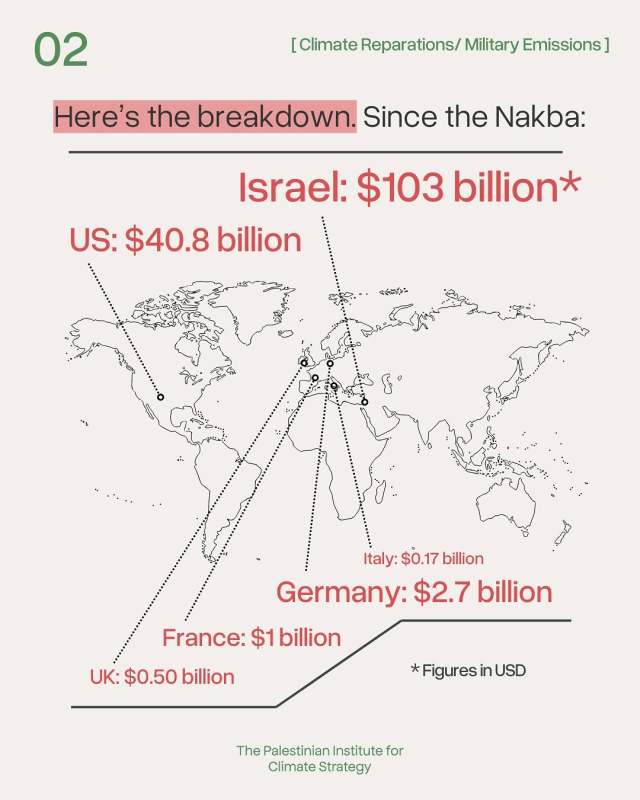
To date, the total estimated amount of the military and conflict-related climate reparations owed by Israel and its allies to the Palestinian people since the Nakba is US$148 billion. Of this,

  • Israel is responsible for US$103 billion.
  • The U.S. is responsible for US$40.8 billion.
  • Israel’s allies share further responsibility: Germany US$2.7 billion, France US$1 billion, the UK US$0.5 billion, and Italy US$0.17 billion.

These figures represent the measurable climate liability of military and conflict-related emissions. Yet, as this briefing makes clear, they capture only one entry point into the broader reparations reckoning for Palestine, which must also encompass the wider harms of occupation, genocide, ecocide and systemic destruction of Palestinian life. Many of these aspects are beyond what we can quantify in simplified carbon metrics, and we must not lose sight of this complexity in rebuilding just futures for Palestine. Continue reading

Global Week Of Action For Peace And Climate Justice – Draw the Line

Global Week Of Action For Peace And Climate Justice – Draw the Line

Sept 15-22 sees the Draw the Line global week of events take place as world leaders meet at the UN General Assembly in New York, followed  by UN climate summit (COP30) just six weeks later.

Draw the Line against inequalities, tyranny, genocide, destruction, and chaos… for rights, jobs, justice, democracy, and a fulfilling life on a safe planet.

As part of Draw the Line, the second annual Week of Action for Peace & Climate Justice take place and addresses the links between war, militarism/militarisation and social, economic and climate injustice.

https://climatemilitarism.org/weekofaction/

TPNS ACTIVITIES 15-21 September

Wednesday 17th September: Briefing & Paper

Military & Conflict-Related Emissions & Climate Reparations for Palestine  

Co-Published with the Palestinian Institute for Climate Strategy

In this briefing, we quantify the historic military and conflict-related emissions of the 77 years of Israel’s occupation of Palestinian land since its founding in 1948, culminating in the ongoing genocide of Palestinians for nearly two years. By applying the monetary measure ‘the social cost of carbon’, that is, the long-term social and environmental damage done by emitting one additional tonne of carbon, the briefing calculates the climate reparation owed by Israel to the Palestinian people as a result of these historic military and conflict-related emissions.

Continue reading

TPNS at Bonn Climate Change Conference (16-26 June 2025)

TPNS at Bonn Climate Change Conference (16-26 June 2025)

Disappointingly, applications for side events addressing military emissions and spending were not accepted this time round at Bonn. Yet with military spending at an all time high, NATO’s future plans for even higher spending, genocide ongoing in Palestine and the war in Ukraine with no end in sight, military related issues were present ‘on the ground’ if not on the agenda.

TPNS attendance made possible with support from the Movement for Abolition of War and Quaker UN Office.

TWO REPORTS PUBLISHED FOR BONN


NATO’s 3.5% Spending Goal: Unsustainable on Every Count. New analysis by Tipping Point North South, TNI and Stop Wapenhandel shows NATO’s rapid military build‑up is already undermining global climate goals and threatening to divert trillions from clean‑energy investment.

https://transformdefence.org/publication/natos-3-5-spending-goal/

The alarming rise of false climate solutions in Africa ― the nuclear energy misadventure has been prepared by campaigners as a collective advocacy report with a number of strong recommendations that reflect the breadth of civil society’s shared concerns about the development of nuclear energy across the continent. They are united in a call for a nuclear free Africa, safe from the dangers of nuclear energy and instead building a future powered by clean, affordable solutions.

https://transformdefence.org/publication/the-nuclear-energy-misadventure/

BONN MEDIA COVERAGE NATO REPORT

Our German co-publisher IPPNW secured this article in German magazine Stern.

https://www.stern.de/politik/ausland/was-die-nato-aufruestung-fuer-den-planeten-bedeutet—exklusive-studie-35816548.html

Our TNI co-author Nick Buxton secured an op-ed for Al Jazeera about the danger of NATO’s 5% target, based on the briefing’s analysis.

https://www.aljazeera.com/opinions/2025/6/26/natos-5-percent-spending-pledge-is-a-threat-to-people-and-the-planet

BONN EVENTS: MILITARY SPENDING & EMISSIONS

Interfaith Liaison Committee Press Conference

Deborah was invited to speak on military spending and climate finance at the Interfaith Liaison Committee press conference for the launch of their Climate Justice Call to Action

Deborah’s contribution here.

CAN Intl Press Conference on Palestine/End the Siege 

CAN International held a packed press conference to address the UNFCCC Secretariat’s censorship of Palestine solidarity actions, specifically the phrase “end the siege”. Deborah was able to raise the issue of Israel’s doubling of its military spending in one year; also referencing Israel’s attacks on Iran.

More on this issue: https://climatenetwork.org/2025/06/21/unfccc-censorship-of-palestine-solidarity-ngos-at-bonn-sb-62-call-out-moral-crisis-within-the-un-climate-process-2/

Disarming the Climate Crisis – Climate Camp

The climate camp runs a programme of activity in parallel to the main conference.  Organised by the Peace and Demilitarisation working group the session looked at the impact of rising military spending  on the MENA region specifically and the global south more widely. Hosted by Laura Wunder from IPPNW Germany, with speakers Fatemah Khafegy and Deborah Burton. (An article based on this session is being drafted)

BONN EVENTS: NUCLEAR ENERGY IN AFRICA

There was a side event held in the first week to promote nuclear power across Africa with speakers from the International Atomic Energy Agency (IAEA) and the Economic Commission for Africa. To a packed room we asked two direct questions to both speakers (i) that nuclear energy will severely crowd out already precious and inadequate climate finance for mitigation, adaption and renewable energy generation projects and (ii) the grave concerns that many NGOs have about the lack of capacity to manage nuclear power plants safely and securely.

Thirty copies of the report Exec Summary were handed to attendees.

MEDIA COVERAGE of the report across the African continent has been extensive. Continue reading

Leila Sansour: ‘Starvation and the Final Test of Impunity: Why Israel Is Willing to Pay the Price in Gaza’

Our colleague writes this devastating analysis for the organisation Security In Context. ‘Israel has long worked to fragment Palestinians — politically, geographically and legally — separating Gazans, West Bankers, Jerusalemites, and the Palestinian citizens of Israel. But the project unfolding in Gaza marks a further, more brutal stage: the wholesale break-up of a functioning society.’

https://www.securityincontext.org/posts/starvation-and-the-final-test-of-impunity-why-israel-is-willing-to-pay-the-price-in-gaza

NAKBA 77

NAKBA 77

The Nakba ( ’the catastrophe’) is the ethnic cleansing of the Palestinian people through violent displacement and dispossession of land, property, and belongings, along with the destruction of their society and the suppression of their culture, identity, political rights, and national aspirations.

This May marks 77 years of Nakba. 77 years of dispossession, ethnic cleansing and apartheid.

77 years of displacement and exile.

77 years of catastrophe.

But in the face of brutal oppression and systematic violence, Palestinians continue to resist.

Make Apartheid History is a TPNS project. READ MORE.

SPRING NEWS: Nakba 77+ new publications +media + climate conference

SPRING NEWS: Nakba 77+ new publications +media + climate conference

Dear Friends,

We hope this email finds you well as we share our recent news and activities with you. During the COVID times, when TPNS decided to focus on climate related work with specific reference to the global military, we were in different times. We could not have foreseen the Russian invasion of Ukraine nor – no matter how horrendous the Israeli occupation had been up to October 7th 2023 – Israel’s decision to implement a genocidal war designed to utterly destroy Gaza and the elimination, one way or another, of Palestinians from their homeland.

The world is now in an insane arms race – $2.4tr annually and rising – and the climate emergency along with basic international development, global health and public services all in the process of being relegated to second place, behind rearmament and talk of WW3.

In every way, we are in dark times.  And the biggest threat to our collective safety – climate chaos – is dropping off the radar.

How on earth can this be?

As ever, it will be down to the tenacity, courage, vision and organising power of civil society where-ever it may be, to push back even harder, despite the deep sadness, despondency and overwhelming scale of the opposition faced – from authoritarian governments locking up climate protesters to genocide-enabling politicians; from amoral and greedy corporate elites to shameless oligarchs.

We have no choice but to resist and to keep hope alive – for the generations to come and for our beautiful blue planet.

Deb & Ho-Chih Continue reading

Sharing this year’s news & progress that is bittersweet

Sharing this year’s news & progress that is bittersweet

Dear friends and supporters,

We hope this e-news roundup finds you well as we approach the holiday season. We have had a busy year taking our work on military emissions and spending to more new audiences internationally.  Wider global civil society is now including military spending as part of its overall climate finance demands and military emissions are now widely acknowledged as a significant contributor to climate change inside the COP space.

But in 2024 it was the genocide in Gaza that brought the intersection of militarism and the climate emergency into the wider civil society arena. Just as our film We Are Many illustrated how the Iraq War mobilised a new generation on anti-war protest, so both Ukraine and Gaza have combined to bring this issue of military emissions and war-spending to the wider climate justice movement.

The challenge now is two-fold:  pushing forward on the various routes identified to get nations to fully report their military emissions and for the UNFCCC to play its part in making that happen; and coupled with this developing the policy and advocacy work that will enable more nations to engage with the sensible – and urgent – calls for the wasted military spending trillions to instead be spent on climate finance.

From presentations to publications to events, this year has proven to be productive and the highlights below give a sense of the progress being made. However, we could not do it without support from our funders and individual donors. Thank-you.

So as we end this year, our thoughts are with the people of Gaza.  We cannot begin to imagine how much they want the horror to end.  Find out how you can support Medical Aid for Palestinians here.
Continue reading

TPNS Participation at COP29

TPNS Participation at COP29

TPNS PARTICIPATION AT COP29

As many predicted, on the main issue of climate finance for global south countries, COP29 was indeed the failure many dreaded.  Rich nations held to their position that they were unable to reach the public funding levels needed and – as feared – ended up relying on private finance and loans to shore up their paltry and insulting $300bn in order to reach the $1trillion plus annually needed.  A far cry from the necessary and just  $5tr annually called for by global civil society.

On phasing out fossil fuels, again, the full on commitment that was needed was not to be found.  The oil lobby and Saudi Arabia led the charge to row back on Dubai COP28 commitment. This, combined with the finance failure, led to deep disappointment and anger on the part of not just civil society but many regional groupings and governments as well.

However, on the topic of military emissions and – vitally – military spending – it was clear that both are now widely recognised as important elements of the mitigation as well as the climate finance debates. Wider global civil society is now including military spending as part of its overall climate finance demands at COP;   a number of states also linked military spending to climate finance.

It was very encouraging to see the relevance of public military spending to the climate finance demands made loud and clear at this COP2 and for TPNS to play its part in this issue ‘breaking out’ inside the official COP space. Deborah Burton attended the first week on behalf of TPNS and her attendance was supported by Movement for the Abolition of War. Continue reading

Military emissions, military spending & the “COP of peace”

Military emissions, military spending & the “COP of peace”

To be a true ‘COP of Peace’ Baku needs to acknowledge the ‘hard’ issues that impact on peace, the climate emergency and climate finance.

Both recent civil society Global Weeks of Action (Payup and Phaseout 13-20 Sept) and (Peace and Climate Justice 21-28 Sept) timed to coincide with the UN Summit for the Future and UN General Assembly included urgent calls to address the impact of military emissions and spending on the climate agenda. With COP29 just a month away, we need to look at ‘COP of Peace’ and Azerbaijan’s ‘Joint Solemn Appeal for a COP29 Truce’.

The truce itself is a very timely wish, given relentless Israel’s bombardment of Gaza and now Lebanon, of Russia’s ongoing invasion of Ukraine and the ever-worsening and desperate humanitarian catastrophe in Sudan. The Geneva Academy charts the sorry state we are in: Middle East and North Africa have 45 armed conflicts ongoing; Africa, 35 armed conflicts; Asia 21 armed conflicts; Europe has seven armed conflicts; Latin America: six armed conflicts.

With social media and 24/7 news coverage, it is impossible not to know, not to see, the horrendous impact of war and conflict on men and women; infants and children; the elderly and the disabled.

To add to this, the global military carbon footprint (including its supply chain) is estimated to be around 5.5% of global GHG emissions. This figure does not include conflict emissions or post-conflict reconstruction. Researchers estimate the GHG emissions burden of the Russian invasion of Ukraine is currently estimated to be 175 million tCO2e. Latest research on Israel’s war on Gaza estimates the emission burden of 60 million tCO2e. As a result, since COP27 in Egypt, conflict-related GHG emissions have been included in the official COP programme and are now being referenced in negotiations.

How will Azerbaijan advance this? Continue reading

New publications & UN Summit of the Future

New publications & UN Summit of the Future

September sees two major Global Weeks of Action – the Global Week of Action for Climate Finance and a Fossil-Free Future (13-20 Sept) and the first Global Week of Action for Peace and Climate Justice (21-28 Sept). Both address the global military’s role and responsibility in both GHG emissions and runaway military spending as an urgent source to tap for climate finance.

TPNS’s Transform Defence project released two publications to mark these international weeks of action, and, notably, also to mark the UN Summit of the Future.

UN SUMMIT OF THE FUTURE: Climate Change, Climate Finance and the Global Military

As the world gathers for the UN Summit of the Future followed by the General Assembly debate, peace and co-operation is at the heart of much of the discussion.

Urgent pressure needed to address the role and responsibility of runaway military expenditure in the climate emergency through the allocation of trillions of dollars to fossil-fuel reliant militaries and associated (supply-chain) industries instead of climate finance.  This briefing was prepared and shared with many of the delegates to the Summit.

WORKING NOTES JOURNAL

‘War and Peace—Exploring Irish Neutrality

Published by the Jesuit Centre for Faith and Justice

Overturning the economics of war to deliver a co-operative future and peaceful green prosperity

This essay was commissioned by Working Notes and explores the ecological aspects of conflict—with a particular focus on the carbon dioxide emissions associated with the military—through an economic lens. It asks what must be done to change course if humanity and our home planet is to reverse the current trajectory.

Global Week Of Action For Peace & Climate Justice

Global Week Of Action For Peace & Climate Justice

21-28 September 2024

This first annual week of action for peace and climate justice runs from 21-28 September. More than 50 events are planned in countries including Australia, the Democratic Republic of Congo, Germany, Malawi, Mexico, India, the Netherlands, Sweden, the UK and the USA, as well as many online.

The week of action aims to raise awareness of the links between war, militarism and climate injustice. It also coincides with the UN Summit of the Future.

Find out more and how to take part https://climatemilitarism.org/weekofaction/.

THIS YEAR’S THEME: DIVEST FROM WAR – INVEST IN CLIMATE JUSTICE

The world’s wealthiest countries have consistently failed to meet targets to provide $100 billion in climate finance to help countries suffering the worst impacts of climate breakdown. Meanwhile, there always money for war: in 2023 global military spending rose for the ninth year in a row, reaching a record high of $2.44 trillion (an increase of 6.8 per cent in real terms from 2022). 2023 also saw the hottest day – highest global temperatures – ever recorded.

The week of action is being facilitated by a sub-committee of the Arms, Militarism and Climate Justice Working Group. Continue reading

Global Week Of Action For Climate Finance And A Fossil-Free Future

Global Week Of Action For Climate Finance And A Fossil-Free Future

As we head towards COP29, the issues of climate finance and a fossil fuel phase-out towards a just energy transition are ever more critical for climate action. The upcoming UN General Assembly, the UN Summit of the Future and the Global Renewables Summit all taking place one after the other in September provide an important opportunity to reiterate our demands and escalate public pressure to compel governments, international institutions and corporations to listen and take action.

The governments of the Global North have consistently failed for decades to undertake their fair share of climate action both domestically and internationally. This fair share includes the delivery of climate finance for the Global South, an obligation that they committed to as parties to the UN Framework Convention on Climate Change. Climate finance is also part of reparations for climate debt they owe to the people of the South for historical and continuing harms caused by their disproportionately large contributions to the climate crisis.

https://payupandphaseout.org/

September 19th – Demilitarisation Day of Action

Pay Up and Phase Out.

The global military – in peace and war – is a significant contributor to climate change. And these emissions correlate to ever rising military spending on fossil fuel reliant hardware.

Increasing militarisation of world affairs is not the answer to climate change – it is at the heart of the problem. There can be no secure nation without a climate-secure planet.

Urgent pressure is needed to address the role and responsibility of runaway military expenditure in the climate emergency through the allocation of trillions of dollars to fossil-fuel reliant militaries and associated (supply-chain) industries instead of climate finance.

Global North governments should end public subsidies for fossil fuels. Tax systems should be reformed, so polluters and profiteers pay their dues.

And with the expansion of a fossil fuelled global arms race well underway and new ‘cold war’ rhetoric rising again, the vast amounts of government spending on weapons and military operations that harm people, destroy the environment while also being a massive source of carbon emissions, should be diverted towards programs for climate justice and our planet’s security.

The various materials below mark this Global Week of Action and Day of Action on Demilitarisation

Summit of the Future: briefing & accompanying letter to UN General Secretary

Download: “TPNS BRIEFING SUMMIT OF THE FUTURE 2024 [PDF]

Released September 18th with an accompanying letter to the UN Secretary General. Continue reading