Trends in U.S. Military Spending

Dinah Walker, “Trends in U.S. Military Spending,” Council on Foreign Relations, 30 July 2013

The following charts present historical trends in U.S. military spending and analyze the forces that may drive it lower.

These charts draw on data from the Stockholm International Peace Research Institute (SIPRI) and from the U.S. Bureau of Economic Analysis (BEA). Both data sets include spending on overseas contingency operations as well as defense. This distinguishes them from data used in the U.S. budget, which separates defense spending from spending on overseas operations.

Download Trends in US Military Spending 2013 [pdf].

USA’s defense budget in charts

Brad Plumer, “America’s staggering defense budget, in charts,” The Washington Post, 7 January 2013

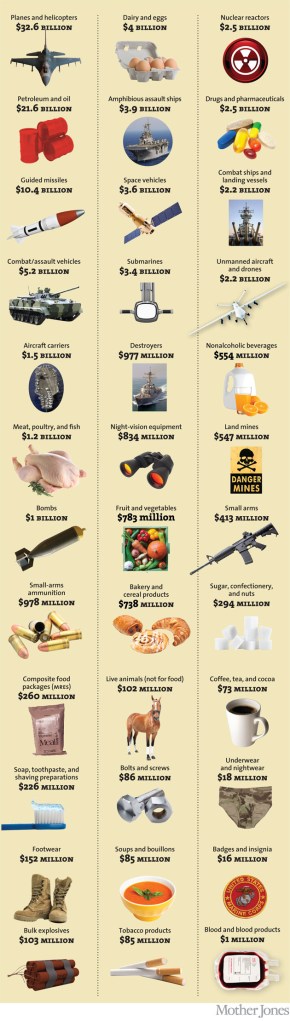
The United States spends far more than any other country on defense and security. Since 2001, the base defense budget has soared from $287 billion to $530 billion — and that’s before accounting for the primary costs of the Iraq and Afghanistan wars.

1) The United States spent 20 percent of the federal budget on defense in 2011. 

budget-defense
Continue reading

7 ways the Pentagon mismanages its massive budget

Timothy McGrath, “7 incredible ways the Pentagon mismanages its massive budget,” GlobalPost, 19 November 2013

In November, Reuters published the second part of its series on the Pentagon’s management (or lack thereof) of its $565.8 billion budget. And it’s a doozy. …

1) The Pentagon cooks the books

The agency in charge of the Pentagon’s accounting is called the Defense Finance and Accounting Service (DFAS). It seems that a lot of what they do is make things up. The official mechanism for making things up is called an “unsubstantiated change action,” more commonly known as a “plug.” …

2) Those “plugs” add up to a lot of money
Continue reading

Big money behind war

Jonathan Turley, “Big money behind war: the military-industrial complex,” Al Jazeera, 11 January 2014

Eisenhower warned that “an immense military establishment and a large arms industry” had emerged as a hidden force in US politics and that Americans “must not fail to comprehend its grave implications”. The speech may have been Eisenhower’s most courageous and prophetic moment. Fifty years and some later, Americans find themselves in what seems like perpetual war. No sooner do we draw down on operations in Iraq than leaders demand an intervention in Libya or Syria or Iran. While perpetual war constitutes perpetual losses for families, and ever expanding budgets, it also represents perpetual profits for a new and larger complex of business and government interests.
Continue reading

On Ending War

E. Douglas Kihn, “On Ending War,” Truthout, 21 January 2014

We are compelled to end warfare, or sooner or later warfare will end us. The great physicist Albert Einstein, one of the architects of the Bomb, said it first: “World War IV will be fought with sticks and stones,” assuming of course that anybody survives World War III and the nuclear winter that would inevitably follow. …
Continue reading

Reducing the defence budget is not the end of Britain

Joe Glenton, “Reducing the defence budget is not the end of Britain. It could be part of our rebirth,” The Independent, 17 January 2014

The tantrums which are emerging from the offense camp should be ignored. Britain has one of the largest military budgets in the world. As part of our swollen offense portfolio this small nation wields a preposterously expensive standing military which lacks utility (see Afghanistan, Iraq, Libya) and a nuclear arsenal which has no practical value beyond masculine prestige. There are three factors to consider.
Continue reading

Renewables Now Cheaper Than Fossil Fuels in Australia

Renewables Now Cheaper Than Fossil Fuels in Australia,” Environmental News Network, 8 January 2014

A study by Bloomberg New Energy Finance (BNEF) in Australia has discovered that renewable energy is cheaper to produce than the old conventional fossil fuel sources, and that is without the subsidies.
Continue reading

Nun Faces up to 30 Years for Breaking Into Weapons Complex

Josh Harkinson, “Nun Faces up to 30 Years for Breaking Into Weapons Complex, Embarrassing the Feds,” Mother Jones, 15 January 2014

Nestled behind a forested ridgeline on the outskirts of Knoxville, Tennessee, is the sprawling Y-12 National Security Complex, America’s “Fort Knox” of weapons-grade uranium. The complex’s security cameras and machine gun nests are designed to repel an attack by the world’s most feared terrorist organizations, but they were no match for Sister Megan Rice, an 83-year-old Catholic nun armed with nothing more than a hammer and bolt cutters.
Continue reading

Why is Europe obsessed with drones?

David Cronin, “Why is Europe obsessed with drones?,” Al Jazeera, 19 December 2013

Despite the economic crisis, the EU is facing serious lobbying to boost its defence spending.

Every time the West contemplates going to war, it’s a safe bet that “defence analysts” will pop up in the press bemoaning how Europe is militarily weaker than the United States. …

The 28-country bloc is under pressure from the arms industry to boost investment in drones.  If this doesn’t occur “it’s quite inevitable that the defence base will further deteriorate,” Tom Enders, head of the Franco-German weapons producer EADS has warned. …
Continue reading

Estimate of nuclear weapons costs undershot by more than $140 billion

R. Jeffrey Smith, “Obama administration understated nuclear weapons costs,” The Center for Public Integrity, 24 December 2013

The Obama administration’s plan for maintaining and upgrading the U.S. nuclear arsenal will likely cost around 66 percent more over the next decade than senior Pentagon officials have predicted, according to a new assessment by the independent Congressional Budget Office.

Under the administration’s plan, operating, maintaining and upgrading the nuclear stockpile will cost a total of $355 billion from 2014 through 2023, said the CBO report, published just before the holidays and shortly after Congress finished action on a 2014 budget bill that restored some planned Pentagon spending cuts.
Continue reading

The unfulfilled promise of minimum, credible deterrence

Michael Krepon, “Fifteen years later,” The Express Tribune News Network, 26 December 2013

India and Pakistan have travelled a long distance since testing nuclear devices in 1998. Back then, government officials and leading strategic thinkers on the subcontinent expressed confidence that these tests would have stabilising effects. Going public with the Bomb would relieve anxieties and facilitate diplomatic efforts to normalise relations. In countries where many lived in poverty that placed a premium on economic growth, all that was needed was minimum, credible deterrence.  It’s worth recalling these aspirations 15 years later, during which Pakistan and India have fought one limited war and have experienced two severe crises. Their nuclear arsenals have grown steadily as diplomacy has faltered.
Continue reading

Why Are US Special Operations Forces Deployed in Over 100 Countries?

Nick Turse, “Tomgram: Nick Turse, Special Ops Goes Global,” TomDispatch, 7 January 2014

It’s said that imitation is the sincerest form of flattery. So consider the actions of the U.S. Special Operations Command flattering indeed to the larger U.S. military. After all, over recent decades the Pentagon has done something that once would have been inconceivable. It has divided the whole globe, just about every inch of it, like a giant pie, into six command slices: U.S. European Command, or EUCOM (for Europe and Russia), U.S. Pacific Command, or PACOM (Asia), U.S. Central Command, or CENTCOM (the Greater Middle East and part of North Africa), U.S. Southern Command, or SOUTHCOM (Latin America), and in this century, U.S. Northern Command, or NORTHCOM (the United States, Canada, and Mexico), and starting in 2007, U.S. Africa Command, or AFRICOM (most of Africa).
Continue reading

Japan boosts military forces to counter China

Japan boosts military forces to counter China,” BBC News, 17 December 2013

Japan’s cabinet has approved a new national security strategy and increased defence spending in a move widely seen as aimed at China.

Over the next five years, Japan will buy hardware including drones, stealth aircraft and amphibious vehicles. Continue reading

US Pentagon has spent $8 Trillion to Guard Gulf Oil

Juan Cole, “Solar would be Cheaper: US Pentagon has spent $8 Trillion to Guard Gulf Oil,” informed Comment, 8 December 2013

It has cost the United States $8 trillion to provide military security in the Gulf since 1976. According to Roger Stern, a Princeton economist, the US has spent as much on Gulf security as it spent on the entire Cold War with the Soviet Union! In recent years through 2010 it has been $400 billion a year, though the US withdrawal from Iraq at the end of 2011 and the gradual withdrawal from Afghanistan this year and next presumably means that the figure is substantially reduced. Still, we have bases in Kuwait, Qatar and elsewhere, and a Naval HQ in Bahrain, none of which is cheap. If it were $200 billion a year, that is a fair chunk of the budget deficit the Republican Party keeps complaining about. And if we could get that $8 trillion back, it would pay down half of the national debt. …
Continue reading