Japan’s ‘nuclear deterrence without building a bomb’

Robert Windrem, “Japan Has Nuclear ‘Bomb in the Basement,’ and China Isn’t Happy,” 12 March 2014, NBC News

… But government officials and proliferation experts say Japan is happy to let neighbors like China and North Korea believe it is part of the nuclear club, because it has a “bomb in the basement” -– the material and the means to produce nuclear weapons within six months, according to some estimates. And with tensions rising in the region, China’s belief in the “bomb in the basement” is strong enough that it has demanded Japan get rid of its massive stockpile of plutonium and drop plans to open a new breeder reactor this fall. …
Continue reading
China’s richest 10% of families own 64% of all family wealth

27 February 2014, 京华时报

宜信财富与联办财经研究院共同推出《2014中国财富报告:展望与策略》,报告撰写人之一西南财经大学经济与管理研究院院长甘犁在会上对报告中关于中国家庭财富的成长与风险部分时称,中国家庭资产的分布非常不均,最高资产10个百分点的中国家庭拥有63.9%的资产。
Continue reading

The Sorry State of Corporate Taxes

The Sorry State of Corporate Taxes,” February 2014, Citizens for Tax Justice

Profitable corporations are supposed to pay a 35 percent federal income tax rate on their U.S. profits. But many corporations pay far less, or nothing at all, because of the many tax loopholes and special breaks they enjoy. This report documents just how successful many Fortune 500 corporations have been at using these loopholes and special breaks over the past five years. …
Continue reading

Japan tilts right

Oliver Stone and Peter Kuznick, “Oliver Stone and Peter Kuznick: Japan tilts right,” 02 February 2014, USA Today

… Today, Kishi’s grandsonShinzo Abe, is prime minister and is doing to Japan what Attorney General John Mitchell predicted Richard Nixon would do to the U.S. — drive the country “so far to the right you’re not even going to recognize it.” …
Continue reading

War between China and Japan is still unlikely

Zack Beauchamp, “Why Everyone Needs To Stop Freaking Out About War With China,” 07 February 2014, ThinkProgress

… It’s wrong to talk about incentives to go war in purely military terms. A key component of the Senkaku/Diaoyou is economic: the islands contain a ton of natural resources, particularly oil and gas. But far more valuable are the trade ties between the two countries. China is Japan’s largest export market, so war would hurt Japan more than China, but it’d be pretty painful for both.
Continue reading

Military spending is integral to capitalism

Richard Seymour, “Global military spending is now an integral part of capitalism,” 7 March 2014, Guardian

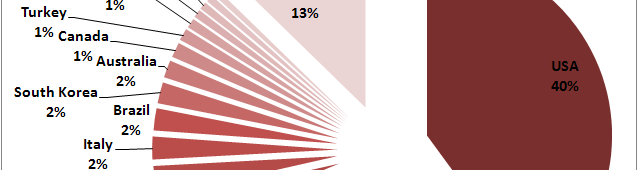
There are few surprises about the distribution of military spending: for all the current focus on China’s growing military outlays – and it is significant that they have embarked on a sequence of double-digit increases as a percentage of GDP – the United States still accounts for 40% of such expenditures. However, the distribution is not the only thing that matters; it’s the sheer scale of such investment – $1.756tn in 2012. The “peace dividend” from the end of the cold war has long since bitten the dust. Global military spending has returned to pre-1989 levels, undoubtedly a legacy of the war on terror and the returning salience of military competition in its context. In fact, by 2011 global military spending was higher than at any year since the end of the second world war. …
Continue reading

Britain to order another 14 F-35 jets

Brenda Goh and Andrea Shalal-Esa, “Britain may order 14 F-35 jets as early as next week: sources,” Reuters, 23 January 2014

The so called ‘Main Gate 4’ order, for the F-35 B vertical take-off variant of the Joint Strike Fighter, would mark the Britain’s first firm F-35 purchase since it committed to buying 48 planes in 2012.
Continue reading

UK’s century of continuous conflict

Guardian had put together an interactive timeline of Britain’s 100 years of conflict. It shows that the UK has been at wars or involved in military conflicts with at least one other country/opposing group every year since 1914.

100 years of war

This is in addition to the revelation in 2012 that only 22 countries in the world have not been invaded by Britain in its history.
Continue reading

Top 20 spenders together account for 87% of the global military spending

Top 20 spenders together account for 87% of the global military spending

There is a huge imbalance of national military spending around the world. Just the top 10 spenders alone account for 76% of the total global military spending. If we add in the next 10 top spenders, the top 20 spenders together spend 87% of the global total, that’s nearly 7 times as much as the rest of the world combined. In SIPRI’s research, they consider 170 countries out of nearly 200 independent countries in the world, no data is available for 34 countries in 2012. Nevertheless, that still leave us more than 100 countries in the rest of the world group.
Continue reading

Some interesting charts about the world

Dylan Matthews, “40 charts that explain the world,” The Washington Post, 15 January 2014

… So we searched for charts that would tell not just the story of how the world is — but where it’s going. Some of these charts are optimistic, like the ones showing huge gains in life expectancy in poorer nations. Some are more worryisome — wait till you see the one on endangered species. But together they tell a story of a world that’s changing faster than at arguably any other time in human history.
Continue reading

Putting Development to Rights

David Mepham, “Putting Development to Rights,” Human Rights Watch

… For the most part, development policy and programs have ignored the critical interdependence of economic and social rights with civil and political rights, and so have failed to challenge systemic patterns of discrimination and disadvantage that keep people in poverty. As a result, many poor people have been excluded, or have failed to benefit, from development programs. More disturbingly still, people have been harmed by abusive policies carried out in the name of development: forced from their land to make way for large commercial investors, compelled to toil long days for low pay in dangerous and exploitative conditions, or exposed to life-threatening pollution from poorly regulated industries.
Continue reading

240 Wars in 237 Years

Yuri Skidanov, “240 Wars in 237 Years: USA Wages War More Often than Just Annually,” RINF Alternative News, 21 January 2014

The United States, an example of public and social order for the countries of the “golden billion,” has a unique history. In the 237 years of its existence, it has been either at war, or preparing for a new attack, looking for victims. During the period from 1798 to 2012 Washington used military force abroad 240 times, more frequently than annually.
Continue reading

$400 billion F-35 jets generated one job per $3 million spent but are not even ready for combat training

Pat Garofalo, “The F-35: Mo’ Money, Fewer Jobs,” U.S. News & World Report , 23 January 2014

If there were a Congressional Boondoggle Hall of Fame, the F-35 fighter jet program would surely merit entry. Officially the most expensive weapons system in history, the cost of manufacturing the jets has increased a whopping 75 percent from its original estimate, and is now closing in on $400 billion. Over its lifetime, the F-35 program is expected to cost U.S. taxpayers $1.5 trillion, between construction and maintenance of the jets, if they ever all materialize.

Oh, and did I mention that the plane doesn’t really work?
Continue reading

F-35’s software “failed to meet even basic requirements.”

Bombs away: Pentagon’s F-35 Joint Strike Fighter can’t escape software problems,” RT, 24 January 2014

The Pentagon’s chief weapons tester, Michael Gilmore, provided an in-depth look at the F-35’s technical features, emphasizing what he calls the “unacceptable” characteristics of the aircraft’s software, according to a draft obtained by Reuters.  …
Continue reading

Resisting Militarism in Japan

John Feffer, “The Sun Also Rises: Resisting Militarism in Japan,” Truthout, 20 January 2014

… Japan’s current prime minister, however, is not big on apologies. Shinzo Abe is a right-wing nationalist who wants to revive Japan as a “normal” military power. He has been brusque in his rhetoric and his actions. At the end of December, his government announced a major increase in military spending of 5 percent over the next five years, which will include purchases of 28 U.S. F-35s and two Aegis-equipped destroyers. Japan under Abe has more aggressively asserted sovereignty over the Senkaku/Diaoyu Islands that China also claims, pledging to use force against Chinese patrols and rejecting any compromise on the islands’ status. On the home front, his administration has pushed through textbook revisions that offer the same airbrushed treatment of Japanese history that the Yushukan displays. …
Continue reading

US nuclear missile force faces questions about their discipline, their professionalism and even the rationale for their job

Robert Burns, “When do nuclear missteps put security in jeopardy?,” AP, 18 January 2014

The disclosures of disturbing behavior by nuclear missile officers are mounting and now include alleged drug use and exam cheating. Yet Air Force leaders insist the trouble is episodic, correctible and not cause for public worry. …
Continue reading

Despite nationalism’s many virtues, it can also be a profound source of national stupidity

Stephen M. Walt, “National Stupidity,” Foreign Policy, 14 January 2014

From Sea to Chinese Sea

… But that same force is also leading China to engage in a number of foolish and self-defeating behaviors. In particular, its aggressive territorial claims in the South China Sea, its recent unilateral declaration of an offshore “air defense identification zone,” and its hard-line stance in the Diaoyu/Senkaku Islands dispute have discredited Beijing’s earlier assurances about a “peaceful rise” and alarmed many of its Asian neighbors. Whatever one may think of China’s claims, this behavior is dumb, because it encourages China’s neighbors to balance more vigorously and makes them eager for more U.S. protection. It would be smarter for Beijing to play the long game and refrain from such demands until China is much stronger than it is today. But given national feeling in China itself, it is not clear that China’s leaders can maintain such a wise and patient approach.
Continue reading