… latest investigation has revealed the presence of hazardous chemicals in clothing made by 12 very well known brands; from the iconic kid’s label Disney, to sportswear brands like Adidas, and even top-end luxury labels like Burberry.
The shocking truth is that no matter what type of kid’s clothes we shop for, there’s no safe haven – all of the tested brands had at least one product containing hazardous toxic monsters. Continue reading →
… Japan’s current prime minister, however, is not big on apologies. Shinzo Abe is a right-wing nationalist who wants to revive Japan as a “normal” military power. He has been brusque in his rhetoric and his actions. At the end of December, his government announced a major increase in military spending of 5 percent over the next five years, which will include purchases of 28 U.S. F-35s and two Aegis-equipped destroyers. Japan under Abe has more aggressively asserted sovereignty over the Senkaku/Diaoyu Islands that China also claims, pledging to use force against Chinese patrols and rejecting any compromise on the islands’ status. On the home front, his administration has pushed through textbook revisions that offer the same airbrushed treatment of Japanese history that the Yushukan displays. … Continue reading →
The disclosures of disturbing behavior by nuclear missile officers are mounting and now include alleged drug use and exam cheating. Yet Air Force leaders insist the trouble is episodic, correctible and not cause for public worry. … Continue reading →
Stephen M. Walt, “National Stupidity,” Foreign Policy, 14 January 2014
From Sea to Chinese Sea
… But that same force is also leading China to engage in a number of foolish and self-defeating behaviors. In particular, its aggressive territorial claims in the South China Sea, its recent unilateral declaration of an offshore “air defense identification zone,” and its hard-line stance in the Diaoyu/Senkaku Islands dispute have discredited Beijing’s earlier assurances about a “peaceful rise” and alarmed many of its Asian neighbors. Whatever one may think of China’s claims, this behavior is dumb, because it encourages China’s neighbors to balance more vigorously and makes them eager for more U.S. protection. It would be smarter for Beijing to play the long game and refrain from such demands until China is much stronger than it is today. But given national feeling in China itself, it is not clear that China’s leaders can maintain such a wise and patient approach. Continue reading →
The following charts present historical trends in U.S. military spending and analyze the forces that may drive it lower.
These charts draw on data from the Stockholm International Peace Research Institute (SIPRI) and from the U.S. Bureau of Economic Analysis (BEA). Both data sets include spending on overseas contingency operations as well as defense. This distinguishes them from data used in the U.S. budget, which separates defense spending from spending on overseas operations.
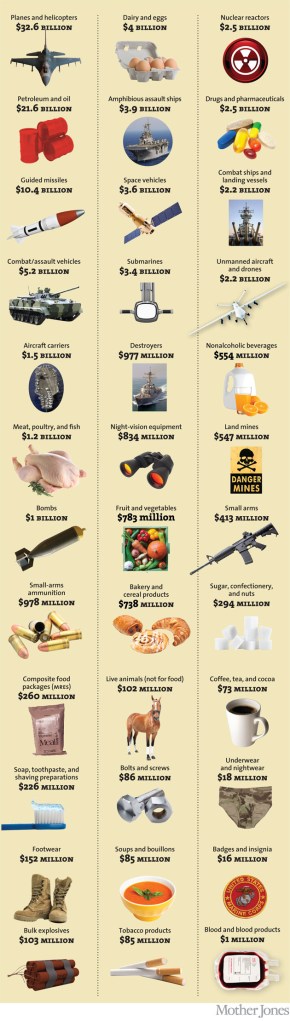
The United States spends far more than any other country on defense and security. Since 2001, the base defense budget has soared from $287 billion to $530 billion — and that’s before accounting for the primary costs of the Iraq and Afghanistan wars.
In November, Reuters published the second part of its series on the Pentagon’s management (or lack thereof) of its $565.8 billion budget. And it’s a doozy. …
1) The Pentagon cooks the books
The agency in charge of the Pentagon’s accounting is called the Defense Finance and Accounting Service (DFAS). It seems that a lot of what they do is make things up. The official mechanism for making things up is called an “unsubstantiated change action,” more commonly known as a “plug.” …
Eisenhower warned that “an immense military establishment and a large arms industry” had emerged as a hidden force in US politics and that Americans “must not fail to comprehend its grave implications”. The speech may have been Eisenhower’s most courageous and prophetic moment. Fifty years and some later, Americans find themselves in what seems like perpetual war. No sooner do we draw down on operations in Iraq than leaders demand an intervention in Libya or Syria or Iran. While perpetual war constitutes perpetual losses for families, and ever expanding budgets, it also represents perpetual profits for a new and larger complex of business and government interests. Continue reading →
E. Douglas Kihn, “On Ending War,” Truthout, 21 January 2014
We are compelled to end warfare, or sooner or later warfare will end us. The great physicist Albert Einstein, one of the architects of the Bomb, said it first: “World War IV will be fought with sticks and stones,” assuming of course that anybody survives World War III and the nuclear winter that would inevitably follow. … Continue reading →
An international study found Britain had the highest level of debt after Japan, that the debt had risen over the past three years to more than 500% of national output, and that on current trends it would take until 2020 for UK households to return debt levels to the pre-bubble trend. … Continue reading →
The tantrums which are emerging from the offense camp should be ignored. Britain has one of the largest military budgets in the world. As part of our swollen offense portfolio this small nation wields a preposterously expensive standing military which lacks utility (see Afghanistan, Iraq, Libya) and a nuclear arsenal which has no practical value beyond masculine prestige. There are three factors to consider. Continue reading →
Jacob Kushner, “China’s Congo Plan,” The American Interest, 10 January 2014
The Chinese are by no means the world’s first to seek their fortunes in Congo. But unlike the Western powers whose legacy is burdened to this day by colonialism, China’s footprints in Africa have been relatively “conflict-free.” During the first decade of the 21st century, at least 230,000 Chinese immigrated to Africa—as many as one million by some estimates. They opened import businesses, electronics shops, pharmacies and restaurants. Chinese trade with Africa blossomed, and China began looking for ways to help some of its state-owned companies to do more business across the continent than ever before. Two Chinese state banks began loaning money to companies willing to make bold investments. China’s Export-Import Bank, the smaller of the two, now provides more loans to sub-Saharan Africa than the World Bank, loans increasingly used to develop African infrastructure. By 2006, Chinese companies were investing more than $6 billion per year in roads, railways and other public infrastructure projects across Africa.By 2015, the figure is expected reach $50 billion. … Continue reading →
A study by Bloomberg New Energy Finance (BNEF) in Australia has discovered that renewable energy is cheaper to produce than the old conventional fossil fuel sources, and that is without the subsidies. Continue reading →
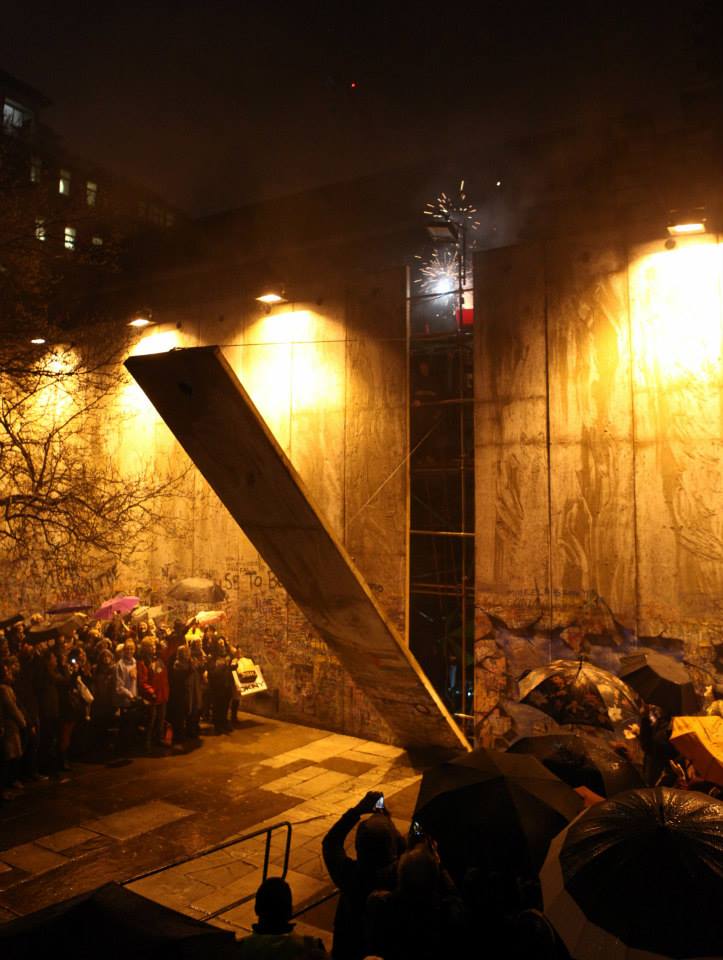
After two incredible weeks, our ‘Bethlehem Unwrapped’ festival hosted by St James’s Church Piccadilly came to end on the 5th January and the replica WALL finally came down. Between December 23rd and January 5th, thousands came to see it and many came to write on it. The vast majority wrote messages of peace and solidarity while small number wrote in favour of the real separation wall. Messages were written in many languages and by British and international visitors alike.
The WALL also hosted film projections – including specially commissioned animated images by Treatment Studios; paintings by children from the Dar Al-Kalima School in Bethlehem (also exhibited inside St James’s); One World’s song ‘Freedom for Palestine’ and two video art pieces from internationally recognised Palestinian artist Larissa Sansour, Run Lara Run, Happy Days and A Space Exodus (for more of her extraordinary work, visit www.larissasansour.com)
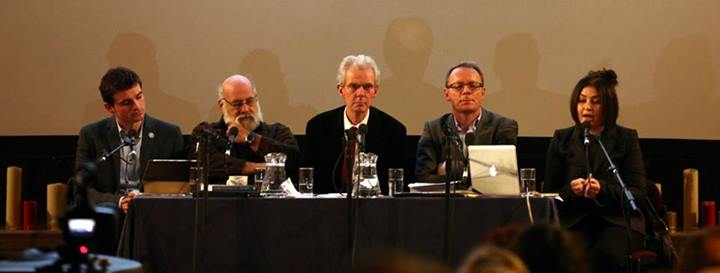
The ‘Bethlehem Unwrapped’ festival programme included a wonderful line up of artists across spoken word, comedy, film, cuisine, debate and music – Rafeef Ziadah, Harry Baker and Bridget Minamore; Mark Steel, Jeremy Hardy and Dave Cohen; Yotam Ottolenghi and Sami Tamimi; Jeff Halper and Leila Sansour; Adjoa Andoh and Yasmin Alibhai Brown; The Tallis Scholars and Nigel Kennedy – all performing to sell-out audiences. And inside St James’s Church we also had a mini-film programme of documentaries which included ‘Portrait of Bethlehem’ – photographs old and new from Planet Bethlehem Archive/Leila Sansour.
So, for all this, we send a HUGE thank-you to all the performers who took part and without whom we would not have had the wonderful two weeks that made up ‘Bethlehem Unwrapped’.
And those performers and contributors would also join us in recognizing the courage and commitment of St. James’s Rector Lucy Winkett, the clergy, wardens, PCC, staff and congregation to hosting a project that was always going to be perceived (by some anyway) as a controversial one.
Tipping Point North South (of which TPFF is an activity) was proud to be a lead partner on ‘Bethlehem Unwrapped’ – the brainchild of Tipping Point co-founder Justin Butcher. He pulled together an extraordinary team to make the event happen, from the WALL design and build team to the events programming and production management; from commissioning animation and film projections for the WALL to social media, press and PR. Together with everyone at St James’s, our wonderful production team forged close partnerships with our partner organisations including ICAHD, Amos Trust, Zaytoun and War on Want.
We’ve made a small selection of some of the reviews, articles and blogs about ‘Bethlehem Unwrapped’. Meantime, our launch clip on the Bethlehem Unwrapped youtube channel continues to be viewed – up to 60k so far. Below are links to this as well as our specially commissioned ‘Wall’ projections. (Special thanks to our photographer Hannah Barton and Tom Pursey our film recordist).
Here is hoping that the Palestinian people will see progress, somehow, in this New Year 2014.
Best wishes,
Deborah, Justin, Ho-Chih and Jen
Bethlehem Unwrapped is presented by St James’s Church, Piccadilly, in association with Amos Trust, Holy Land Trust, Interpal, Israeli Committee Against House Demolitions (ICAHD) UK, Jews for Justice for Palestinians, P21 Gallery, Tipping Point North South, War on Want & Zaytoun CIC.
Tipping Point North South is a co-operative that supports and initiates creative, campaign-driven projects that advance the global social justice agenda, through its Film Fund and other activities.
Nestled behind a forested ridgeline on the outskirts of Knoxville, Tennessee, is the sprawling Y-12 National Security Complex, America’s “Fort Knox” of weapons-grade uranium. The complex’s security cameras and machine gun nests are designed to repel an attack by the world’s most feared terrorist organizations, but they were no match for Sister Megan Rice, an 83-year-old Catholic nun armed with nothing more than a hammer and bolt cutters. Continue reading →
9. Will the Chinese economic miracle continue? Yes. After thirty years of rapid growth, the Chinese economy is now threatening to overtake the U.S. economy as the world’s largest, according to some measures. But there’s still plenty of scope for so-called “catch-up growth.” In terms of G.D.P. per person, the United States is still about five times as rich as China. Even middle-income countries such as Latvia and Chile are twice as rich. But with the formerly Communist nation still spending close to fifty per cent of its G.D.P. on infrastructure projects, education, and other forms of investment, the gap is likely to keep closing for some time. That’s what happened in other fast-growing Asian economies that industrialized earlier, such as Japan and Korea, and there’s no reason to expect China will be different. Continue reading →
Despite the economic crisis, the EU is facing serious lobbying to boost its defence spending.
Every time the West contemplates going to war, it’s a safe bet that “defence analysts” will pop up in the press bemoaning how Europe is militarily weaker than the United States. …
The 28-country bloc is under pressure from the arms industry to boost investment in drones. If this doesn’t occur “it’s quite inevitable that the defence base will further deteriorate,” Tom Enders, head of the Franco-German weapons producer EADS has warned. … Continue reading →















 Tipping Point North South