The rise of disaster militarism

Annie Isabel Fukushima, Ayano Ginoza, Michiko Hase, Gwyn Kirk, Deborah Lee, Taeva Shefler, “Disaster Militarism: Rethinking US Relief in the Asia-Pacific,” 14 March 2014, The Nation and Foreign Policy In Focus

… Paralleling these disasters has been the disaster response of the US military. According to this “disaster militarism”—which is a pattern of rhetoric, beliefs and practices—the military should be the primary responder to large-scale disasters. Disaster militarism is not only reflected in the deployment of troops but also in media discourse that naturalizes and calls for military action in times of environmental catastrophes.
Continue reading

Massive war budget remains despite Afghanistan pullout

Stephanie Gaskell, “Pentagon Wants to Keep Controversial War Budget Beyond Afghanistan,” 5 March 2014, Defense One

… But despite the massive drawdown, Pentagon officials want to keep a comparably oversized war chest funded well into next year, quickly raising eyebrows among members of Congress.

The fiscal year 2015 budget calls for $79 billion for Overseas Contingency Operations, or OCO, which funds the war in Afghanistan and other overseas operations. Although the U.S.footprint in Afghanistan has shrunk over the past couple of years, the war budget has stayed robust. This year Congress approved $85 billion for the account.
Continue reading

U.S. Air Force is redundant

Kyle Mizokami, “The Independent Air Force Is a Mistake,” War is Boring

… In Grounded: The Case for Abolishing the United States Air Force, Farley argues that the Air Force is redundant. And, he claims, its existence actually hurts American national security.

Now, Farley doesn’t suggest getting rid of air power. Instead, he recommends the Pentagon dismantle the Air Force and hand its missions—and aircraft—over to the Army and Navy. …
Continue reading

The Pentagon’s use of euphemisms

Tom Ackerman, “The Pentagon’s war on words,” 12 March 2014, Al Jazeera English

He calls the treatment of hunger-striking prisoners at Guantanamo “force-feeding”.

But in a just declassified Pentagon document, many of the detainees are described as engaging in “long term non-religious fasting”.

It’s the latest linguistic leavening from the US Department of Defence, a title in itself emblematic of the culture of euphemism at an agency that for 150 years proudly called itself the Department of War. …
Continue reading

$400 billion F-35 jets generated one job per $3 million spent but are not even ready for combat training

Pat Garofalo, “The F-35: Mo’ Money, Fewer Jobs,” U.S. News & World Report , 23 January 2014

If there were a Congressional Boondoggle Hall of Fame, the F-35 fighter jet program would surely merit entry. Officially the most expensive weapons system in history, the cost of manufacturing the jets has increased a whopping 75 percent from its original estimate, and is now closing in on $400 billion. Over its lifetime, the F-35 program is expected to cost U.S. taxpayers $1.5 trillion, between construction and maintenance of the jets, if they ever all materialize.

Oh, and did I mention that the plane doesn’t really work?
Continue reading

F-35’s software “failed to meet even basic requirements.”

Bombs away: Pentagon’s F-35 Joint Strike Fighter can’t escape software problems,” RT, 24 January 2014

The Pentagon’s chief weapons tester, Michael Gilmore, provided an in-depth look at the F-35’s technical features, emphasizing what he calls the “unacceptable” characteristics of the aircraft’s software, according to a draft obtained by Reuters.  …
Continue reading

USA’s defense budget in charts

Brad Plumer, “America’s staggering defense budget, in charts,” The Washington Post, 7 January 2013

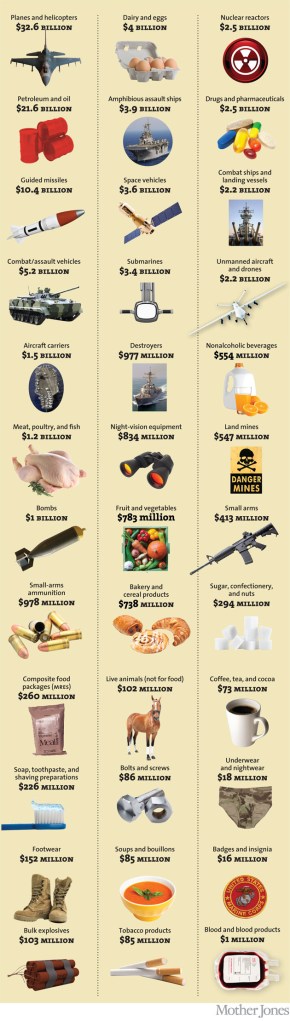
The United States spends far more than any other country on defense and security. Since 2001, the base defense budget has soared from $287 billion to $530 billion — and that’s before accounting for the primary costs of the Iraq and Afghanistan wars.

1) The United States spent 20 percent of the federal budget on defense in 2011. 

budget-defense
Continue reading

7 ways the Pentagon mismanages its massive budget

Timothy McGrath, “7 incredible ways the Pentagon mismanages its massive budget,” GlobalPost, 19 November 2013

In November, Reuters published the second part of its series on the Pentagon’s management (or lack thereof) of its $565.8 billion budget. And it’s a doozy. …

1) The Pentagon cooks the books

The agency in charge of the Pentagon’s accounting is called the Defense Finance and Accounting Service (DFAS). It seems that a lot of what they do is make things up. The official mechanism for making things up is called an “unsubstantiated change action,” more commonly known as a “plug.” …

2) Those “plugs” add up to a lot of money
Continue reading

Why Are US Special Operations Forces Deployed in Over 100 Countries?

Nick Turse, “Tomgram: Nick Turse, Special Ops Goes Global,” TomDispatch, 7 January 2014

It’s said that imitation is the sincerest form of flattery. So consider the actions of the U.S. Special Operations Command flattering indeed to the larger U.S. military. After all, over recent decades the Pentagon has done something that once would have been inconceivable. It has divided the whole globe, just about every inch of it, like a giant pie, into six command slices: U.S. European Command, or EUCOM (for Europe and Russia), U.S. Pacific Command, or PACOM (Asia), U.S. Central Command, or CENTCOM (the Greater Middle East and part of North Africa), U.S. Southern Command, or SOUTHCOM (Latin America), and in this century, U.S. Northern Command, or NORTHCOM (the United States, Canada, and Mexico), and starting in 2007, U.S. Africa Command, or AFRICOM (most of Africa).
Continue reading

US Department of Defense is the Worst Polluter on the Planet

US Department of Defense is the Worst Polluter on the Planet,” Project Censored

The US military is responsible for the most egregious and widespread pollution of the planet, yet this information and accompanying documentation goes almost entirely unreported. In spite of the evidence, the environmental impact of the US military goes largely unaddressed by environmental organizations and was not the focus of any discussions or proposed restrictions at the recent UN Climate Change Conference in Copenhagen. This impact includes uninhibited use of fossil fuels, massive creation of greenhouse gases, and extensive release of radioactive and chemical contaminants into the air, water, and soil.
Continue reading

$8.5 trillion missing from the Pentagon

Scot J. Paltrow, “Special Report: The Pentagon’s doctored ledgers conceal epic waste,” Reuters, 18 November 2013

Because of its persistent inability to tally its accounts, the Pentagon is the only federal agency that has not complied with a law that requires annual audits of all government departments. That means that the $8.5 trillion in taxpayer money doled out by Congress to the Pentagon since 1996, the first year it was supposed to be audited, has never been accounted for. That sum exceeds the value of China’s economic output last year. …
Continue reading

Is Pentagon paying for study it can get for free?

Ray Locker, “Is Pentagon paying for study it can get for free?,” USA TODAY, 6 November 2013

Is the Office of Net Assessment, the Pentagon’s futurist think-tank, paying $184,000 to a conservative Washington research group for a study on nuclear deterrence that has already been published and is available for free?
Continue reading

Pentagon Spent $5 Billion on Weapons on the Eve of the Shutdown

John Reed, “Pentagon Spent $5 Billion on Weapons on the Eve of the Shutdown,” The Washington Post, 01 October 2013

The Pentagon pumped billions of dollars into contractors’ bank accounts on the eve of the U.S. government’s shutdown that saw 400,000 Defense Department employees furloughed.

All told, the Pentagon awarded 94 contracts yesterday evening on its annual end-of-the-fiscal-year spending spree, spending more than five billion dollars on everything from robot submarines to Finnish hand grenades and a radar base mounted on an offshore oil platform. To put things in perspective, the Pentagon gave out only 14 contracts on September 3, the first workday of the month.
Continue reading

The rise of the military-entertainment complex

Excerpted from War Play: Video Games and the Future of Armed Conflict

Corey Mead, “Shall we play a game?: The rise of the military-entertainment complex,” Salon, 19 September 2013

The origins of the U.S. military’s involvement with video games lie in its century-old status as this country’s primary sponsor of new technologies. A quick checklist of the technologies that either stem from or were significantly refined in defense-funded contexts shows how pervasive the military’s influence has been: digital computers, nuclear power, high-speed integrated circuits, the first version of the Internet, semiconductors, radar, sonar, jet engines, portable phones, transistors, microwave ovens, GPS—the list goes on. As Ed Halter writes in his book “From Sun Tzu to Xbox,” “The technologies that shape our culture have always been pushed forward by war.” Continue reading

Civil-military relations haven’t been this bad in decades

MicahZenko, “The Soldier and the State Go Public,” Foreign Policy, 25 September 2013

Washington has found itself in a crisis over the proper relationship between senior civilian and military officials. This has played out in recent op-eds (“A War the Pentagon Doesn’t Want“) and articles (“Some U.S. Military Officers Not Happy With Syrian War Prep“), which have been countered by other op-eds (“No Military Consensus on Syria” and “U.S. War Decisions Rightfully Belong to Elected Civilian Leaders, Not the Military“). It’s a tension that shows little sign of abating, regardless of how the Syria issue plays out: Underlying forces seem guaranteed to make it worse.
Continue reading