Trends in U.S. Military Spending

Dinah Walker, “Trends in U.S. Military Spending,” Council on Foreign Relations, 30 July 2013

The following charts present historical trends in U.S. military spending and analyze the forces that may drive it lower.

These charts draw on data from the Stockholm International Peace Research Institute (SIPRI) and from the U.S. Bureau of Economic Analysis (BEA). Both data sets include spending on overseas contingency operations as well as defense. This distinguishes them from data used in the U.S. budget, which separates defense spending from spending on overseas operations.

Download Trends in US Military Spending 2013 [pdf].

USA’s defense budget in charts

Brad Plumer, “America’s staggering defense budget, in charts,” The Washington Post, 7 January 2013

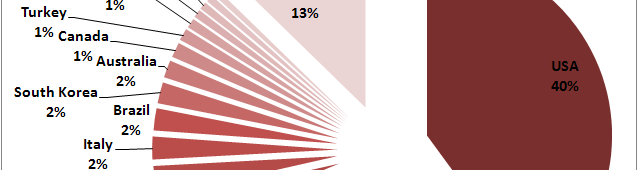
The United States spends far more than any other country on defense and security. Since 2001, the base defense budget has soared from $287 billion to $530 billion — and that’s before accounting for the primary costs of the Iraq and Afghanistan wars.

1) The United States spent 20 percent of the federal budget on defense in 2011. 

budget-defense
Continue reading

7 ways the Pentagon mismanages its massive budget

Timothy McGrath, “7 incredible ways the Pentagon mismanages its massive budget,” GlobalPost, 19 November 2013

In November, Reuters published the second part of its series on the Pentagon’s management (or lack thereof) of its $565.8 billion budget. And it’s a doozy. …

1) The Pentagon cooks the books

The agency in charge of the Pentagon’s accounting is called the Defense Finance and Accounting Service (DFAS). It seems that a lot of what they do is make things up. The official mechanism for making things up is called an “unsubstantiated change action,” more commonly known as a “plug.” …

2) Those “plugs” add up to a lot of money
Continue reading

Big money behind war

Jonathan Turley, “Big money behind war: the military-industrial complex,” Al Jazeera, 11 January 2014

Eisenhower warned that “an immense military establishment and a large arms industry” had emerged as a hidden force in US politics and that Americans “must not fail to comprehend its grave implications”. The speech may have been Eisenhower’s most courageous and prophetic moment. Fifty years and some later, Americans find themselves in what seems like perpetual war. No sooner do we draw down on operations in Iraq than leaders demand an intervention in Libya or Syria or Iran. While perpetual war constitutes perpetual losses for families, and ever expanding budgets, it also represents perpetual profits for a new and larger complex of business and government interests.
Continue reading

Reducing the defence budget is not the end of Britain

Joe Glenton, “Reducing the defence budget is not the end of Britain. It could be part of our rebirth,” The Independent, 17 January 2014

The tantrums which are emerging from the offense camp should be ignored. Britain has one of the largest military budgets in the world. As part of our swollen offense portfolio this small nation wields a preposterously expensive standing military which lacks utility (see Afghanistan, Iraq, Libya) and a nuclear arsenal which has no practical value beyond masculine prestige. There are three factors to consider.
Continue reading

Why is Europe obsessed with drones?

David Cronin, “Why is Europe obsessed with drones?,” Al Jazeera, 19 December 2013

Despite the economic crisis, the EU is facing serious lobbying to boost its defence spending.

Every time the West contemplates going to war, it’s a safe bet that “defence analysts” will pop up in the press bemoaning how Europe is militarily weaker than the United States. …

The 28-country bloc is under pressure from the arms industry to boost investment in drones.  If this doesn’t occur “it’s quite inevitable that the defence base will further deteriorate,” Tom Enders, head of the Franco-German weapons producer EADS has warned. …
Continue reading

Japan boosts military forces to counter China

Japan boosts military forces to counter China,” BBC News, 17 December 2013

Japan’s cabinet has approved a new national security strategy and increased defence spending in a move widely seen as aimed at China.

Over the next five years, Japan will buy hardware including drones, stealth aircraft and amphibious vehicles. Continue reading

US Pentagon has spent $8 Trillion to Guard Gulf Oil

Juan Cole, “Solar would be Cheaper: US Pentagon has spent $8 Trillion to Guard Gulf Oil,” informed Comment, 8 December 2013

It has cost the United States $8 trillion to provide military security in the Gulf since 1976. According to Roger Stern, a Princeton economist, the US has spent as much on Gulf security as it spent on the entire Cold War with the Soviet Union! In recent years through 2010 it has been $400 billion a year, though the US withdrawal from Iraq at the end of 2011 and the gradual withdrawal from Afghanistan this year and next presumably means that the figure is substantially reduced. Still, we have bases in Kuwait, Qatar and elsewhere, and a Naval HQ in Bahrain, none of which is cheap. If it were $200 billion a year, that is a fair chunk of the budget deficit the Republican Party keeps complaining about. And if we could get that $8 trillion back, it would pay down half of the national debt. …
Continue reading

The True Cost of National Security

David Cay Johnston, “The True Cost of National Security,” Columbia Journalism Review, 31 January 2013

But budget stories then and now tend to report on the base budget from the Department of Defense, leaving readers with the impression that that is the full cost of fulfilling the Constitutional mandate to “provide for the common defense.”

It isn’t. From the perspective of taxpayers who must bear the burden, total national security costs are as much as 2.5 times the base Defense budget. Reporters might want to take a look at the true costs, and not just at the way the White House prepares the budget and Pentagon spins it. Continue reading

Key US contracts for military aid to Egypt

Sophia Jones, “Here’s what $230 million in US aid bought Egypt’s military since the revolution,” GlobalPost, 25 November 2013

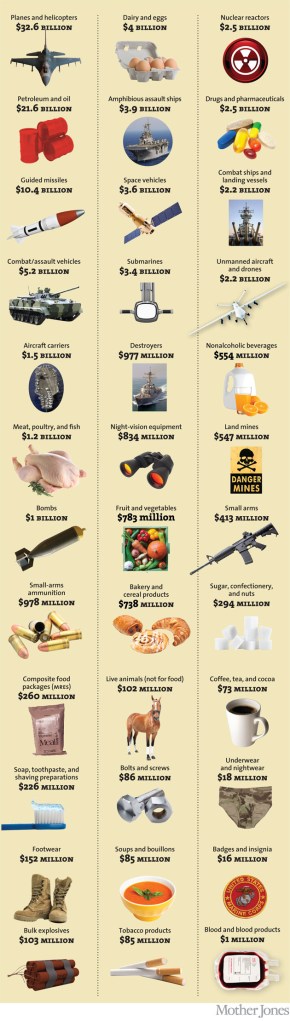
While the change may be largely symbolic, before Oct. 9 — no matter how bad it got, no matter how much violence or no matter who was leading the government — US companies producing and providing Egypt’s tanks, helicopters, and bullets did not flinch. Business was business.

To illustrate just how unwavering the arrangement was, GlobalPost compiled key US contracts for military aid to Egypt, held by the American defense giants that profited the most from that aid. We mapped this sample within the context of significant political moments, from the 2011 revolution that toppled a dictator to the military ousting of the president who took his place.
Continue reading

The top 10 American corporations profiting from Egypt’s military

Kyle Kim, “Here are the top 10 American corporations profiting from Egypt’s military,” GlobalPost, 16 August 2013

For decades, Egypt has been one of the largest recipients of US foreign military aid, receiving everything from F-16s to teargas grenades.

So who are the companies reaping the benefits?
Continue reading

$8.5 trillion missing from the Pentagon

Scot J. Paltrow, “Special Report: The Pentagon’s doctored ledgers conceal epic waste,” Reuters, 18 November 2013

Because of its persistent inability to tally its accounts, the Pentagon is the only federal agency that has not complied with a law that requires annual audits of all government departments. That means that the $8.5 trillion in taxpayer money doled out by Congress to the Pentagon since 1996, the first year it was supposed to be audited, has never been accounted for. That sum exceeds the value of China’s economic output last year. …
Continue reading

Is Pentagon paying for study it can get for free?

Ray Locker, “Is Pentagon paying for study it can get for free?,” USA TODAY, 6 November 2013

Is the Office of Net Assessment, the Pentagon’s futurist think-tank, paying $184,000 to a conservative Washington research group for a study on nuclear deterrence that has already been published and is available for free?
Continue reading

The Nearly $1 Trillion National Security Budget

Chris Hellman and Mattea Kramer, “War Pay,” TomDispatch, 22 May 2012

Here, then, is a simple question that, for some curious reason, no one bothers to ask, no less answer: How much are we spending on national security these days? With major wars winding down, has Washington already cut such spending so close to the bone that further reductions would be perilous to our safety?

In fact, with projected cuts added in, the national security budget in fiscal 2013 will be nearly $1 trillion — a staggering enough sum that it’s worth taking a walk through the maze of the national security budget to see just where that money’s lodged.
Continue reading

The “Unusual” Yet Ubiquitous Left-Right Alliance: Towards an Anti-Establishment Center

Sam Husseini, “The ‘Unusual’ Yet Ubiquitous Left-Right Alliance: Towards an Anti-Establishment Center,” Sam Husseini’s Blog, 28 July 2013

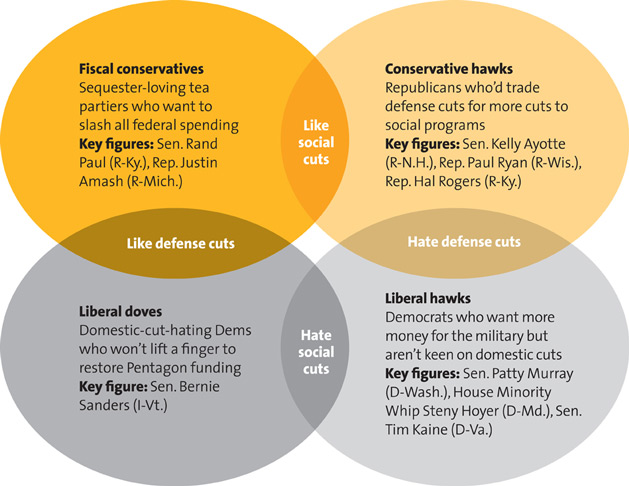
Every time you have this convergence of progressives and conservatives against the establishment, it’s regarded as “unusual” “odd” or “bizarre”  — even though it keeps coming up on issue after issue: war, military spending, trade, corporate power, Wall Street, fossil fuel subsidies, as well as — in the case of the NSA spying on the citizenry — the central issue of Constitutional rights and civil liberties. 

As documented below, the meme in the media and elsewhere is a permanent note of surprise, when it should be an established aspect of U.S. politics: There are in fact two “centers” — one that is pro-war and Wall Street (the establishment center) — and another that is pro-peace and populist (the anti-establishment center)
Continue reading