
- The population of the UK is an estimated 65.1 million.
- 1 in 20 GP surgeries have closed or merged since 2013. 57 closing down in 2016 alone.
- The NHS England budget is £117 billion for 2016/7 and will rise after inflation to £120 billion by 2019/20.
- Every 36 hours the NHS will treat 1,000,000 patients.
- Accident and emergency departments recorded their worst ever waiting times in 2016/7.
- Hospitals recorded their worst ever waiting times for elective surgery in 2015.
- The NHS in England has 149,808 doctors, 314,966 nurses, and employs 1.3 million people.
- 19% of NHS staff and 29.5% of NHS doctors are non-British.
- The average age of recent migrants to the UK is 26.
- Healthcare costs change with age: a 20-year old costs an estimated £500 per year, a 65-year old £3750 per year and an 85-year old £7500 per year.
- The population of the UK over 65 in 1975 was 1 in 8. Today it is 1 in 6. By 2050 it will be 1 in 4. There are 1.5 million people over 85 in the U.K today.
- The NHS buys many drugs from Europe and the USA paying in Euros (€) and US dollars ($).
- Health tourism, foreign citizens using the NHS, costs the NHS an estimated £1-300 million per year. A new overseas surcharge recouped £289m in 2015. This is 0.3% of the total NHS budget.
- Stationery costs the NHS £146m/year.
- Compared internationally the NHS achieves above average outcomes, with average funding and below average staff numbers. OECD.
- Health costs rise each year in developed countries, above real world inflation. This is broken down into staff wage inflation, new technologies, population growth, new drugs and medical advances.
- The NHS was estimated to require £30 billion by 2020 to meet predicted demand. To date, it has received £4.5 billion.
- Social care is estimated to require £4 billion by 2020 to maintain current service.
- The ratio of people working to those retired is called the Old Age Dependency Ratio (OADR). This was steady at around 300 retirees for every 1000 people working from the 1980s to 2006, but has now since started to rise. With retirement age changes, it will still increase by 20% by 2037 to 365.
Category Archives: News and Analysis
Globalisation, France, USA, Brexit and Trump
At the heart of Guilluy’s inquiry is globalization. Internationalizing the division of labor has brought significant economic efficiencies. But it has also brought inequalities unseen for a century, demographic upheaval, and cultural disruption. Now we face the question of what—if anything—we should do about it.
A process that Guilluy calls métropolisation has cut French society in two. In 16 dynamic urban areas (Paris, Lyon, Marseille, Aix-en-Provence, Toulouse, Lille, Bordeaux, Nice, Nantes, Strasbourg, Grenoble, Rennes, Rouen, Toulon, Douai-Lens, and Montpellier), the world’s resources have proved a profitable complement to those found in France. These urban areas are home to all the country’s educational and financial institutions, as well as almost all its corporations and the many well-paying jobs that go with them. Here, too, are the individuals—the entrepreneurs and engineers and CEOs, the fashion designers and models, the film directors and chefs and other “symbolic analysts,” as Robert Reich once called them—who shape the country’s tastes, form its opinions, and renew its prestige. Cheap labor, tariff-free consumer goods, and new markets of billions of people have made globalization a windfall for such prosperous places. But globalization has had no such galvanizing effect on the rest of France. Cities that were lively for hundreds of years—Tarbes, Agen, Albi, Béziers—are now, to use Guilluy’s word, “desertified,” haunted by the empty storefronts and blighted downtowns that Rust Belt Americans know well. Continue reading
Total world military expenditure rose to $1686 billion in 2016
Military spending in North America saw its first annual increase since 2010, while spending in Western Europe grew for the second consecutive year.
World military expenditure rose for a second consecutive year to a total of $1686 billion in 2016—the first consecutive annual increase since 2011 when spending reached its peak of $1699 billion.* Trends and patterns in military expenditure vary considerably between regions. Spending continued to grow in Asia and Oceania, Central and Eastern Europe and North Africa. By contrast, spending fell in Central America and the Caribbean, the Middle East (based on countries for which data is available), South America and sub-Saharan Africa.
Continue reading

Don’t Buy Don’t Sell in the Trump era
After authorising the firing of 59 Tomahawk missiles (each costing around $1.5 million) at a Syrian airbase with no apparent consequential strategic purpose and diminishing none of the Syrian regime’s chemical weapons capability, the maker of the Tomahawk missiles, Raytheon’s stock rose sharply, adding more than $1 billion to its market capitalisation. Other missile and weapons manufacturers, Boeing, Lockheed Martin, Northrop Grumman and General Dynamics, also saw their stock rose considerably – collectively gaining nearly $5 billion in market value. This on its own may not matter much, after all, which president of the USA has not dropped expensive bombs on some ‘remote’ nations of the world. But this time may be different.
Trump used anti-establishment and anti-corporate language during his election campaign to distinguish himself from all other candidates – he opposed neoconservative foreign policy, financial and corporate interests, notably Goldman Sachs. Now, after his inauguration, you can hardly see much difference between his foreign policy plans and policies proposed by neoconservatives. His cabinet looks like a ‘who’s who’ of Goldman Sachs alumni. He ratcheted up the military tension in the South China Sea, ordered a failed major special force operation in Yemen, and now seems to be pushing the USA to the edge of nuclear war with North Korea. The more he uses militaristic confrontational rhetoric and actions, the more ‘presidential’ he looks in the eyes of the mainstream media. He seems ‘unstoppable’.
But is he, really?
Calling North Korea ‘crazy’ won’t help with anything
Trump’s North Korea policy will reportedly focus more on pressuring Beijing to constrain North Korea, and on additional sanctions.
Two things to keep in mind: don’t underestimate North Korean leader Kim Jong Un, and don’t forget South Korea. …
Kim’s desire for deterrence – to not end up like Saddam Hussein or Muammar Gaddafi – helps explain the existence of its weapons program. Someone who has participated in more than a decade of Track 2 dialogues with the North Koreans once recounted to me how North Koreans asked them: “Would the Americans have gone in and done what they did to Gaddaffi, and to Syria, if they had what we have?’ Continue reading
UBI for India
The Finance Ministry’s economic survey estimated that a modest sum of $4 per person per month could reduce India’s poverty level from 22 percent at present to seven percent. The cost would be a mere two percent of GDP, or $42 billion, which is approximately the same amount the government spends in total on food, fuel, and fertilizer subsidies.
Continue reading
Deficit hawks are destroying our children’s future
The combined impact of fewer workers and lower productivity is enormous. In 2008, before the true extent of the recession was known, the Congressional Budget Office (CBO) projected that by 2017 the economy’s potential would be 29 percent larger than it had been in 2007. In its most recent report, the CBO puts the economy’s potential for 2017 at just 16 percent more than its 2007 level. This difference of 13 percentage points translates into more than $2 trillion a year in today’s economy.
It’s also well worth noting that this lost output is income that disproportionately would have gone to those at the middle and bottom of the income ladder. The people who don’t get employed in a weak economy are overwhelmingly African Americans, Hispanics, and workers with less education. Furthermore, in a weak labor market, workers at the middle and bottom of the wage ladder aren’t well positioned to get wage increases. The weakness of the labor market in the Great Recession and the anemic recovery that followed were both associated with a large shift in national income from wages to profits. In short, this was a hard punch to the belly for large segments of the working population.
US was responsible for four fifth of global weapons exports
US was responsible for 82% of all $188 billion in global weapons exports (by value, in 2014 dollars).
Top weapons exporters by value:
US: $153.8B
EU states: $15B
Russia: $10B
China: $3B
State Dept WMEAT, Table III
Continue reading
The global F-35 complex
It helps considerably that many of these customers have more than just a few tonnes of precision-engineered titanium to gain from any deal: the beauty of the JSF project is that everyone can bring something to the party. In a Lancashire workshop, for instance, BAE Systems is building a section of the aft fuselage, including the tail, for every F-35; along with other contributions from all over the world, these pieces are then shipped to Texas for final assembly. This means that every F-35 sale is a boost to the coffers of Britain’s own largest arms company. (BAE has also been allowed to do the foldy bits at the end of the wings.) And the opportunities are everywhere. There are aluminium sheets from Milton Keynes, electronic modules from Billingstad, circuit boards from Ankara, hydraulics from Melbourne, wiring systems from Rotterdam, manifolds from Adelaide, wing parts from Turin and actuators from New York. So when Trump threatened to slash the cost of the F-35 programme, or divert some of the custom to cheaper competitors, it wasn’t only American defence contractors who were in the firing line. Everyone had something to lose. On 30 January, ten days after taking office, Trump announced that he had negotiated $600 million off the price tag of the next batch of F-35s. Lockheed’s CEO chose not to shatter his illusion, but it turned out that the next ninety planes were always going to be cheaper anyway – by between 6 and 7 per cent, or $550 and $650 million. The more you build the cheaper they get, thanks to economies of scale. Happily for everyone involved, this also means that more get sold. The ‘military-industrial complex’ turns out to be very simple: the juggernaut has its own momentum. Once it’s rolling it can’t be stopped, even if you’re Donald Trump, something he finally came to acknowledge on 16 March, when his budget plan for the next fiscal year allowed for the ramping-up of F-35 production as part of a proposed 10 per cent increase in overall military spending.
“If you ask why we’re backing this … the answer is that we weren’t going to be able to stop it.”
As Rep. Adam Schiff, minority leader of the House Intelligence Committee, said, U.S. support would be perceived “as an indicator of our willingness to push back against Iranian efforts to increase hegemony in the region [and] that may influence how comfortable they are with a nuclear agreement,” adding, “it is very important for the U.S. to have Saudi Arabia’s back when it comes to Yemen.” One anonymous Pentagon official put it coldly: “If you ask why we’re backing this … the answer you’re going to get from most people — if they were being honest — is that we weren’t going to be able to stop it.”
Peace Movement in the Age of Trump
Throughout those conversations, there was consensus that the contemporary peace movement was not nearly powerful enough to mount a serious challenge to the forces of American empire and militarism. As the challenges facing that movement came into focus for me, so did their scale. It is hard to imagine a more difficult target, from an organizing perspective, than military policy. The US empire today leaves a great deal of ruin in its wake, but its cost is only vaguely felt by most Americans, while its gargantuan profits are pocketed by a few and its most recognized organization—the military itself—is widely celebrated as the most trusted public institution.
In the wake of the election, as the need for a constituency to challenge American militarism grows in urgency, how might such challenges be met? Doing so will require reimagining the constituency, strategy, and purpose of the movement itself. It is not at all clear that a “peace movement” or even an “antiwar movement,” as those have generally been conceived, will suffice. Rather, we need a movement that can speak to the anger that so many Americans feel toward the corporate powers that dominate our politics. Such a movement would expose how militarism is not immune to that influence but is particularly beholden to it. Can such a movement be organized? …
Continue reading
Analysis of the U.S. Military
Rather than cutting foreign aid, Trump should be cutting these instead
If President Trump really feels the need to cut foreign aid, he should take a close look at the Pentagon’s “shadow” security assistance programs — programs that are buried deep in the department’s budget, where they are largely shielded from scrutiny by the news media, the public and most members of Congress.
Since the Sept. 11 terrorist attacks, the Pentagon has created dozens of new arms and training programs within its own budget, at a cost of about $10 billion per year, in support of activities in more than 130 countries, according to the Security Assistance Monitor. This is small change by Pentagon standards, but more than three times the value of the domestic programs that are on the White House’s “hit list,” including the Corporation for Public Broadcasting, the National Endowments for the Arts and the Humanities, and funding for Planned Parenthood, Legal Services, AmeriCorps and the Export-Import Bank. Continue reading
UBI for 1%
In 2015, according to PSZ, the richest 1% of people in America received 20.2% of all the income in the nation. Ten points of that 20.2% came from equity income, net interest, housing rents, and the capital component of mixed income. Which is to say, 10% of all national income is paid out to the 1% as capital income. Let me reiterate: 1 in 10 dollars of income produced in this country is paid out to the richest 1% without them having to work for it.
Continue reading
UK is the only developed country where workers are getting poorer while the country is getting richer
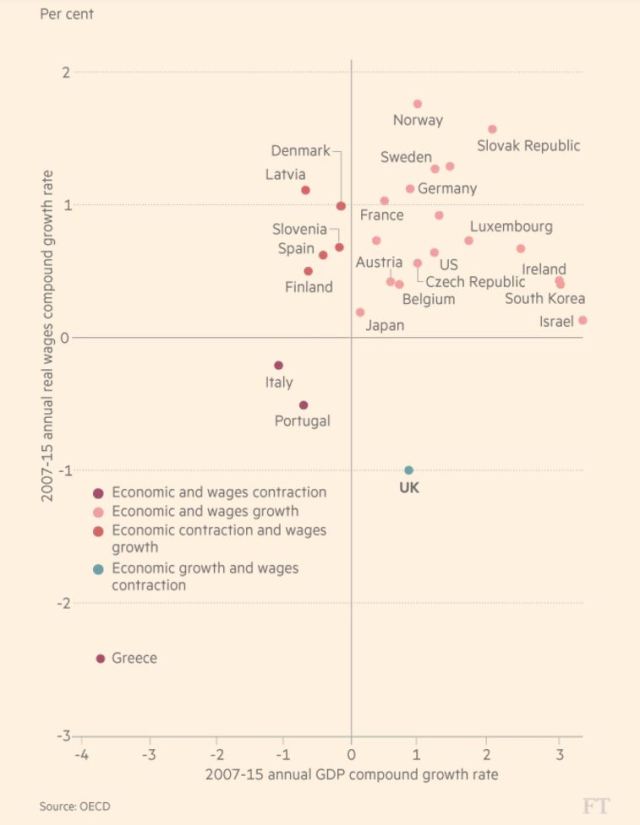
Trump’s Military Budget Doesn’t Add Up
And while Trump says increased military spending will reassert America’s strength, the United States already is the world’s 800-pound gorilla. In 2015, it was responsible for more than one third of all military spending on the planet. China and Russia, the United States’ main military competitors, don’t even come close.
Trump’s budget plans also feature drastic cuts to international and environmental spending. He’s reportedly pushing for a 24 percent cut to the EPA budget and a 37 percent cut to the State Department and USAID budget. While such reductions would have profound effects on these agencies, they are a drop in the bucket compared with the Pentagon budget. In 2016, the Department of State and USAID received an estimated $50.6 billion, or 1.3 percent of all federal spending. The EPA received $8.3 billion, or 0.2 percent of all federal spending. Meanwhile, the Pentagon got 15 percent.
Continue reading
Meritocracy and the decline of the Democratic Party
Meritocracy, Franks argues, is the ideology that allowed Democrats to self-consciously claim the mantle of social justice and egalitarianism while subverting both. In this framework, one’s race, creed, color, gender, or sexual orientation shouldn’t matter when it comes to achieving success in America; what does matter is having the talent and ability to graduate from a place like Harvard Law. But at the same time, meritocracy demands inequality—not everyone, after all, can go to Harvard Law or become a doctor or a high-tech executive. In fetishizing meritocracy, therefore, the Democratic Party has embraced an ideology based on inequality.
Frank contrasts this ideology with the GOP’s more traditional plutocratic one. In the United States, as elsewhere, having a lot of money gives you power. But this “hierarchy of money,” as he puts it, is rivaled by another: a “hierarchy of merit, learning, and status.” The lawyers, doctors, and academics who compose “the liberal class” (to use the journalist Chris Hedges’s term) have erected their own edifice of power—one that has also come to ignore the interests of working-class people and reproduced structures of extreme racism, particularly in the prison system.
Continue reading
Trump put budget in a muddle with big military spending increase
“I don’t know how you take $54 billion out without wholesale taking out entire departments,” said Bill Hoagland, a longtime Republican budget aide in the Senate and now a senior vice president at the Bipartisan Policy Center. “You need to control it in the area of the entitlement programs, which he’s taken off the table. It is a proposal, I dare say, that will be dead on arrival even with a Republican Congress.” Continue reading
Ken Loach on Corbyn
The spate of calls for Jeremy Corbyn to quit since last week’s byelections in Stoke and Copeland has been as predictable as it was premeditated. It says everything about the political agenda of the media, and nothing about people’s real needs and experiences.
I went to Stoke and Whitehaven, in Cumbria, a few days before polling. Momentum arranged screenings of Daniel Blake. We went to Labour clubs in neglected areas, old estates away from the centre. At one club I was asked: “Why have you come here? No one comes here.”
Joe Bradley and Georgie Robertson, the organisers, were a model of how Labour activists should work: full of energy, hard-working and brilliantly efficient. They had a warm greeting for everyone, checked the screening facilities, made space for local contributors so people from that community felt it was their event and that they were being heard. This is how Labour can reconnect.
Both screenings were packed. The discussions were passionate, informed and invigorating, a world away from the tired cliches of the public discourse. This was not a marketing exercise but a real engagement with people and their concerns.
The failure of Labour governments – and, importantly, Labour councillors – was a common theme. It is not hard to see the neglect around Stoke. Solid Labour, for sure, but what good has it done them? A 2015 report into the area found 60,000 people in poverty, 3,000 households dependent on charity food, and £25m in council tax arrears. The presence of the BNP, now replaced by Ukip, shows how Labour’s failure left space for the far right.
It was a similar story in Copeland. Industries have been lost – steel, mines, a chemical factory – without any plan to replace them. Labour is seen to be as culpable as the Tories. Someone said that in Copeland it was an anti-establishment vote, and Labour is the local establishment. It was a vote against Tony Blair, Gordon Brown and previous MPs Jack Cunningham and Jamie Reed.
In both constituencies the Labour candidates, neither from the left of the party, were invited, but both candidates ignored the meetings. With coverage on television, radio and the press, this is bizarre. Could it be because Momentum were the organisers? We were there to support Labour. There was not even the courtesy of a reply.
Continue reading
Trump is continuing the trend of ever-increasing military spending
WILLIAM HARTUNG: Well, he committed truth: He said it’s one of the largest military budget increases in history—about 10 percent, $54 billion, which, to put it in perspective, would be about what the United Kingdom spends—just the increase. That would be the seventh biggest military budget in the world. And, of course, we’re spending at historic levels, $600 billion a year, which is more than the peak of Reagan. The Obama years, we spent more than under George W. Bush. So the idea that there’s a gap in military spending is ludicrous. He hasn’t talked about tens of billion dollars in Pentagon waste. And, of course, he hasn’t said how he’s going use the military, other than rattling sabers about Iran, which, were they to go to war with Iran, as one person said, would be—make Iraq look like a walk in the park. So, I think the money is problematic, but also kind of the reckless possibilities of how they might use the military.
Continue reading
 Tipping Point North South