
King addressed the issue of the relationship between the struggles for peace and civil rights in his Riverside Church speech. He began the speech by addressing the criticisms of those who suggested that it was not his “place” to speak out against the war:
“”Peace and civil rights don’t mix,” they say. “Aren’t you hurting the cause of your people,” they ask? And when I hear them, though I often understand the source of their concern, I am nevertheless greatly saddened, for such questions mean that the inquirers have not really known my commitment, my calling or me. Indeed, their questions suggest that they do not know the world in which they live.” Continue reading
Category Archives: Blog
Some Reflections of the Taiwanese Presidential Election 2016
Tsai Ing-Wen’s recent election as Taiwan’s first female president and the first female ethnic Chinese head of state, has seen the international media full of praise of this historic moment. However, we should not get carried away. This is a historic moment similar to Barack Obama’s election as the first Black president of the United States of America and, if it comes to pass, Hilary Clinton’s election as the first female US president. In times of prosperity and stability, these are s that are worthy of wide celebration and even euphoria, in times such as ours -uncertain and going from crisis after crisis – the impact has a rather different effect. This is why Obama’s election, apart from some notable exceptions ie diplomatic foreign policy in the case of Iran and the Affordable Care Act, was largely symbolic, with business going on as usual. Apart from some fines levied on the Wall Street banks, there are no criminal convictions of bankers. It was the first time in American history that no criminal bankers have been brought to justice after a major financial fraud; an enormous opportunity missed to reform a not-fit-for-public-service financial system. The West is still mired in the Middle East, even though military interventions were restrained. US military spending experienced hardly a dip despite of sequestration (automatic cuts to federal spending) because of the liberal use of the Overseas Contingency Operations (OCO) fund to make up any shortfalls. Profits of major defense contractors actually went up significantly during the Obama years and US arms sales to the rest of the world has gone from strength to strength.
Continue reading
Martin Luther King Jr.’s Critiques of Capitalism and Militarism
America’s celebrations of Martin Luther King Jr. typically focus on his civil rights activism: the nonviolent actions that led to the Civil Rights Act of 1964 and the Voting Rights Act of 1965.
The last few years of King’s life, by contrast, are generally overlooked. When he was assassinated in 1968, King was in the midst of waging a radical campaign against economic inequality and poverty, while protesting vigorously against the Vietnam War. Continue reading
An analysis of the ‘Davos Class’
This is worth a look, not only because I helped this research.
TNI takes a close look at the World Economic Forum’s Board to see who they represent, their economic interests and political beliefs. Might this be the future of global governance?
ProjectsSeriesThe research showed that:
- Only 6 of its 24 Board members are women (25%)
- 16 are from North America and Europe (67%). There is not one African Board member.
- Half of the Board (12) are currently corporate executives. However if you look at their careers, 16 have a corporate background (67%)
- 22 of the 24 went to universities in US and Europe; 10 went to the same university (Harvard)
- Only one member can be said to represent civil society (Peter Maurer of Red Cross). There are no representatives of trade unions, public sector organisations, human rights groups, peasant or indigenous organisations, students and youth.
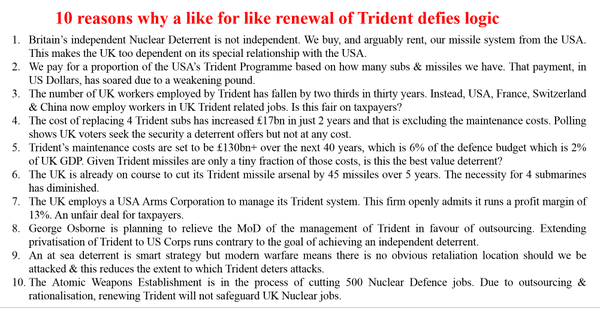
Why we should not renew Trident
‘diplomatic relations and arms sales trump the lives of Yemen’s children’
According to the Campaign Against Arms Trade (CAAT), the UK has sold more than £5.6 billion of arms to Saudi Arabia since 2010, including combat aircraft worth £1.7 billion last May.
The arms trade also receives generous state backing. The UK Trade and Industry Defence and Security Organisation, which exists to promote arms sales, gets far more funding than other UKTI sectors, even though the arms trade is responsible for only 1.5 per cent of UK exports.
Continue reading
Corbyn is right on Trident
Simon Jenkins is spot on on this:
Corbyn was right on Iraq. He was right on Syria. He is right on Islamic State. On the idiocy, waste and vacuous drivel that constitutes “the case for Trident”, he has been right. Fighting him on it just to make Labour seem macho makes no sense.
Political influence on the decision to drop FCA’s banking inquiry
This from Financial Times:
A Bank of England official oversaw the move by the City regulator to scrap a review into Britain’s banks, it emerged on Tuesday, just a day after the Financial Conduct Authority insisted external pressure had not influenced its decision.
Continue reading
Age of Dissent: more protests in 2015 than any time since the late 70s
The year 2011 is widely viewed as the peak of protest and dissent in the wake of the 2008 financial crisis and the austerity agenda that followed it. It was the year of the Arab Spring, Occupy, UK Uncut, indignados, urban riots and anti-austerity and tuition fee protests – and in which Time magazine famously named “The Protester” as its person of the year.
Yet in the UK, protests continue to occur at a rate rarely seen prior to the global economic crisis in 2008. Indeed, 2015 seems to have confirmed the suggestion, made at the beginning of the year, that 2011 was “really only just the beginning”. …
Continue reading
Obama SOTU 2016
The United States of America is the most powerful nation on Earth. Period. It’s not even close. We spend more on our military than the next eight nations combined. Our troops are the finest fighting force in the history of the world. No nation dares to attack us or our allies because they know that’s the path to ruin. Surveys show our standing around the world is higher than when I was elected to this office, and when it comes to every important international issue, people of the world do not look to Beijing or Moscow to lead – they call us.
Pakistan’s annual $20m arms sales to over 40 countries, incl. UK and USA
Pakistan has been selling weapons to many countries of the world including United States and Britain.
Minister for Defence Production, Rana Tanveer Hussain, while answering questions in the National Assembly session, said that during 2013, UK bought 69 Pakistan-made sub-machine guns (SMG MP5) and 250 G-3 rifles. … Continue reading
London is a floodplain
According to David Cameron, London is a floodplain.
This from Miles King:
[The PM] rejected the idea that it was a bad idea to build on floodplains claiming that London was a floodplain. Only a tiny proportion of London sits in the floodplain of the Thames, perhaps he was confusing Westminster with London.
Household Debt
That simple observation holds the key to explaining the post-79 era in British politics. How do you win an election? Inflate the property market. How do you mimic economic growth? Encourage housing equity withdrawal.
In savvier parts of the establishment, that relationship is now tacitly accepted. The latest Economist has a discussion on household debt in the UK that concludes: “It remains unsustainable for household debt to rise relative to incomes indefinitely … But for the time being rising debt may not be a bad thing … The British economy may be somewhat unbalanced, but at least it is growing.” This is the house journal of the departure-lounge capitalist class admitting that the British economy may be tapped out, but at least we can keep borrowing.
Continue reading
MoD accounts half of all government carbon emissions
Ministers had targeted a 25% cut in carbon emissions from government buildings and travel in 201 4-15 , compared to 2009-10, but achieved 22%. The failure was largely due to the Ministry of Defence, which accounts for half of all government emissions and cut its emissions by 19%.
Basic Income, an idea whose time has come
A wide array of different approaches to a Basic Income have been proposed over the years. But perhaps one of the most credible and immediately possible proposals has recently emerged in a new report by the RSA.
Continue reading
Use of Drones by Non-State Actors
“The Hostile Use of Drones by Non-State Actors Against British Targets,” a new report by the Oxford Research Group’s Remote Control Project.
Chris Abbott, the lead author of the report and visiting research fellow at Bradford University’s School of Social and International Studies, said: “The use of drones for surveillance and attack is no longer the purview of state militaries alone. A range of terrorist, insurgent, criminal, corporate and activist groups have already shown their desire and ability to use drones against British targets.”
Continue reading
UK MoD won’t investigate drone deaths in the Middle East
The Ministry of Defence told the Sunday Herald that it will not investigate reports of deaths on the ground in Syria and Iraq – from anyone but UK military personnel, and ‘local forces’ deemed friendly.
The UK Government is being urged to launch an immediate investigation after independent monitoring group Airwars reported between 72 and 81 civilian deaths in Iraq could be linked to British air strikes.
Safety issues with F-35’s ejection seat won’t be resolved until 2018
The US Air Force won’t lift weight restrictions on F-35 pilots until 2018 — at the earliest — as more testing needs to be done to address safety issues with the jet’s ejection seat, Defense News has learned. …
Continue reading
China’s Stealth Jet Fleet
When the squadron has enough planes and trained pilots and maintainers, the air force can declare the first J-20 unit “combat-ready”—a milestone most analysts expect sometime in 2017. At that time, China will join an exclusive club—as only the second country to field a fleet of frontline radar-evading jets. The American F-117, the world’s first stealth warplane, entered service with the U.S. Air Force in 1983. The U.S. B-2 stealth bomber followed in 1997, the supersonic F-22 stealth fighter in 2005, and the F-22’s smaller cousin the F-35 in July 2015.
By the 2030s, the Pentagon could possess as many as 1,700 F-35s plus 180 or so F-22s and 20 B-2s.
No other country has war-ready stealth warplanes, although Russia is working on one—and eight U.S. allies have ordered the F-35, with several more planning on also buying the plane in the near future. But while it’s pretty certain China will soon deploy J-20s, it’s not clear why—or how effectively—it will do so. Continue reading
A Realist worldview
A good brief summary of Realism approach to foreign policy by Stephen Walt:
To remind you: Realism sees power as the centerpiece of political life and sees states as primarily concerned with ensuring their own security in a world where there’s no world government to protect them from others. Realists believe military power is essential to preserving a state’s independence and autonomy, but they recognize it is a crude instrument that often produces unintended consequences. Realists believe nationalism and other local identities are powerful and enduring; states are mostly selfish; altruism is rare; trust is hard to come by; and norms and institutions have a limited impact on what powerful states do. In short, realists have a generally pessimistic view of international affairs and are wary of efforts to remake the world according to some ideological blueprint, no matter how appealing it might be in the abstract.
 Tipping Point North South