There is no population explosion on this planet

Robert Newman, “There is no population explosion on this planet,” The Guardian, 22 September 2013

Let’s get one thing straight from the start. There is no population explosion. The rate of population growth has been slowing since the 1960s, and has fallen below replacement levels half the world over. But what about the other half? That’s where population is exploding, right? Well, actually, no. The UN Population Division’s world fertility patterns show that, worldwide, fertility per woman has fallen from 4.7 babies in 1970–75 to 2.6 in 2005-10. As Peoplequake author Fred Pearce puts it: “Today’s women have half as many babies as their mothers … That is not just in the rich world. It is the global average today.” …
Continue reading

Defense Contractor: Climate Change Could Create “Business Opportunities”

Jeremy Schulman, “Defense Contractor: Climate Change Could Create ‘Business Opportunities,” Mother Jones, 14 August 2013

Of all the business opportunities presented by global warming, Raytheon Company may have found one of the most alarming. The Massachusetts-based defense contractor—which makes everything from communications systems to Tomahawk missiles—thinks that future “security concerns” caused by climate change could mean expanded sales of its military products. …
Continue reading

Harry Belafonte remembers ‘I Have a Dream’

Harry Belafonte, “Martin Luther King: Harry Belafonte remembers ‘I Have a Dream’,” The Observer, 11 August 2013

There is one thing I have to say about the speech, though, and I say it when I am called on to speak about Dr King to students all over America. I tell them: you need to study the whole speech because the text before the “I Have a Dream” part is a deeper reflection of what he was striving for. The details and the passion of the struggle are spelt out in the preceding passages.

The spirit that Dr King called forth was a profoundly American spirit, as was his struggle. What made me feel so good about that struggle was that it was ordinary people who were becoming empowered through his words, to realise their own possibilities.
Continue reading

The shocking truth

The shocking truth,” The Economist, Aug 27th 2013

The numbers may be small but they are growing. In 2011 documentary films grossed £11m at the British box office. This was only 1% of the year’s total box-office takings but it was a six-fold increase on the year before. Moreover, while the budgets can be high they are still much cheaper to produce than studio features.

But why are audiences increasingly choosing fact over fiction? Perhaps the current dearth of realism (endless comic-book sequels and apocalyptic action movies) is forcing more discerning viewers to choose authentic storytelling over spectacular visuals and far-fetched plots. Documentaries such as “Blackfish” may also fill a gap in investigative journalism, as fewer newspapers and broadcasters invest in long-term projects.
Continue reading

Solar Energy Perspectives

Solar Energy Perspectives,” International Energy Agency‌, 2011

In 90 minutes, enough sunlight strikes the earth to provide the entire planet’s energy needs for one year. While solar energy is abundant, it represents a tiny fraction of the world’s current energy mix. But this is changing rapidly and is being driven by global action to improve energy access and supply security, and to mitigate climate change.

Download the report here.

MLK’s vehement condemnations of US militarism are more relevant than ever

Glenn Greenwald, “MLK’s vehement condemnations of US militarism are more relevant than ever,” The Guardian, 21 January 2013

The civil right achievements of Martin Luther King are quite justly the focus of the annual birthday commemoration of his legacy. But it is remarkable, as I’ve noted before on this holiday, how completely his vehement anti-war advocacy is ignored when commemorating his life (just as his economic views are). By King’s own description, his work against US violence and militarism, not only in Vietnam but generally, was central – indispensable – to his worldview and activism, yet it has been almost completely erased from how he is remembered.
Continue reading

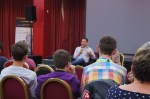
Operation Bethlehem at Cambridge

Operation Bethlehem at Cambridge

Cambridge Film Festival – Work In Progress Screening

Monday 23rd September, 6.30pm

We are delighted that the Cambridge Film Festival 2013 are screening Leila Sansour’s ‘Operation Bethlehem’ as a work in progress

Leila will join the audience for a post-film discussion.

For more information, see link below.

http://www.cambridgefilmfestival.org.uk/films/2013/operation-bethlehem#sthash.5ghqnjqL.dpuf

CAMBRIDGE FILM FESTIVAL – OPERATION BETHLEHEM

A work in progress: Daughter to the late founder of Bethlehem University, Leila Sansour returned to the place she was so desperate to escape as teenager with the intention of making a film honouring her father and his relationship with the legendary town. Instead, she found herself compelled to document the wall being built around Bethlehem, transforming the city into an open-air prison patrolled by the Israeli military. Five years later, Sansour has created a touching personal record of her own re-assimilation into her ancestral home, but also an evocative archive of Bethlehem’s cultural and historical riches, and a crucial expose of the threats this history is facing. Allied with a campaign to resist this erasure and preserve the town’s identity as bastion of harmonious multifaith cohabitation in the Middle East, OPERATION BETHLEHEM is a hugely affecting and significant work.

See more at:

http://www.cambridgefilmfestival.org.uk/films/2013/operation-bethlehem#sthash.5ghqnjqL.dpuf

Event: TPFF at Greenbelt 2013

Tipping Point’s Programme – 24,25,26 August

“Greenbelt ranks alongside Glastonbury as my favourite festival gig of the summer.”  Mark Thomas.

TPFF looks forward to another bank holiday Greenbelt festival – and a special one as Greenbelt celebrates its 40thBirthday!

And our three day programme stays with the ‘anniversary’ theme as 50 years on, we mark Martin Luther King’s ‘I have a dream’ speech through the beautifully told story of his fellow civil rights friend and activist, the extra-ordinary Harry Belafonte; we preview TPFF supported film by Amir Amirani ‘We Are Many’ – a film marking  the 10th anniversary of the 2003 global anti-Iraq war marches; and eight years on from Make Poverty History,  we look at the tax campaign related outcomes of the recent G8 meeting as we screen the highly popular ‘We’re Not Broke’ – a film about corporates, tax avoidance and citizens.

We’ll be there Saturday, Sunday and Monday – 2pm-4.30pm at the film venue.  Each screening is followed by post film discussion with specially invited guests…

We look forward to seeing you there!


Continue reading

Nuke the Budget

Tom Z. Collina, “Nuke the Budget,” Foreign Policy, August 9 2013

Consider this: The Pentagon, as directed by Congress, must dramatically cut its budget. Defense Secretary Chuck Hagel warns the projected cuts are so large that they would “break” key parts of the military’s national security strategy, and even then “the savings fall well short” of meeting the $500 billion 10-year target.

At the same time, President Barack Obama, the Joint Chiefs of Staff, and the Pentagon have determined that the United States has more strategic nuclear warheads than it needs to deter potential threats and can therefore reduce the deployed stockpile by up to one-third, to about 1,000 warheads. Hagel supported even deeper nuclear reductions before he was tapped to head the Pentagon.

Perfect target for budget cuts, right? Wrong, says Hagel, who has taken the U.S. nuclear weapons budget off the chopping block, all $31 billion per year of it. …
Continue reading

Famine as a crime against humanity

Abdi Ismail Samatar, “Famine as a crime against humanity,” Al Jazeera, 01 Dec 2011

Drought does not necessarily lead to famine: The catastrophe in Somalia was man-made.

The coordinator of the Monitoring Group recently published an article in which he claimed that the Somali famine is not only a catastrophe, but that identifiable individuals and groups engaged in the production of the famine and therefore have committed crimes against humanity. This bold statement by the coordinator of the Monitoring Group demands careful assessment.

It has been common wisdom for decades that droughts do not by themselves lead to famines, and the cause of the latter is the failure by national and international authorities to take action long before people run out of food. There have been 10 major droughts over the last 50 years in the Horn of Africa in general, and in Somalia in particular.

The evidence gleaned from this climatic record show that most droughts did not produce famine. …
Continue reading

Sharing science is a crime

Charles Davis, “Sharing science is a crime,” Al Jazeera, 03 Aug 2013

The more one shares, the more one undermines a future patent application and a system that encourages privatisation.

It doesn’t matter if you start out working for a university. Scientists are given two choices for getting their research funded, academia or not: go to work for the Pentagon or start making something you can patent. And the government and its corporations want it that way.

Of the $140bn in research and development funding requested by President Barack Obama for 2013, according to the Congressional Research Service, more than half goes through the Department of Defense; less than $30bn through the National Institutes of Health (NIH). That invariably leads to a shift in resources, with scientists going to where the money is: instead of finding ways to cure, finding high-tech ways to kill or otherwise aid the war effort. Researchers at the University of Arizona, for instance, received a $1.5m grant to “adapt their breast cancer imaging research for detection of embedded explosives”, which speaks rather well to the US government’s priorities and the toll it takes on research that has the general public in mind. …
Continue reading

TPFF at GREENBELT 2013

TPFF at GREENBELT 2013

Tipping Point’s Programme – 24,25,26 August

“Greenbelt ranks alongside Glastonbury as my favourite festival gig of the summer.”  Mark Thomas.

TPFF looks forward to another bank holiday Greenbelt festival – and a special one as Greenbelt celebrates its 40thBirthday!

And our three day programme stays with the ‘anniversary’ theme as 50 years on, we mark Martin Luther King’s ‘I have a dream’ speech through the beautifully told story of his fellow civil rights friend and activist, the extra-ordinary Harry Belafonte; we preview TPFF supported film by Amir Amirani ‘We Are Many’ – a film marking  the 10th anniversary of the 2003 global anti-Iraq war marches; and eight years on from Make Poverty History,  we look at the tax campaign related outcomes of the recent G8 meeting as we screen the highly popular ‘We’re Not Broke’ – a film about corporates, tax avoidance and citizens.

We’ll be there Saturday, Sunday and Monday – 2pm-4.30pm at the film venue.  Each screening is followed by post film discussion with specially invited guests…

We look forward to seeing you there!

Saturday 24th August  2pm

Sing Your Song (Susanne Rostock, 2011, 103 mins)

In this the 50th Anniversary of Martin Luther King’s ‘I have a dream’ speech, we are screening a documentary about one of Dr King’s friends and iconic campaigners – Harry Belafonte.

Harry Belafonte is one of the truly heroic cultural and political figures of the past 60 years. Told from his point of view, the film charts his life from a boy born in New York and raised in Jamaica; his theatre beginnings and move into film. However, even as a superstar, the life of a black man in 1960s America was far from easy and Belafonte was confronted with the same Jim Crow laws and prejudices that every other black man, woman and child in America was facing. Among other things, the film presents a look at the Civil Rights Movement through the eyes of an insider; someone who despite his high profile, wasn’t afraid to spend time in the trenches. From Harlem to Mississippi to Africa and South Central Los Angeles, Sing Your Song takes us on a journey through Harry Belafonte’s life, work and most of all, his conscience, as it inspires us all to action.

Joining us for a post film discussion is Reverend Rose Hudson-Wilkin, Speakers Chaplain to the House of Commons

The Revd Rose Hudson-Wilkin was appointed to the role of Speaker’s Chaplain in June 2010 by the Speaker of the House of Commons, Rt Hon John Bercow MP. She is the Vicar of the United Benefice of Holy Trinity with St Philip, Dalston, and All Saints, Haggerston, in the London diocese. Rose combines this parish role with the position of Speaker’s Chaplain and as Priest Vicar at Westminster Abbey. Rose was born and grew up in Montego Bay, Jamaica. Commissioned as a Church Army Officer in 1982, her theological training took place at the West Midlands Ministerial Training Course at Queens Theological College. She was ordained Deacon in 1991, and Priest in 1994. In 2007 she was appointed a chaplain to the Queen.

Sunday 25th August, 2pm

We Are Many (Amir Amirani, 2013, 100 mins)                         PREVIEW


In this the 10th anniversary of the global anti-war marches and invasion of Iraq, we are previewing this TPFF supported film that tells an as yet untold story about the hidden ‘people power’ legacy of those anti-Iraq war marches of February 2003.  Interviewees include Danny Glover, Damon Albarn, Medea Benjamin, Phyllis Bennis, Richard Branson, Claire Short, Brian Eno, Ken Loach.

On February 15 2003, millions and millions of people, in over 800 cities across all seven continents, marched against the impending invasion of Iraq. It was the largest mobilization of people in human history and We Are Many shows the remarkable links  between the 2003 protests and citizen movements such as Avaaz and 38 degrees;  the Arab Spring, as well as with the occupation of cities across Europe and the USA – a clear line through the last 10 years of history. The 2003 protest failed to stop the Iraq War, and makde many question their democracies, but it drew a new map for protests to come.

Join us for a pre-autumn release preview followed by Q&A with director Amir Amirani. Amir has made award-winning radio and television programmes for BBC, C4, Al Jazeera and others. This is his first cinema documentary.

Monday 26th August, 2pm

We’re Not Broke (Victoria Bruce and Karin Hayes, 2012, 81 mins)

Eight years on from Make Poverty History, the G8 met again in the UK.  Tax avoidance was top of the agenda, and we are seeing more and more attention on how society can truly ensure that rich individuals and corporations pay what taxes are truly due.

We’re Not Broke was an Official Selection at the 2012 Sundance Film Festival and is the story of how U.S. corporations have been able to hide over a trillion dollars from Uncle Sam; how seven fed-up Americans from across the country, take their frustration to the streets;  and how they vow to make the corporations pay their fair share America is in the grip of economic panic.

United States legislators cry “We’re Broke!” as they slash budgets, lay off schoolteachers, police, and fire-fighters, destroying the country’s social fabric and leaving many Americans scrambling to survive. Meanwhile, multibillion-dollar American corporations like Exxon, Google and Bank of America are making record profits. And while the deficit climbs and the cuts go deeper, these corporations—with intimate ties to  political leaders—are concealing colossal profits overseas to avoid paying U.S. income tax.

Join us for a Q&A after the film with Alastair Roxburgh, Tax Campaign Christian Aid and Liz Nelson from Tax Justice Network. TJN promotes research into and education on the ways in which tax and related regulation and legislation can be used to promote development, encourage citizenship and relieve poverty within the context of local, national and international economies and societies.

Pictures of the Day

Event: Cancer Prevention – A Toxic Tour


On the 29th June 2013, From Pink to Prevention organised a toxic tour in Central London. The tour took in various sites of significance in relation to cancer prevention – or rather the lack of action on cancer prevention by government offices and other bodies.

Blue Plaque

At each venue speakers addressed various aspects in relation to the total lack of action on the part of governments and the cancer establishment on the issue of the primary prevention of cancer (ie stopping it before it starts).  They discussed their work on the issue and posted up Blue Plaques announcing ‘Cancer Prevention does not live here’ at each site to commemorate the visit.
Continue reading

Selfish traits not favoured by evolution

Melissa Hogenboom, “Selfish traits not favoured by evolution, study shows,” BBC News, 2 August 2013

Evolution does not favour selfish people, according to new research.

This challenges a previous theory which suggested it was preferable to put yourself first.

Instead, it pays to be co-operative, shown in a model of “the prisoner’s dilemma”, a scenario of game theory – the study of strategic decision-making.

Published in Nature Communications, the team says their work shows that exhibiting only selfish traits would have made us become extinct.
Continue reading

How Buck McKeon created a global drone enterprise

Tara McKelvey, “How Buck McKeon created a global drone enterprise,” BBC News Magazine, 2 August 2013

Many countries, including China and Israel, make drones. Yet the US is the world’s leader in creating technology for drones and in promoting their use – for both military and civilian purposes. The interest in drones in the US crosses political lines, with both Democrats and Republicans investing in the aircraft. …

Less well known, however, is the fact that drones are used in the civilian airspace over the US, UK and Europe.

It is a growing, if under-reported, trend. Many of the drones used in Pakistan, along with those sent to Afghanistan, now have a permanent home in the US. These drones are turned over to civilians who work for the federal Customs and Border Protection agency, police departments, and other government offices.

The story of how drones became a robust niche in domestic law enforcement – and part of the commercial world as well – is rooted in Washington DC. Indeed, the rise of the drone can be traced in part to one man, Howard “Buck” McKeon.

Continue reading

WHO report on the global tobacco epidemic, 2013

Enforcing bans on tobacco advertising, promotion and sponsorship

The continued success in global tobacco control is detailed in this year’s WHO Report on the Global Tobacco Epidemic, 2013. The fourth in the series, this year’s report presents the status of the MPOWER measures, with country-specific data updated and aggregated through 2012. In addition, the report provides a special focus on legislation to ban tobacco advertising, promotion and sponsorship (TAPS) in WHO Member States and an in-depth analyses of TAPS bans were performed, allowing for a more detailed understanding of progress and future challenges in this area.
Continue reading

What’s disrupting you? Take Action now to let governments know you want an EDC Free Future

Information alert

What’s disrupting you? Take Action now to let governments know you want an EDC Free Future

Brussels, 30 July 2013 – A coalition of public interest groups representing more than 31 organisations across Europe have launched a Take Action initiative for an EDC-Free Future.

This fun and creative Take Action photo initiative is part of the EDC-Free Europe campaign [1] set up in March 2013 by a diverse group of campaign partners with a common concern about endocrine disrupting chemicals (EDCs) and how they may be affecting our health. EDCs are linked to serious health conditions such as cancers, fertility problems and diabetes and obesity. These chemicals are used in a wide range of everyday products and objects, including children’s toys, personal care, consumer and electronic products. They can also end up as residues on our food.
Continue reading

Despite West’s Efforts, Afghan Youths Cling to Traditional Ways

Azam Ahmed And Habib Zahori, “Despite West’s Efforts, Afghan Youths Cling to Traditional Ways,” The New York Times, July 31 2013

To those who like to think that the foreign presence here has left more than spent shells and hollowed-out buildings, what the young people of Kabul wear and value can itself offer a sense of comfort. These trappings of the West, the hope goes, belong to a generation ready to embrace women’s rights, democracy and other ideals that America and its allies have spent billions of dollars trying to instill. …

“If someone thinks that youngsters have changed, they should think twice,” said Amina Mustaqim Jawid, the director of the Afghan Women’s Coalition Against Corruption. “These young men grew up in a war environment. They don’t know about their own rights; how can we expect them to know about their sisters’ rights, their mothers’ rights or their wives’ rights? If they wear jeans and have Western haircuts, that doesn’t mean they are progressive.”

Read the full article here.


‘Go home or face arrest’

Jeremy Harding , “‘Go home or face arrest’,” London Review of Books, 1 August 2013

Three years ago in Arizona, Russell Pearce, the leader of the state senate, hit the ‘illegal’ button, and a strange thing happened: authorised migrants and citizens of non-US extraction – often the first to call for stricter immigration targets – changed their position and started muttering about racism. Meanwhile, as the round-ups began, thousands of unauthorised workers left for neighbouring states and the local economy went from steep decline to death row.

Unauthorised arrivals by boat have always been a prickly issue in Australia.

Read the full article here.

There Is No Good Drug War

Maya Schenwar, Interview “There Is No Good Drug War,” Truthout, 31 July 2013

Twenty years ago, when acclaimed neuroscientist Carl Hart began studying drugs, he was motivated by a desire to help communities like the one in which he grew up: poor communities of color that had been, he believed, ravaged by the crack “epidemic.” The media craze around crack headlines was swirling to a fever pitch at the time – the late ’80s and early ’90s – and, Hart writes, “I became utterly convinced that crack cocaine was the cause of everything that I now saw as wrong with the neighborhood.”

However, nothing is that straightforward, in the world or in High Price, and Hart’s work in the lab called into question some of his most deeply rooted assumptions.
Continue reading