
Take the current budget. It’s down slightly from its peak in 2011, when it reached the highest level since World War II, but this year’s budget for the Pentagon and related agencies is nothing to sneeze at. It comes in at roughly $600 billion—more than the peak year of the massive arms buildup initiated by President Ronald Reagan back in the 1980s. To put this figure in perspective: Despite troop levels in Iraq and Afghanistan dropping sharply over the past eight years, the Obama administration has still managed to spend more on the Pentagon than the Bush administration did during its two terms in office. Continue reading
Monthly Archives: October 2016
Intellectual Property and Inequality
That’s the displacement story, but suppose that robots are extremely cheap. There is no obvious reason they shouldn’t be cheap. After all, we probably won’t need any rare materials to make robots. And presumably robots could be mostly manufactured by other robots, so the labor involved wouldn’t be expensive. In this case, we should be able to buy a robot at our local hardware store or from our favorite internet retailer for a few hundred dollars.
Once we buy the robot, we can have it clean our house, cook our food, mow our lawn and do all sorts of other tasks that we may not want to do ourselves. We can probably even save on our food budget by having the robot plant and tend a vegetable garden. If robots are doing all this work for us and we no longer need to buy and maintain a car to meet our transportation needs, we should have all have a high standard of living.
But suppose that patents and related protections keep the price of robots high. And instead of technology driving down the cost of transportation with self-driving cars to almost nothing, patent monopolies allow the top executives and shareholders of Uber or its equivalent to get very rich at the expense of the rest of the population. In that scenario, most people may not benefit to any great extent from technology. In that case, robots may take our jobs, but instead of the benefits from productivity growth being passed along in higher wages and lower prices, as was true in past decades, the benefits go to minority of well-situated individuals. Continue reading
Posters, films & books – more ways to widen the breast cancer risk-factor debate this October
From Pink to Prevention activities & toolkit this Breast Cancer Prevention Month
Dear friends, supporters and colleagues,
 As we find ourselves mid-way through the global fundraising phenomena that is Breast Cancer Awareness Month, we ask are environmental and occupational links to the disease ‘an elephant in the room’?
We want to draw attention to a breast cancer narrative that is excluded from the ‘pink’ limelight.
For decades now, scientists and activists alike have argued that the persistent exclusion of environmental and occupational risk factors for breast cancer (eg carcinogens and hormone disrupting chemicals) by government, breast cancer charities and industry is, at the very least baffling and, at worst, obstructing a basic public health right to know. We argue that the time has come for policy-makers to explain why they are refusing to acknowledge the evidence that links these risk factors to breast cancer.
We hope you find something of interest in our activities listed below – from our new online toolkit, to our book launch on 31st October, to our calls for action on breast cancer charities and politicians alike. Help us widen the breast cancer risk-factor debate – and let everyone know about this ‘elephant in the room’ each and every October.
Best wishes
Deb, Diana, Helen & Ho-Chih
From Pink to Prevention Campaign
ONLINE TOOLKIT TO HELP WIDEN THE DEBATE ON BREAST CANCER RISK FACTORS
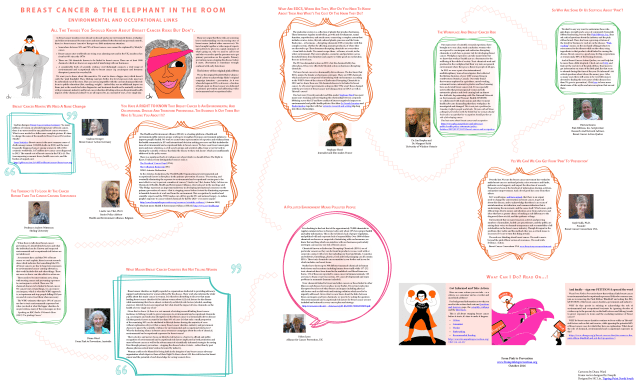
From Pink to Prevention has produced an online ‘tool-kit’ to help you understand the nature of the problem we are facing – both in terms of the links between environmental and occupational risk factors as well as the inaction of those with the power to address it. It includes an interactive webpage, PDF and poster which brings together some of the leading experts, writers and campaigners from across Europe (Belgium, France, Germany, UK), USA, Canada, Australia and the Philippines; it also includes films to watch, in-depth resources and how to take action. Please share as widely as you can.
BOOK LAUNCH MONDAY 31ST OCTOBER 6PM-8PM.
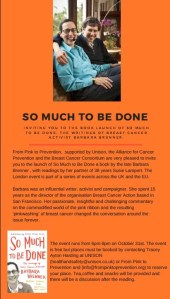 From Pink to Prevention supported by Unison, the Alliance for Cancer Prevention and the Breast Cancer Consortium, are hosting the launch of So Much to Be Done, a book of writings by the late Barbara Brenner, with readings by her partner of 38 years Susie Lampert. Barbara was 15 years as the director of the hugely influential organisation Breast Cancer Action based in San Francisco and was a leading contributor to the film Pink Ribbons, Inc.
Venue: UNISON Café 130 Euston Road London NW1 2 AY
Event is free. Please RSVP to info@frompinktoprevention.org
Tea, coffee and snacks will be provided.
SPREAD THE WORD AND SIGN OUR BIG QUESTION PETITION
We advocate that better diagnostics and treatment is not mutually exclusive with looking at how our profoundly polluted environment, homes and workplaces impact on our bodies and health, while also taking into consideration the ‘precautionary principle’ – better safe than sorry.
https://www.change.org/p/breast-cancer-charities-remove-the-pink-ribbon-blindfold-and-ask-the-big-question-3
EARLY DAY MOTION
We are delighted that Caroline Lucas MP will table an Early Day Motion to Parliament calling upon the Government to act upon the urgent inclusion of environmental and occupational risk factors into all National Cancer Plans and strategies.
It will run until spring 2017. We would like to get as many MPs signing as possible. Once our EDM is live, we will let you know!
Keep in touch and follow us on
TPFF
FACEBOOK, TWITTER
FROM PINK TO PREVENTION
FACEBOOK, TWITTER
Posters, films & books – more ways to widen the breast cancer risk-factor debate this October
From Pink to Prevention activities & toolkit this Breast Cancer Prevention Month
Dear friends, supporters and colleagues,
 As we find ourselves mid-way through the global fundraising phenomena that is Breast Cancer Awareness Month, we ask are environmental and occupational links to the disease ‘an elephant in the room’?
We want to draw attention to a breast cancer narrative that is excluded from the ‘pink’ limelight.
For decades now, scientists and activists alike have argued that the persistent exclusion of environmental and occupational risk factors for breast cancer (eg carcinogens and hormone disrupting chemicals) by government, breast cancer charities and industry is, at the very least baffling and, at worst, obstructing a basic public health right to know. We argue that the time has come for policy-makers to explain why they are refusing to acknowledge the evidence that links these risk factors to breast cancer.
Continue reading
We can’t afford to have war with Russia
I don’t think there’s much question about it. Even if they think it’s unlikely, Russia thinks war is possible enough that steps are required.
Citing routine drills, Russia has even moved missiles within striking range of NATO targets, into the Kaliningrad enclave bordering Poland and Lithuania.
And,
Meanwhile, CNN informs us that:
“Moscow abruptly left a nuclear security pact, citing U.S. aggression, and moved nuclear-capable Iskandar missiles to the edge of NATO territory in Europe. Its officials have openly raised the possible use of nuclear weapons.”
It would take black Americans two hundred and twenty-eight years to have as much wealth as white Americans have today
Everyone knows that wealth is unequally distributed. The work of Thomas Piketty has made this a mainstream concern. But the magnitude of the gap between white and black Americans is on a different scale. According to a recent report from two progressive think tanks, CFED and the Institute for Policy Studies, white households own, on average, seven times as much wealth as African-American households (and six times as much as Latino ones). The Forbes 100 billionaires are collectively as rich as all black Americans combined. At current growth rates, it would take black Americans two hundred and twenty-eight years to have as much wealth as white Americans have today.
Some of the reasons are clear: the unemployment rate among black Americans is roughly twice that of whites, and black people earn, on average, between twelve and twenty-two per cent less than white people with similar education and experience. But the wealth gap between black and white Americans is much bigger than the income gap, thanks to a toxic combination of institutionalized discrimination, persistent racism, and policies that amplify inequality. As Thomas Shapiro, a sociologist at Brandeis and the co-author of the seminal book “Black Wealth/White Wealth,” told me, “History and legacy created the racial gap. Policies have maintained it.” Together, they contribute to what he’s called “the hidden cost of being African-American.” Continue reading
Inequality and democracy
Of the features of modern society that exacerbate that fear and threaten that hope, the distribution of wealth may not be the most important. Money matters to people, but status matters more, and precisely because status is something you cannot buy. Status is related to identity as much as it is to income. It is also, unfortunately, a zero-sum game. The struggles over status are socially divisive, and they can resemble class warfare.
Basic Income for India
First, any universal programme is expensive.
For example, if we were to give every adult exactly the amount of income that defines the poverty line, which would ensure that everyone would be brought above the poverty line, calculations suggest the bill would amount to 11% of the GDP (Gross Domestic Product). This is just a hypothetical example. One can, of course, offer a lower amount per person that would be more affordable.
However, in this context, a sense of perspective is needed in discussing expenditures on programmes aimed at the poor, who by official estimates, constitute 30% of the population. Calculations suggest that if we take just twice the amounts that define the poverty line, almost 80% of the population lives below that.
Continue reading
Autumn News
Dear friends, supporters and colleagues,We hope there is something here for everyone in our autumn round-up, whether film related, campaign related – or both.
It’s been a summer where we have seen no let-up of the horrors inflicted by all sides on the people of Syria; calls to halt the sales of UK arms to Saudi Arabia as it continues its attacks on Yemen’s civilian population; Donald Trump seemingly rising in the polls; confusion after Brexit; and an unhealthy media preoccupation with Jeremy Corbyn resulting in attention to deeper domestic issues inevitably being sidelined.
But we are seeing progress in one hugely significant area. TTIP is now on the ropes. It has been a long battle – and it’s not over yet – but it proves that civil society’s determination to take on huge vested interests can pay off, as hundreds of thousands citizens across the EU who took part in the effort to stop TTIP can testify to.
We are working across a variety of projects that connect with many of the issues above. A short round-up is below. As always, a big thanks to ALL our funders – individuals and grant-makers alike.
Best wishes
From all at Tipping Point North South
FILMS TO WATCH
We Are Many is now available to buy on iTunes and DVD. The release of the Chilcot Report led to a second wave of interest in Amir’s film with numerous screenings across the UK. This included a special TPFF hosted post-Chilcot Report event at Friends Meeting House in London, home to the first anti-Iraq war movement meeting; and a special Oxford city screening with Larry Sanders, brother of Bernie, who joined Amir for the post film debate. And with the ongoing attention on Jeremy Corbyn, a contributor throughout the film, We Are Many also remains pertinent to current Labour Party debates as well as wider public debate, on the subject of UK foreign and military policy-making.
Open Bethlehem We are delighted that the English language version can now be streamed here on Vimeo. Leila’s film is now on release in Canada and the Montreal premiere was made possible with support from our Candian funding partners, Development and Peace. This follows on the heels of a successful spring /summer tour of Middle East countries, including several very special screenings in Bethlehem itself. Here’s a review describing Open Bethlehem as one of the five films to help you understand the modern Arab world. Finally, as of this month, we welcome Sara Apps, formerly Palestine Solidarity Campaign, to the Open Bethlehem team.
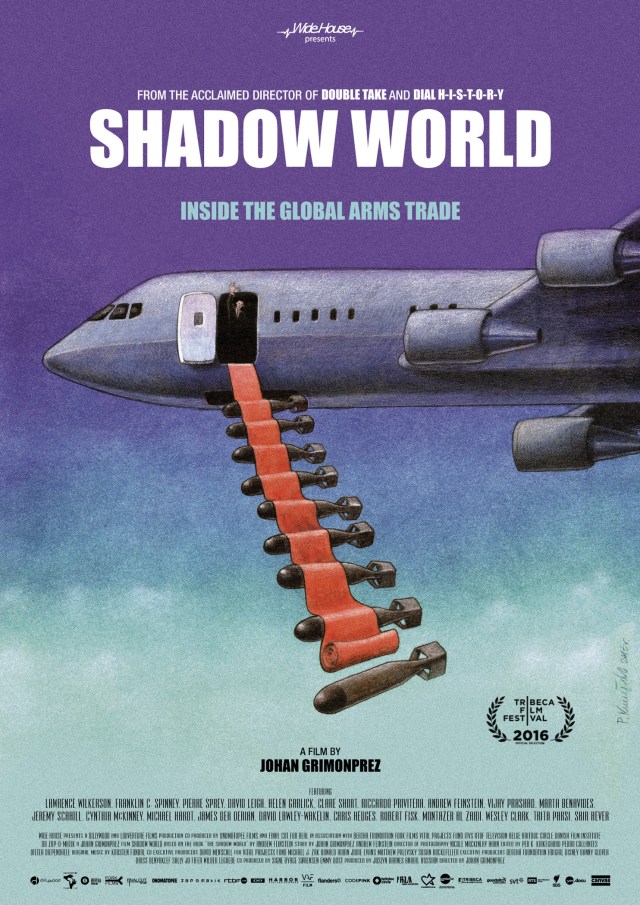
The Shadow World The Edinburgh Film Festival’s Best Cinema Documentary prize went to this eye-opening documentary about the shocking realities of the global arms trade. Director Johan Grimonprez and writer Andrew Feinstein pose the question ‘will we be allowed to choose peace over the business of war’? The film is based on Feinstein’s extraordinary book of the same name which uncovered the real cost of war, the way the arms trade drives it and how weapons are now being turned against the citizens of liberal democracies. We hope to work with this film in 2017 and in relation to our Five Per Cent campaign on runaway military spending.
Ken Loach has uploaded all his films to youtube. Start working your way through FIVE decades of utterly brilliant work…
And connected to our work this coming October Breast Cancer Awareness month, why not take a look at the brilliant work of French investigative journalist and film-maker Stephane Horel.We are looking forward to working with both her films Endocrination and Le Grande Invasion as part of our From Pink to Prevention campaign activity (more below). Stéphane has investigated the links between business, government and public health policy, with a special focus on a class of chemicals called endocrine (hormone) disruptors.
CAMPAIGNS
 Make Apartheid History We marked our first year’s activity on Mandela Day (July 18th) and released a short highlights compilation video, which was screened as part of Palestine related events at the Edinburgh Festival (Café Palestina) and Greenbelt Festival, where TPFF hosted an event showcasing our MAH work. Next year sees some significant anniversaries including 100 years since the Balfour Declaration – we are working with our MAH partners on plans to mark this and other key calendar moments in 2017.
The Five Percent Campaign The UK is now number 2 in the world’s arms sales table, thanks largely to the conflicts in Syria and Yemen. The world’s No. 1 arms dealer, the United States alone has sold more than $115 billion in weapons to Saudi Arabia under Obama’s presidency. India is on a $150bn military spending spree. Oxfam and CAAT are keeping up public and political pressure on the issue of UK arms sales to Saudi Arabia. We are calling for runaway military spending to be placed in the same category of international campaigns as debt cancellation, trade, tax and climate justice. While we continue to share 5% with our NGO colleagues here in the UK, we look forward to attending the forthcoming annual International Peace Bureau gathering in Berlin where we can share our ideas with colleagues across the world.
From Pink to Prevention Next month is October Breast Cancer Awareness Month. We will be hosting a special book launch event at UNISON on Mon 31st October with the publication of So Much To Be Done by the late American activist Barbara Brenner. We’re also producing a public awareness tool which we hope will help spread awareness about an elephant in the room – the role of environmental and occupational exposures in the global breast cancer epidemic.
More to come in our next Breast Cancer Month October newsletter.
 EVENTS
As part of our economic justice work, we have developed several new projects rooted in recent history but with a profound resonance for today. They include Attlee Nation and Attlee Festival for 2017 and Project 2018 based on Martin Luther King’s Poor People’s Campaign and Economic Bill of Rights. Both projects are now moving forward as we secure collaborations with like-minded networks and organisations which can help in the realisation of work that is rooted in the legacy handed to us by those who have come before, in the struggle for social justice.
If you would like to know more about our work, email info@tippingpointnorthsouth.org

Autumn News
Dear friends, supporters and colleagues,
We hope there is something here for everyone in our autumn round-up, whether film related, campaign related – or both.
It’s been a summer where we have seen no let-up of the horrors inflicted by all sides on the people of Syria; calls to halt the sales of UK arms to Saudi Arabia as it continues its attacks on Yemen’s civilian population; Donald Trump seemingly rising in the polls; confusion after Brexit; and an unhealthy media preoccupation with Jeremy Corbyn resulting in attention to deeper domestic issues inevitably being sidelined.
But we are seeing progress in one hugely significant area. TTIP is now on the ropes. It has been a long battle – and it’s not over yet – but it proves that civil society’s determination to take on huge vested interests can pay off, as hundreds of thousands citizens across the EU who took part in the effort to stop TTIP can testify to.
Continue reading
CAAT: UK government works ‘hand in glove’ with arms firms
The British government and the UK arms industry have a “politically intimate and hugely compromising relationship” that sees government officials working “hand in glove” with companies promoting weapons exports, according to campaigners who have tracked thousands of meetings between officials and arms trade representatives.
Officials from the government’s dedicated arms export department, the Defence and Security Organisation (DSO), attended more than 1,000 meetings since the 2010 election – more than a third of all meetings recorded by the Campaign Against Arms Trade (CAAT), which has published data on contact between the government and the arms industry.
Continue reading
Immigration and wages
In fact, we might go even further. Restrictions on free movement may actually reduce wages and workers’ standards.
Because we know from history that immigration doesn’t stop when it becomes harder. Just look at Mexico and the United States. If more EU nationals enter the UK undocumented, they will be working outside official channels, labour laws and the official minimum wage.
Continue reading
 Tipping Point North South