
Saudi Arabia / Arab Group/ G77+China Proposal for a sales tax on developed nations’ defence industries as part of a climate finance package

Saudi Arabia / Arab Group/ G77+China Proposal for a sales tax on developed nations’ defence industries as part of a climate finance package

The arms industry finds itself in the climate finance frame

At Bonn talks, G77 group floats a 5% sales tax on tech, fashion and defence firms to fund green spending in the Global South’

Climate Home News reported in the first days of the Bonn Climate Conference, the annual mid-year preparatory conference that precedes COP each year.

Early on in the conference the debate about how to fill the coffers of the new climate finance goal (NCQG) – in other words, how to move from billions to trillions (and fast) – was clearly taking priority.  While rich nations  (Annex II ) are obligated to pay for international climate finance under the Paris Agreement, they are now saying they are struggling to find the funds to do so and are calling on countries like China to step up also.

As a route to pushing this back, Saudi Arabia, endorsed by the Arab Group and G77+China offered a proposal whereby developed countries can raise $441 billion “without compromising spending on other priorities entirely by adopting targeted domestic measures” such as a “financial transaction tax”, a defence company tax, a fashion tax and a “Big Tech Monopoly Tax”.

‘Referring to the document in talks on the new finance goal yesterday, Saudi Arabia’s negotiator justified a tax on arms manufacturers by saying that military emissions of planet-heating gases represent 5% of global historical emissions. “One… potential idea is to have a tax on defence companies in developed countries,” he said, suggesting it could be put forward….  Around $21 billion a year could come from a 5% tax on the annual sales of the top 80 defense firms in developed countries, the paper says.’  Climate Home News

Credit: Climate Home News

Some eyebrows raised – was Gaza a reason?

A proposal on an arms industry tax from one of the world’s biggest arms buyers left some asking very obvious question: what’s this about?

Anabella Rosemberg and Tasneem Essop protest at the opening plenary (Photo: Kiara Worth/IISD ENB)

It certainly raised eyebrows in some quarters. Why bother to include it alongside the much bigger industries of  finance, tech and fashion? Supported by the Arab Group and G77+China, one can only wonder if the war on Gaza played some role in the inclusion of arms in this proposal. Gaza was ever present in many ways at Bonn.
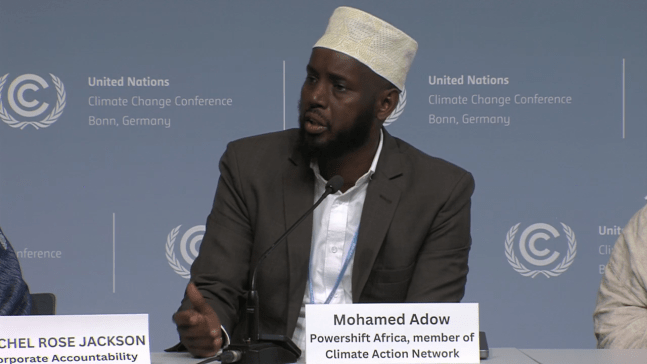
And Mohamed Adow, Director of Powershift Africa and a leading media spokesperson on climate and climate finance referenced military emissions and spending at a CAN Int’l press conference ‘ Defund the genocide.’

Inevitably the sales tax proposal was widely covered by the climate media with special interest in the arms sales tax component. There are questions that will need to be addressed concerning the arms industry aspect of the sales tax: after all, it’s not the public who procure arms as they do tech or fashion – it’s governments via  defence budgets. So how will that work? The arms companies add it to the cost and the buying governments simply pay more?

However, there remains no way to avoid the elephant in this particular room:  the oil-military-arms industry nexus. The latter are utterly dependent on the former and of course, oil has been a cause of war and instability decade in and decade out.  The proposal also does not deflect from the hard truth that Saudi Arabia is in the hottest of hot seats in relation to the ‘make polluters pay’ demands by civil society.

The idea ‘is in the air’ and we support it

The timing of the Saudi /Arab Group/G77+China Sales Tax proposal chimed exactly with our report released for Bonn ‘Excess profits tax on the arms Industry to fund climate finance.’

The G77+China proposal clearly reinforces the in-principle value of such a call. It’s time has come.

We are watching its development closely while we continue to advocate an excess profits tax, not a sales tax and one that is universal, not just levied on rich world arms companies.

Taking these differences into account, the numbers in each proposal are not far from each other – the G77+China proposal and our Transform Defence proposal arrive at very similar revenues from taxing arms companies for funding climate finance.

And critically, our call for a global arms profiteering tax is not to call into question the Paris Agreement decision that only Annex 2 – highly developed countries – should pay for climate finance. They should. And in this sense, we applaud the inclusion of the arms industry in the G77+China proposal, directed at developed country arms industries. There must be no rule change. No more disingenuous delaying tactics to avoid paying up.

Big step forward

For all of us who work to get military emissions taken much more seriously and urgently addressed alongside the interlinked (and big) problem of runaway military spending and arms industry profiteering, this proposal by Saudi/Arab Group/G77+China is a huge step forward. Any effort – especially one led by states – that places the arms industry alongside other industries such as tech, finance and fashion in the climate finance frame – is of value to the wider debate. 

Bolivian negotiator Diego Pacheco, who often speaks for the influential Like-Minded Developing Countries group, told Climate Home that

“The [argument of a] lack of public finance is not true,” he said. “There is a lot of finance available and political will is lacking.”  He suggested that developed countries should shift military budgets towards tackling climate change or tax luxury products “because luxurious patterns of consumption are also a driver of the climate crisis”.

The climate justice movement wholeheartedly agrees.

The appetite is there

Since we attended our first COP at Sharm El Sheikh in November 2022 there has been a quantum shift in awareness concerning military emissions and it has been catapulted onto the UNFCCC agenda – primarily due to Russia’s invasion of Ukraine and Israel’s genocidal war on the Gazan population. This in turn has enabled some of us to connect the emissions narrative to another: runaway military spending, and the madness of ever rising investments in war while the greatest threat to human safety – climate chaos – is de-prioritised.  


Our work has shown that the wealthiest countries (Annex II in the UN climate talks) are spending 30 times more on their militaries than on providing climate finance for the world’s most vulnerable countries.

This situation is becoming ever less tenable. From the UN Secretary General to calls by states at UNFCCC meetings, military spending vs climate finance is becoming an ever more present issue. In the call for the move from billons to trillions for climate finance, it is clear that the $2.4tr p/a spent on militaries is an ever more legitimate source to tap for climate finance. And within that, a tax on the close military spending bed-fellow: the arms industry polluters and profiteers.

This, coupled with the worldwide recognition that fair taxation is central to lifting all our societies up, from public services to climate finance, means that we are getting ever closer to putting both the arms industry and military spending in the climate finance frame.

The sooner the better.

*******

Notes

  1. TPNS’s Transform Defence project proposes an excess profits tax on the arms industry to be applied to fund climate finance needs. It estimates that a global excess profits tax on arms companies could deliver $30 billion dollars every year to fund international climate finance. In times of war, we estimate that an additional punitive excess profits tax on war profiteers could deliver considerably more. Had this war profiteers tax been applied in 2024 (for Ukraine and Gaza wars), an extra $52bn would have brought the 2024 annual total to $82 billion. This tax alone would be more than four fifths of the pledged (but never fully fulfilled) $100 billion a year climate finance by developed countries to developing countries
  2. Annex I Parties include the industrialized countries that were members of the OECD (Organisation for Economic Co-operation and Development) in 1992, plus countries with economies in transition (the EIT Parties), including the Russian Federation, the Baltic States, and several Central and Eastern European States. Annex II Parties consist of the OECD members of Annex I, but not the EIT Parties. They are required to provide financial resources to enable developing countries to undertake emissions reduction activities under the Convention and to help them adapt to adverse effects of climate change.
UK arms firms pay little tax in Saudi arms sale

The report, released by children’s charity War Child, claims that corporations, including BAE systems and Raytheon, have made an estimated $775m in profit on $8bn worth of revenue by selling arms to Saudi Arabia between March 2015 and the end of 2016.

Yet corporation tax receipts since the war in Yemen began stands at just $40m, something the NGO describes as “pitiful”.
Continue reading

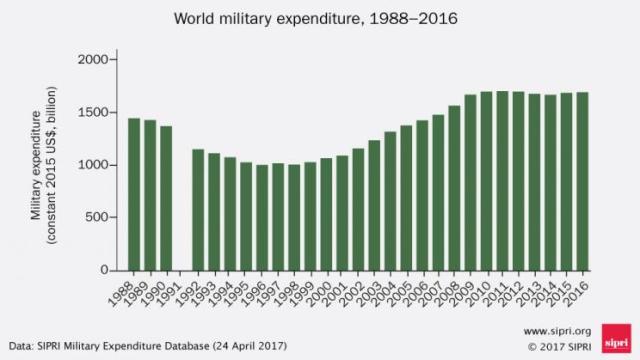
Total world military expenditure rose to $1686 billion in 2016

Military spending in North America saw its first annual increase since 2010, while spending in Western Europe grew for the second consecutive year.

World military expenditure rose for a second consecutive year to a total of $1686 billion in 2016—the first consecutive annual increase since 2011 when spending reached its peak of $1699 billion.* Trends and patterns in military expenditure vary considerably between regions. Spending continued to grow in Asia and Oceania, Central and Eastern Europe and North Africa. By contrast, spending fell in Central America and the Caribbean, the Middle East (based on countries for which data is available), South America and sub-Saharan Africa.
Continue reading

“If you ask why we’re backing this … the answer is that we weren’t going to be able to stop it.”

As Rep. Adam Schiff, minority leader of the House Intelligence Committee, said, U.S. support would be perceived “as an indicator of our willingness to push back against Iranian efforts to increase hegemony in the region [and] that may influence how comfortable they are with a nuclear agreement,” adding, “it is very important for the U.S. to have Saudi Arabia’s back when it comes to Yemen.” One anonymous Pentagon official put it coldly: “If you ask why we’re backing this … the answer you’re going to get from most people — if they were being honest — is that we weren’t going to be able to stop it.”

Continue reading

Obama administration has sold more than $115 billion in weapons to the Saudi kingdom

In addition to providing Saudi Arabia with intelligence and flying refueling missions for its air force, the United States has enabled the bombing campaign by supplying $20 billion in weapons over the past 18 months. In total, President Obama has sold more than $115 billion in weapons to the Saudi kingdom – more than any other president.

27 U.S. Senators Rebel Against Arming Saudi Arabia
https://theintercept.com/2016/09/21/27-u-s-senators-rebel-against-arming-saudi-arabia/

Health workers say stop arms sales to Saudi!

The Medact Arms Control Group:

Open letter to the Secretary of State of Business, Innovation and Skills (BIS), Sajid Javid. BIS are in charge of licensing arms sales.

STOP FUELLING THE YEMEN CONFLICT

End all UK arms sales to Saudi Arabia

It is now over a year since the recent outbreak of armed conflict in Yemen began, forcing 2.4 million people to flee their homes, and leaving over 22 million people in need of humanitarian support. The conflict has killed over six thousand people, and left the health care system on its knees.

Humanitarian agencies are struggling to respond and the country stands on the brink of famine. A senior representative of Médecins Sans Frontières (MSF) has described the current level of humanitarian assistance in Yemen as a “drop in the ocean.”
Continue reading

The Arms Trade Treaty won’t stop controversial arms deals

The Arms Trade Treaty won’t mean an immediate end to controversial arms deals like Canada’s $15 billion sale of light armoured vehicles to Saudi Arabia, says the United Nations disarmament chief.

Kim Won-soo, the UN’s High Representative on Disarmament Affairs, offered that assessment in an exclusive interview with The Canadian Press following his Monday meeting with Foreign Affairs Minister Stephane Dion. Continue reading

$33 Billion arms sales from US to 6 Gulf Coordination Council countries in just 11 months since May 2015

The six Gulf Cooperation Council (GCC) countries have received weapons including ballistic missile defense capabilities, attack helicopters, advanced frigates and anti-armor missiles, according to David McKeeby, a spokesman the State Department’s Bureau of Political-Military Affairs.

“Consistent with the commitments we made to our Gulf partners at the Camp David summit last May, we have made every effort to expedite sales. Since then, the State and Defense departments have authorized more than $33 billion in defense sales to the 6 Gulf Coordination Council countries,” McKeeby told Defense News.
Continue reading

European Parliament voted for a ban on arms export to Saudi Arabia

The European Parliament has voted in favour of an EU-wide embargo on selling arms to Saudi Arabia.

A resolution calling for a ban on all weapons sales to the country was passed by 359 votes to 212, with 31 MEPs abstaining.

The non-binding motion calls on member states to stop selling weapons to the country, which is currently conducting a widely-criticised military operation in neighbouring Yemen marked by high civilian casualties.

Continue reading

SIPRI: Dramatic increase in arms imports in the Middle East

The international transfer of weapons to the Middle East has risen dramatically over the past five years, with Saudi Arabia’s imports for 2011-15 increasing by 275% compared with 2006–10, according to an authoritative report.

Overall, imports by states in the Middle East increased by 61%; imports by European states decreased by 41% over the same period. Britain sold more weapons to Saudi Arabia than to any other country. Saudi Arabia is also the biggest US arms market and buys more American arms than British, the report shows. Continue reading

US arms sales to Saudi Arabia

Amid regional turmoil, Obama Administration officials have referred to the Saudi government as an important regional partner, and U.S. arms sales and related security cooperation programs have continued with congressional oversight. Since October 2010, Congress has been notified of proposed sales to Saudi Arabia of fighter aircraft, helicopters, naval vessels, missile defense systems, missiles, bombs, armored vehicles, and related equipment and services, with a potential value of more than $100 billion. Since March 2015, the U.S.-trained Saudi military has used U.S.-origin weaponry, U.S. logistical assistance, and shared intelligence to carry out strikes in Yemen. Some Members of Congress have expressed skepticism about Saudi leaders’ commitment to combating extremism and the extent to which they share U.S. policy priorities. Nevertheless, U.S.-Saudi counterterrorism ties reportedly remain close, and Saudi forces have participated in some coalition strikes on Islamic State targets in Syria since 2014.

Continue reading

UK – Saudi arms sales

Just over fifty years since this “Letter of Intent”, what can we learn from the history of British arms deals with Saudi Arabia?

1)      “Bribery has always played a role in the sale of weapons”

2)      The Saudi Kingdom can successfully intimidate British politicians and officials

3)      The British arms industry has extensive political connections

4)      British military equipment will be used

Continue reading

Saferworld new reports: Yemen, Afghanistan, Somalia

However, alternatives to the dominant military-authoritarian paradigm – in which militarised notions of masculinity are also a prominent feature – are available. In the discussion paper, Dilemmas of Counter-Terror, Stabilisation and Statebuilding, Saferworld provided a review of global evidence on the impacts of existing approaches, and suggested a number of constructive directions for improved policy, including:

  • Avoiding defining conflicts narrowly as problems of ‘terror’, ‘extremism’ or ‘radicalisation’, and instead adopting a more impartial, holistic and sustainable approach to resolving them
  • Changing international and national policies and approaches that fuel grievances and undermine human rights
  • Redoubling efforts for diplomacy, lobbying, advocacy and local-level dialogue to make the case for peace and adherence to international law by conflict actors
  • Looking for opportunities to negotiate peace – balancing pragmatic considerations with a determined focus to achieve inclusive and just political settlements in any given context
  • Considering the careful use of legal and judicial responses and targeted sanctions as alternatives to the use of force
  • Taking greater care when choosing and reviewing relationships with supposed ‘allies’
  • Supporting transformative reform efforts to improve governance and state-society relations and uphold human rights
  • Choosing not to engage if harm cannot be effectively mitigated and no clear solution is evident.

Continue reading

” I have never seen such destruction conducted in such a short period as in Yemen”

Many civilians continue to live in Saada, northern Yemen, despite almost daily airstrikes in the area. Michael Seawright from Auckland, New Zealand, was recently Project Coordinator for Médecins Sans Frontières (MSF) projects in the war-torn region.

“I’ve worked in war zones for the past 11 to 12 years, in some of the worst conflicts like Syria, but I have never seen such destruction conducted in such a short period as in Yemen. I was based in Saada, in the north, in a Houthi-controlled area that was experiencing almost daily attacks from Coalition air forces. These air strikes were often close to our facilities and we clearly felt their effects.

Continue reading

‘diplomatic relations and arms sales trump the lives of Yemen’s children’

According to the Campaign Against Arms Trade (CAAT), the UK has sold more than £5.6 billion of arms to Saudi Arabia since 2010, including combat aircraft worth £1.7 billion last May.

The arms trade also receives generous state backing. The UK Trade and Industry Defence and Security Organisation, which exists to promote arms sales, gets far more funding than other UKTI sectors, even though the arms trade is responsible for only 1.5 per cent of UK exports.
Continue reading

5% Digest (week 30/03/15)

Physicians for Social Responsibility’s (PRS) study concluds that the death toll from 10 years of the “War on Terror” since the 9/11 attacks is at least 1.3 million, and could be as high as 2 million.

It is heavily critical of the figure most widely cited by mainstream media as authoritative, namely, the Iraq Body Count (IBC) estimate of 110,000 dead. According to the PSR study, the much-disputed Lancet study that estimated 655,000 Iraq deaths up to 2006 (and over a million until today by extrapolation) was likely to be far more accurate than IBC’s figures.

Nafeez Ahmed argued that

total deaths from Western interventions in Iraq and Afghanistan since the 1990s – from direct killings and the longer-term impact of war-imposed deprivation – likely constitute around 4 million (2 million in Iraq from 1991-2003, plus 2 million from the “war on terror”), and could be as high as 6-8 million people when accounting for higher avoidable death estimates in Afghanistan.

Continue reading