Trident
Posted on by Lin •
Posted in Blog, The 5% Campaign, What interests us
•
Tagged Military spending, Nuclear weapons, Trident, UK
Cripin Blunt, the Conservative chair of the Commons foreign affairs committee, spoke after Angus Robertson in the debate and he said he would not be voting for Trident renewal.
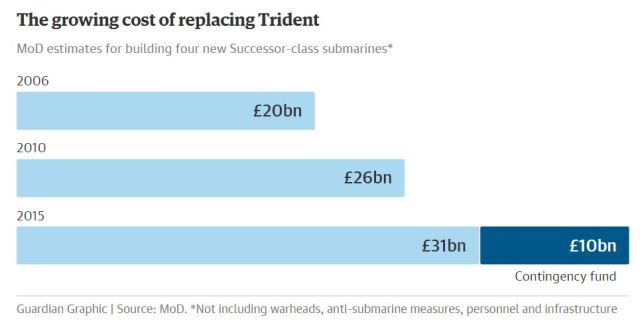
Earlier, in an intervention, he said that his current estimate was that Trident renewal would have a lifetime cost of £179bn.
- Blunt said Trident renewal would be “the most egregious act of self-harm to our conventional defence”.
Sara Flounders’ remarkable 2009 article on the Copenhagen climate meeting tied together the military and climate change, but delinking of the two persists. She wrote that “with more than 15,000 participants from 192 countries, including more than 100 heads of state, as well as 100,000 demonstrators in the streets – it is important to ask: How is it possible that the worst polluter of carbon dioxide and other toxic emissions on the planet is not a focus of any conference discussion or proposed restrictions? …the Pentagon has a blanket exemption in all international climate agreements.”
Overall, environmentalists pay little attention to the military, and the anti-war movement does not address the climate. Both squander precious time. At a slow pace, industrialized countries have been “transitioning” to clean energy since the 1960s, without any specified and enforceable time frame. Renewables remain a very small part of the energy mix and will not remedy the carbon-intensive military or industrial agriculture. Transition fuels like natural gas and biofuels have proven to be disastrous to human communities and to the climate. By contrast is the fast pace rapidly rising temperature, accelerating greenhouse gas concentration (due to amplifying feedbacks), increased military spending including nuclear weapons, and new weapons/surveillance/pacification technology.[1] At some point recently, the climate goal shifted from elimination of greenhouse gases to mitigation. Continue reading
To begin with, basic income would give us all genuine freedom. Nowadays, numerous people are forced to spend their entire working lives doing jobs they consider to be pointless. Jobs like telemarketer, HR manager, social media strategist, PR advisor, and a whole host of administrative positions at hospitals, universities, and government offices. “Bullshit jobs,” the anthropologist David Graeber calls them. They’re the jobs that even the people doing them admit are, in essence, superfluous.
And we’re not talking about just a handful of people here. In a survey of 12,000 professionals by the Harvard Business Review, half said they felt their job had no “meaning and significance,” and an equal number were unable to relate to their company’s mission. Another recent poll among Brits revealed that as many as 37% think they have a bullshit job. Continue reading
One issue that is ripe for attention is the effect corruption has on military aid programs. Providers of such assistance need to take more care to ensure that their partners are not subverting the purpose of these programs by engaging in corrupt practices.
U.S. military aid programs are a case in point. According to data compiled by the Security Assistance Monitor, this year the United States is providing over $8 billion in arms and training to 50 of the 63 nations that Transparency International has identified as being at “high” or “critical” risk of corruption in their defense sectors. …
Widespread corruption poses other serious challenges to providers of military assistance. There is a danger that tilting aid too heavily toward the defense sector can strengthen it at the expensive of civilian institutions, undermining civilian control of the military. There is a significant risk that this may be occurring among key recipients of U.S. security assistance. The Security Assistance Monitor’sassessment of dependence on U.S. military aid demonstrates that, for 2014, U.S. military aid accounted anywhere from 15% to 20% of defense expenditures of recipient countries like Egypt, Pakistan, and Burundi; over 50% in Liberia; and over 90% in Afghanistan. …
Corruption in defense assistance programs is about more than just a diversion of funds. It is also a threat to local, regional, and global security. Any effort to reduce global corruption must make cleaning up corruption in military aid programs a top priority.
Corruption in Military Aid Undermines Global Security
http://lobelog.com/corruption-in-military-aid-undermines-global-security/
President Obama has proposed granting Israel the largest package of military aid ever provided by the United States to another nation, but he and Prime Minister Benjamin Netanyahu remain deeply at odds over a figure for the assistance despite months of negotiations.
Please go on to read the whole article, link at the end.
From spending $150 million on private villas for a handful of personnel in Afghanistan to blowing $2.7 billion on an air surveillance balloon that doesn’t work, the latest revelations of waste at the Pentagon are just the most recent howlers in a long line of similar stories stretching back at least five decades. Other hot-off-the-presses examples would include the Army’s purchase of helicopter gears worth $500 each for $8,000 each and the accumulation of billions of dollars’ worth of weapons components that will never be used. And then there’s the one that would have to be everyone’s favorite Pentagon waste story: the spending of $50,000 to investigate the bomb-detecting capabilities of African elephants. (And here’s a shock: they didn’t turn out to be that great!) The elephant research, of course, represents chump change in the Pentagon’s wastage sweepstakes and in the context of its $600-billion-plus budget, but think of it as indicative of the absurd lengths the Department of Defense will go to when what’s at stake is throwing away taxpayer dollars. Continue reading
The world heaped more than $1.6 trillion on military programs and personnel in 2015, roughly 1 percent more than in 2014, a SIPRI analyst declared at the nonpartisan Stimson Center in Washington, D.C. on April 5. The increase follows four years of decline, which was preceded by 12 years of steady increases.
So the brief falloff is over, and the familiar routine is back. Continue reading
At a “state of the Air Force” press conference, Air Force secretary Deborah James and Chief of Staff Gen. Mark Welsh listed seven companies that will build components for the new plane. They didn’t provide many details as to what those contributions will be, but a quick look at the history of the companies provides some indication of how this project will be built. It also shows the program is being designed to have broad political support by spreading the work across numerous states and congressional districts.
Veteran military reformer Franklin “Chuck” Spinney described political engineering as “business as usual” for programs of this kind. “By designing overly complex weapons, then spreading subcontracts, jobs, and profits all over the country, the political engineers in the Defense Department deliberately magnify the power of these forces to punish Congress, should it subsequently try to reduce defense spending by terminating major procurement programs.”
Continue reading
Important piece.
The essence of the situation begins, but doesn’t end, with civilian control of the military, where direction, oversight, and final decision-making authority reside with duly elected and appointed civil officials. That’s a minimalist precondition for democracy. A more ideal version of the relationship would be civilian supremacy, where there is civically engaged public oversight of strategically competent legislative oversight of strategically competent executive oversight of a willingly accountable, self-policing military.
What we have today, instead, is the polar opposite: not civilian supremacy over, nor even civilian control of the military, but what could be characterized as civilian subjugation to the military, where civilian officials are largely militarily illiterate, more militaristic than the military itself, advocates for — rather than overseers of — the institution, and running scared politically (lest they be labeled weak on defense and security). Continue reading
Another way to conveniently increase the military spending while pretending otherwise.
The definition of foreign aid has been changed to include some military spending, in a move that charities fear will lead to less cash being spent on directly alleviating poverty.
The change in wording was agreed by the Organisation for Economic Co-operation and Development (OECD) after the UK and other countries lobbied to be allowed to use overseas aid budgets to support the military and security forces in fragile countries, as long as this still promotes development goals. Continue reading
There is a defense budget crisis on the horizon, but the Pentagon is hiding its head in the sand. Defense Secretary Ash Carter’s reluctance to deal with it threatens to waste billions and saddle the next president with a political time bomb before she/he even sets foot in the White House. …
According to a Jan. 27 report by budget guru Todd Harrison at the centrist Center for Strategic and International Studies (CSIS), many of the new weapon systems the Pentagon plans to build will reach their peak funding requirements at the same time, around 2022. This is known in defense jargon as a modernization “bow wave” and, given budget caps and limited resources, there will not be enough money to pay for it. Continue reading
The United States plans to spend $66 million to construct military facilities in the Philippines under the Enhanced Defense Cooperation Agreement. Continue reading
By a U.S Marine infantry veteran:
Strengthening the military is not simply a matter of demanding more taxpayer dollars for the Department of Defense. We don’t simply need more defense spending—we need smarterdefense spending. And, if Republicans want to legitimately claim to be the party of fiscal responsibility, then they must lay out robust plans to tackle waste and inefficiency within the Pentagon- not just give lip service to the issue. Continue reading
On Europe, Mr Carter said increased funds would allow greater numbers of troops to be deployed to European bases, as well as more training and exercises with allies.
“We’re taking a strong and balanced approach to deter Russian aggression,” he said. “We haven’t had to worry about this for 25 years, and while I wish it were otherwise, now we do.” …
The Pentagon’s proposed 2017 defence budget will include $3.4bn for its European Reassurance Initiative – up from $789m for the current budget year. Continue reading