
President Obama has proposed granting Israel the largest package of military aid ever provided by the United States to another nation, but he and Prime Minister Benjamin Netanyahu remain deeply at odds over a figure for the assistance despite months of negotiations.
Tag Archives: Military spending
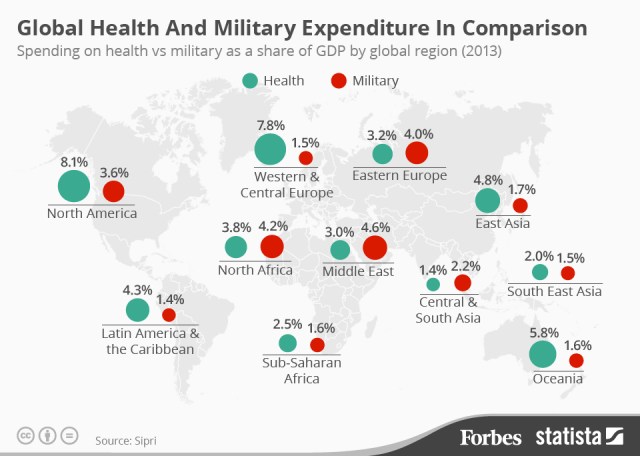
Health vs military spending as a share of GDP
The US military is smaller than it was on 9/11, but costs 50% more

F35: Better Ways to Spend a Trillion Dollars
The Pentagon’s waste and why we should do something about it
Please go on to read the whole article, link at the end.
From spending $150 million on private villas for a handful of personnel in Afghanistan to blowing $2.7 billion on an air surveillance balloon that doesn’t work, the latest revelations of waste at the Pentagon are just the most recent howlers in a long line of similar stories stretching back at least five decades. Other hot-off-the-presses examples would include the Army’s purchase of helicopter gears worth $500 each for $8,000 each and the accumulation of billions of dollars’ worth of weapons components that will never be used. And then there’s the one that would have to be everyone’s favorite Pentagon waste story: the spending of $50,000 to investigate the bomb-detecting capabilities of African elephants. (And here’s a shock: they didn’t turn out to be that great!) The elephant research, of course, represents chump change in the Pentagon’s wastage sweepstakes and in the context of its $600-billion-plus budget, but think of it as indicative of the absurd lengths the Department of Defense will go to when what’s at stake is throwing away taxpayer dollars. Continue reading
SIPRI: Global military spending is on the rise
The world heaped more than $1.6 trillion on military programs and personnel in 2015, roughly 1 percent more than in 2014, a SIPRI analyst declared at the nonpartisan Stimson Center in Washington, D.C. on April 5. The increase follows four years of decline, which was preceded by 12 years of steady increases.
So the brief falloff is over, and the familiar routine is back. Continue reading
Northrop Grumman’s B-21
At a “state of the Air Force” press conference, Air Force secretary Deborah James and Chief of Staff Gen. Mark Welsh listed seven companies that will build components for the new plane. They didn’t provide many details as to what those contributions will be, but a quick look at the history of the companies provides some indication of how this project will be built. It also shows the program is being designed to have broad political support by spreading the work across numerous states and congressional districts.
Veteran military reformer Franklin “Chuck” Spinney described political engineering as “business as usual” for programs of this kind. “By designing overly complex weapons, then spreading subcontracts, jobs, and profits all over the country, the political engineers in the Defense Department deliberately magnify the power of these forces to punish Congress, should it subsequently try to reduce defense spending by terminating major procurement programs.”
Continue reading
How Civilian Control of the Military Has Become a Fantasy
Important piece.
The essence of the situation begins, but doesn’t end, with civilian control of the military, where direction, oversight, and final decision-making authority reside with duly elected and appointed civil officials. That’s a minimalist precondition for democracy. A more ideal version of the relationship would be civilian supremacy, where there is civically engaged public oversight of strategically competent legislative oversight of strategically competent executive oversight of a willingly accountable, self-policing military.
What we have today, instead, is the polar opposite: not civilian supremacy over, nor even civilian control of the military, but what could be characterized as civilian subjugation to the military, where civilian officials are largely militarily illiterate, more militaristic than the military itself, advocates for — rather than overseers of — the institution, and running scared politically (lest they be labeled weak on defense and security). Continue reading
OECD redefines foreign aid to include some military spending
Another way to conveniently increase the military spending while pretending otherwise.
The definition of foreign aid has been changed to include some military spending, in a move that charities fear will lead to less cash being spent on directly alleviating poverty.
The change in wording was agreed by the Organisation for Economic Co-operation and Development (OECD) after the UK and other countries lobbied to be allowed to use overseas aid budgets to support the military and security forces in fragile countries, as long as this still promotes development goals. Continue reading
Obama’s final defense budget will be a huge headache for the next POTUS
There is a defense budget crisis on the horizon, but the Pentagon is hiding its head in the sand. Defense Secretary Ash Carter’s reluctance to deal with it threatens to waste billions and saddle the next president with a political time bomb before she/he even sets foot in the White House. …
According to a Jan. 27 report by budget guru Todd Harrison at the centrist Center for Strategic and International Studies (CSIS), many of the new weapon systems the Pentagon plans to build will reach their peak funding requirements at the same time, around 2022. This is known in defense jargon as a modernization “bow wave” and, given budget caps and limited resources, there will not be enough money to pay for it. Continue reading
Cutting Global Military Spending – The $1 Trillion Yellow Line That We Need To Return To
The United States plans to spend $66 million to construct military facilities in the Philippines
The United States plans to spend $66 million to construct military facilities in the Philippines under the Enhanced Defense Cooperation Agreement. Continue reading
Smarter defense spending
By a U.S Marine infantry veteran:
Strengthening the military is not simply a matter of demanding more taxpayer dollars for the Department of Defense. We don’t simply need more defense spending—we need smarterdefense spending. And, if Republicans want to legitimately claim to be the party of fiscal responsibility, then they must lay out robust plans to tackle waste and inefficiency within the Pentagon- not just give lip service to the issue. Continue reading
US ‘to quadruple defence budget for Europe’
On Europe, Mr Carter said increased funds would allow greater numbers of troops to be deployed to European bases, as well as more training and exercises with allies.
“We’re taking a strong and balanced approach to deter Russian aggression,” he said. “We haven’t had to worry about this for 25 years, and while I wish it were otherwise, now we do.” …
The Pentagon’s proposed 2017 defence budget will include $3.4bn for its European Reassurance Initiative – up from $789m for the current budget year. Continue reading
UK to spend tens of millions of pounds more to refit £1bn warships’ unreliable engines
In an email seen by the BBC, a serving Royal Navy officer wrote that “total electric failures are common” on its fleet of six £1bn Type 45 destroyers.
The Ministry of Defence said there were reliability issues with the propulsion system and work to fix it would be done to ensure “ships remain available”.
One Royal Navy officer said the cost could reach tens of millions of pounds. Continue reading
British Brimstone missile
Proving George Orwell’s dictum that “Circus dogs jump when the trainer cracks the whip, but the really well-trained dog is the one that turns somersaults when there is no whip,” significant sections of our free press and many so-called independent experts faithfully echoed the government’s official line.
“The missile uses a low-powered but highly focused explosive warhead to reduce shrapnel hitting civilians,” noted the Telegraph. “The Brimstone is capable of hitting moving targets travelling at speeds of up to 70mph” and “can be launched from an aircraft up to seven miles away from as high as 20,000 feet.” The Daily Mail transformed from a newspaper into a sales brochure: “The missile that never misses: watch the incredible moment a drone launched Brimstone hits a car moving at 70mph from seven MILES away’. The Sun was equally enthusiastic just a week before the parliamentary vote: “Raining hell on IS: RAF missile will pinpoint jihadists SEVEN miles away.” The online media watchdog Media Lens accurately dubs this kind of overexcited narrow focus on the technical aspects of weaponry as “war porn”, with the BBC a big culprit.
Continue reading
The $2 trillion redline
During the 1980s, the Cold War and the global nuclear arms race propelled total military spending in the world higher than ever before. After the fall of the Soviet Union, the idea of the “peace dividend” got hold and for a short while, it did indeed look like that was where the world was going and that global military spending would gradually normalise to a much lower level, appropriate for a reduced-conflict, non-confrontational, uni-polar world. The two biggest spenders saw the biggest drop in their spending. Russia simply could not afford the Soviet level of spending after the collapse of the Soviet Union, and its economy went from crisis to crisis, further diminishing their ability to spend. In the United States, without any notable enemy and significant military threats to their national security, military spending gradually came down while the economy boomed. It came down to the lowest point in recent history in the middle of the Clinton years. Since the USA is the largest military spending nation by far (accounting more than one thirds), it coincided with the lowest point in global military spending too.

Corbyn is right on Trident
Simon Jenkins is spot on on this:
Corbyn was right on Iraq. He was right on Syria. He is right on Islamic State. On the idiocy, waste and vacuous drivel that constitutes “the case for Trident”, he has been right. Fighting him on it just to make Labour seem macho makes no sense.
Obama SOTU 2016
The United States of America is the most powerful nation on Earth. Period. It’s not even close. We spend more on our military than the next eight nations combined. Our troops are the finest fighting force in the history of the world. No nation dares to attack us or our allies because they know that’s the path to ruin. Surveys show our standing around the world is higher than when I was elected to this office, and when it comes to every important international issue, people of the world do not look to Beijing or Moscow to lead – they call us.
How the US blew $17 billion in Afghanistan
ProPublica pored over more than 200 audits, special projects and inspections done by SIGAR since 2009 and built a database to add up the total cost of failed reconstruction projects. Looking at the botched projects collectively — rather than as one-off headlines — reveals a grim picture of the overall reconstruction effort and a repeated cycle of mistakes.
- In just six years, the IG has tallied at least $17 billion in questionable spending. This includes $3.6 billion in outright waste, projects teetering on the brink of waste, or projects that can’t — or won’t — be sustained by the Afghans, as well as an additional $13.5 billion that the average taxpayer might easily judge to be waste. Exhibit A for “You be the judge”: $8.4 billion was spent on counter-narcotics programs that were so ineffective that Afghanistan has produced record levels of heroin — more than it did before the war started.
 Tipping Point North South