TPNS participation at COP30 in Brazil

TPNS participation at COP30 in Brazil

For COP30 in Brazil TPNS activities included a new report, updated briefings and an official side event, all addressing military emissions, military spending and climate finance.

PUBLICATIONS

Report “Climate Reparations for Military Emissions

Key findingsIn this report, we estimate that the global top 20 military spenders alone are responsible for at least 10 billion metric tonnes of CO2 equivalent (tCO2e) of military-related emissions during the first quarter of the 21th century.  This has accrued from the US$40 trillion spent on their militaries since 2001. We estimate that collectively they owe the world, especially the poorest and the most climate vulnerable countries, US$2.67 trillion in reparation for their military-GHG-emission-related climate costs (as measured by the social cost of carbon). This is more than 8 times the new climate finance pledge of US$300 billion to developing countries set at Baku COP29.

This report includes our work on the reparations owed by Israel to Palestine from 1948 to the present day genocide, co-authored with The Palestinian Institute for Climate Strategy.

Briefing “Climate Collateral (2025 update): Why the military’s impact on climate change can no longer be ignored”

The struggle for climate justice is increasingly overshadowed by a global arms race even though global temperatures are reaching record highs. States that should be working together to invest in urgent climate action are instead spending record sums on the military (over $2.7 trillion in 2024). This spending produces huge emissions, drains resources from climate action, and escalates geopolitical tensions that make multilateral climate action more difficult. Published by Tipping Point North South jointly with the Transnational Institute and Stop Wapenhandel.

BLUE ZONE OFFICIAL SIDE EVENT

DISARMING THE CLIMATE CRISIS: THE TRUE COST OF MILITARISM

13 NOVEMBER

This official side event, co-hosted by IPPNW, Peace Boat, Peace Track Initiative, and WILPF brought together diverse speakers that addressed the deep connections between militarism and the climate crisis — from hidden military emissions and the vast gap between military spending and climate finance to the catastrophic risks nuclear weapons pose to the planet. The event concluded in spotlighting avenues for peace and climate justice – including the Fossil Fuel Treaty to the Global Energy Embargo for Palestine.

Deborah Burton’s contribution was addressing the urgent need to fund public climate finance over military spending.

Read transcript here.

This side event followed on from a press conference the previous day: Disarming the Climate Crisis: Putting Militarism on the Agenda at COP30

ECO ARTICLE  

Day 5 COP30

ECO is Climate Action Network’s (CAN) widely read daily newsletter is distributed on the ground to delegates each morning, and is an important advocacy tool for civil society.  As an active member of the Peace and Demilitarisation Working Group of the Women and Gender Constituency, TPNS contributed to the drafting of Militarism is fueling the climate crisis– COP must confront it.

We call for: (i) Stepping up ambition: Include military emissions in updated NDCs before COP31 (ii) Reallocation of military budgets: redirect spending to close the climate finance gap (iii) Integration of peace and justice: recognise that true climate justice cannot coexist with war and structural violence. Ending militarisation begins with stopping aggressors and demanding accountability.

https://climatenetwork.org/resource/eco-5-cop30/

QUNO PRESS CONFERENCE

Our colleague at Quaker UN Office (Geneva) Lindsey Fielder Cook spoke on the interconnections between peace and climate change at a COP press conference organized by the Interfaith Liaison Committee, addressing in part, the issue of military emissions and spending. The press conference can be viewed here.

Also Deborah participated in a webinar organised by QUNO just before COP.

FLAGGED AT THE COP30 OPENING CEREMONY BUT NOT – YET ANYWAY – ON THE OFFICIAL UNFCCC AGENDA

“Spending twice as much on weapons as we do on climate action is paving the way for climate apocalypse. There will be no energy security in a world at war.” — President Luiz Inácio Lula da Silva, Leaders’ Summit.

At the Opening Summit of COP30, President Lula condemned massive global military spending as a misallocation of resources that should instead be channelled into climate solutions for global south countries. He said:

“If the men who wage war were at COP30, it would be much cheaper to spend $1.3 trillion a year to end the climate problem than $2.7 trillion to wage war as they did last year.”

Outside the formal negotiation rooms, momentum kept growing on the recognition of the intersections between militarism and the climate crisis– from multiple official side events, press conferences, radical spaces at the People’s Summit, staged actions and protests, and coverage in outlets from ECO to the Guardian.

Colombia’s President Gustavo Petro called out NATO members’ commitment to allocate 5% of their GDP to “investing in more weapons,” arguing that Russia is not the enemy; the climate crisis is the enemy.” Latvia’s President Edgars Rinkēvičs highlighted that Russia’s invasion of Ukraine “takes away human lives and inflicts harm on nature,” while also “limiting climate investment as resources are redirected to defense spending.” Honduras’ President Xiomara Castro called for the cessation of all wars devastating the planet and demanded accountability for the genocide against Palestinians, presenting this as part of her seven-point climate justice proposal launched at COP29.

Despite the undeniable real-world impacts of militarism on the climate—from Ukraine to Gaza—the rising strength of climate and peace movements exposing these intersections, and even world leaders’ acknowledgments of the issue, this reality has yet to enter the official negotiation spaces of the climate talks.

Perhaps Turkey – COP31 – is where that will change and the military-fossil fuel complex will be fully in the spotlight.

This is what we work towards in the coming year.

COP30 BRIEF NEWS ROUNDUP

Finance outcomes at COP30 were deeply inadequate. ‘Developed’ countries repeatedly refused to provide the finance required across adaptation, mitigation, and the just transition, weakening the overall outcome and undermining trust rooted in their historical obligations. Parties have left Belém with no meaningful action but a vague pledge to triple adaptation finance by 2035, and a lack of commitments to grant-based, non-debt-creating finance. For communities bearing the brunt of the crisis, these outcomes bring no hope.

Equally disappointing is the absence of a global response to the so-called ‘ambition gap,’ exemplified by countries’ lack of concrete plans to phase out fossil fuels. The final COP30 decision offers no roadmap for a just, equitable, and fully financed transition away from fossil fuels—a stark failure of the only existing multilateral process tasked with addressing the climate crisis.

Read More:

TPNS activities for COP30 supported by Movement for the Abolition of War.

https://climatenetwork.org/2025/11/22/cop30-takes-a-hopeful-step-towards-justice-but-does-not-go-far-enough/

https://oilchange.org/news/cop30-makes-progress-on-just-transition-but-misses-on-everything-else/

https://www.theguardian.com/environment/2025/nov/27/beyond-the-negative-headlines-some-truly-good-things-came-out-of-cop30

https://theconversation.com/cop30-five-reasons-the-un-climate-conference-failed-to-deliver-on-its-peoples-summit-promise-269750


New publications: Report “Climate Reparations for Military Emissions” and Briefing “Climate Collateral (2025 update)”

New publications: Report “Climate Reparations for Military Emissions” and Briefing “Climate Collateral (2025 update)”

We published the following two publications for COP30:

Report “Climate Reparations for Military Emissions” and

Briefing “Climate Collateral (2025 update): Why the military’s impact on climate change can no longer be ignored” Continue reading

New Briefing: Military & Conflict-Related Emissions & Climate Reparations for Palestine

New Briefing: Military & Conflict-Related Emissions & Climate Reparations for Palestine

DOWNLOAD PDFs: Briefing (executive summary) and Full Paper.

Military & Conflict-Related Emissions & Climate Reparations for Palestine prepared by Tipping Point North South and the Palestinian Institute for Climate Strategy.

In this research the historic military and conflict-related emissions of the 77 years of Israel’s occupation of Palestinian land since its founding in 1948, culminating in the ongoing genocide of Palestinians for nearly two years is quantified. By applying the monetary measure ‘the social cost of carbon’, that is, the long-term social and environmental damage done by emitting one additional tonne of carbon, the paper calculates the climate reparation owed by Israel to the Palestinian people as a result of these historic military and conflict-related emissions.

KEY FINDINGS

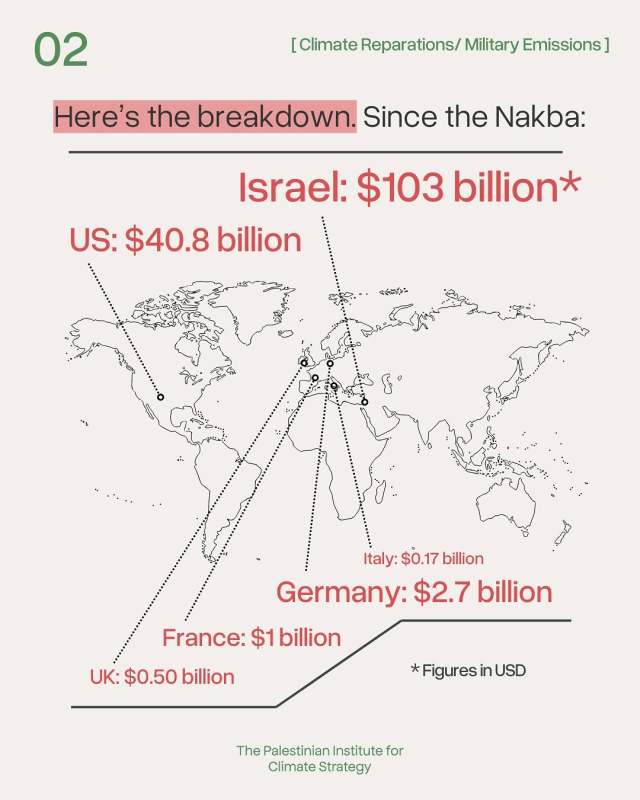
To date, the total estimated amount of the military and conflict-related climate reparations owed by Israel and its allies to the Palestinian people since the Nakba is US$148 billion. Of this,

  • Israel is responsible for US$103 billion.
  • The U.S. is responsible for US$40.8 billion.
  • Israel’s allies share further responsibility: Germany US$2.7 billion, France US$1 billion, the UK US$0.5 billion, and Italy US$0.17 billion.

These figures represent the measurable climate liability of military and conflict-related emissions. Yet, as this briefing makes clear, they capture only one entry point into the broader reparations reckoning for Palestine, which must also encompass the wider harms of occupation, genocide, ecocide and systemic destruction of Palestinian life. Many of these aspects are beyond what we can quantify in simplified carbon metrics, and we must not lose sight of this complexity in rebuilding just futures for Palestine. Continue reading

TPNS at Bonn Climate Change Conference (16-26 June 2025)

TPNS at Bonn Climate Change Conference (16-26 June 2025)

Disappointingly, applications for side events addressing military emissions and spending were not accepted this time round at Bonn. Yet with military spending at an all time high, NATO’s future plans for even higher spending, genocide ongoing in Palestine and the war in Ukraine with no end in sight, military related issues were present ‘on the ground’ if not on the agenda.

TPNS attendance made possible with support from the Movement for Abolition of War and Quaker UN Office.

TWO REPORTS PUBLISHED FOR BONN


NATO’s 3.5% Spending Goal: Unsustainable on Every Count. New analysis by Tipping Point North South, TNI and Stop Wapenhandel shows NATO’s rapid military build‑up is already undermining global climate goals and threatening to divert trillions from clean‑energy investment.

https://transformdefence.org/publication/natos-3-5-spending-goal/

The alarming rise of false climate solutions in Africa ― the nuclear energy misadventure has been prepared by campaigners as a collective advocacy report with a number of strong recommendations that reflect the breadth of civil society’s shared concerns about the development of nuclear energy across the continent. They are united in a call for a nuclear free Africa, safe from the dangers of nuclear energy and instead building a future powered by clean, affordable solutions.

https://transformdefence.org/publication/the-nuclear-energy-misadventure/

BONN MEDIA COVERAGE NATO REPORT

Our German co-publisher IPPNW secured this article in German magazine Stern.

https://www.stern.de/politik/ausland/was-die-nato-aufruestung-fuer-den-planeten-bedeutet—exklusive-studie-35816548.html

Our TNI co-author Nick Buxton secured an op-ed for Al Jazeera about the danger of NATO’s 5% target, based on the briefing’s analysis.

https://www.aljazeera.com/opinions/2025/6/26/natos-5-percent-spending-pledge-is-a-threat-to-people-and-the-planet

BONN EVENTS: MILITARY SPENDING & EMISSIONS

Interfaith Liaison Committee Press Conference

Deborah was invited to speak on military spending and climate finance at the Interfaith Liaison Committee press conference for the launch of their Climate Justice Call to Action

Deborah’s contribution here.

CAN Intl Press Conference on Palestine/End the Siege 

CAN International held a packed press conference to address the UNFCCC Secretariat’s censorship of Palestine solidarity actions, specifically the phrase “end the siege”. Deborah was able to raise the issue of Israel’s doubling of its military spending in one year; also referencing Israel’s attacks on Iran.

More on this issue: https://climatenetwork.org/2025/06/21/unfccc-censorship-of-palestine-solidarity-ngos-at-bonn-sb-62-call-out-moral-crisis-within-the-un-climate-process-2/

Disarming the Climate Crisis – Climate Camp

The climate camp runs a programme of activity in parallel to the main conference.  Organised by the Peace and Demilitarisation working group the session looked at the impact of rising military spending  on the MENA region specifically and the global south more widely. Hosted by Laura Wunder from IPPNW Germany, with speakers Fatemah Khafegy and Deborah Burton. (An article based on this session is being drafted)

BONN EVENTS: NUCLEAR ENERGY IN AFRICA

There was a side event held in the first week to promote nuclear power across Africa with speakers from the International Atomic Energy Agency (IAEA) and the Economic Commission for Africa. To a packed room we asked two direct questions to both speakers (i) that nuclear energy will severely crowd out already precious and inadequate climate finance for mitigation, adaption and renewable energy generation projects and (ii) the grave concerns that many NGOs have about the lack of capacity to manage nuclear power plants safely and securely.

Thirty copies of the report Exec Summary were handed to attendees.

MEDIA COVERAGE of the report across the African continent has been extensive. Continue reading

SPRING NEWS: Nakba 77+ new publications +media + climate conference

SPRING NEWS: Nakba 77+ new publications +media + climate conference

Dear Friends,

We hope this email finds you well as we share our recent news and activities with you. During the COVID times, when TPNS decided to focus on climate related work with specific reference to the global military, we were in different times. We could not have foreseen the Russian invasion of Ukraine nor – no matter how horrendous the Israeli occupation had been up to October 7th 2023 – Israel’s decision to implement a genocidal war designed to utterly destroy Gaza and the elimination, one way or another, of Palestinians from their homeland.

The world is now in an insane arms race – $2.4tr annually and rising – and the climate emergency along with basic international development, global health and public services all in the process of being relegated to second place, behind rearmament and talk of WW3.

In every way, we are in dark times.  And the biggest threat to our collective safety – climate chaos – is dropping off the radar.

How on earth can this be?

As ever, it will be down to the tenacity, courage, vision and organising power of civil society where-ever it may be, to push back even harder, despite the deep sadness, despondency and overwhelming scale of the opposition faced – from authoritarian governments locking up climate protesters to genocide-enabling politicians; from amoral and greedy corporate elites to shameless oligarchs.

We have no choice but to resist and to keep hope alive – for the generations to come and for our beautiful blue planet.

Deb & Ho-Chih Continue reading

Sharing this year’s news & progress that is bittersweet

Sharing this year’s news & progress that is bittersweet

Dear friends and supporters,

We hope this e-news roundup finds you well as we approach the holiday season. We have had a busy year taking our work on military emissions and spending to more new audiences internationally.  Wider global civil society is now including military spending as part of its overall climate finance demands and military emissions are now widely acknowledged as a significant contributor to climate change inside the COP space.

But in 2024 it was the genocide in Gaza that brought the intersection of militarism and the climate emergency into the wider civil society arena. Just as our film We Are Many illustrated how the Iraq War mobilised a new generation on anti-war protest, so both Ukraine and Gaza have combined to bring this issue of military emissions and war-spending to the wider climate justice movement.

The challenge now is two-fold:  pushing forward on the various routes identified to get nations to fully report their military emissions and for the UNFCCC to play its part in making that happen; and coupled with this developing the policy and advocacy work that will enable more nations to engage with the sensible – and urgent – calls for the wasted military spending trillions to instead be spent on climate finance.

From presentations to publications to events, this year has proven to be productive and the highlights below give a sense of the progress being made. However, we could not do it without support from our funders and individual donors. Thank-you.

So as we end this year, our thoughts are with the people of Gaza.  We cannot begin to imagine how much they want the horror to end.  Find out how you can support Medical Aid for Palestinians here.
Continue reading

TPNS Participation at COP29

TPNS Participation at COP29

TPNS PARTICIPATION AT COP29

As many predicted, on the main issue of climate finance for global south countries, COP29 was indeed the failure many dreaded.  Rich nations held to their position that they were unable to reach the public funding levels needed and – as feared – ended up relying on private finance and loans to shore up their paltry and insulting $300bn in order to reach the $1trillion plus annually needed.  A far cry from the necessary and just  $5tr annually called for by global civil society.

On phasing out fossil fuels, again, the full on commitment that was needed was not to be found.  The oil lobby and Saudi Arabia led the charge to row back on Dubai COP28 commitment. This, combined with the finance failure, led to deep disappointment and anger on the part of not just civil society but many regional groupings and governments as well.

However, on the topic of military emissions and – vitally – military spending – it was clear that both are now widely recognised as important elements of the mitigation as well as the climate finance debates. Wider global civil society is now including military spending as part of its overall climate finance demands at COP;   a number of states also linked military spending to climate finance.

It was very encouraging to see the relevance of public military spending to the climate finance demands made loud and clear at this COP2 and for TPNS to play its part in this issue ‘breaking out’ inside the official COP space. Deborah Burton attended the first week on behalf of TPNS and her attendance was supported by Movement for the Abolition of War. Continue reading

Military emissions, military spending & the “COP of peace”

Military emissions, military spending & the “COP of peace”

To be a true ‘COP of Peace’ Baku needs to acknowledge the ‘hard’ issues that impact on peace, the climate emergency and climate finance.

Both recent civil society Global Weeks of Action (Payup and Phaseout 13-20 Sept) and (Peace and Climate Justice 21-28 Sept) timed to coincide with the UN Summit for the Future and UN General Assembly included urgent calls to address the impact of military emissions and spending on the climate agenda. With COP29 just a month away, we need to look at ‘COP of Peace’ and Azerbaijan’s ‘Joint Solemn Appeal for a COP29 Truce’.

The truce itself is a very timely wish, given relentless Israel’s bombardment of Gaza and now Lebanon, of Russia’s ongoing invasion of Ukraine and the ever-worsening and desperate humanitarian catastrophe in Sudan. The Geneva Academy charts the sorry state we are in: Middle East and North Africa have 45 armed conflicts ongoing; Africa, 35 armed conflicts; Asia 21 armed conflicts; Europe has seven armed conflicts; Latin America: six armed conflicts.

With social media and 24/7 news coverage, it is impossible not to know, not to see, the horrendous impact of war and conflict on men and women; infants and children; the elderly and the disabled.

To add to this, the global military carbon footprint (including its supply chain) is estimated to be around 5.5% of global GHG emissions. This figure does not include conflict emissions or post-conflict reconstruction. Researchers estimate the GHG emissions burden of the Russian invasion of Ukraine is currently estimated to be 175 million tCO2e. Latest research on Israel’s war on Gaza estimates the emission burden of 60 million tCO2e. As a result, since COP27 in Egypt, conflict-related GHG emissions have been included in the official COP programme and are now being referenced in negotiations.

How will Azerbaijan advance this? Continue reading

New publications & UN Summit of the Future

New publications & UN Summit of the Future

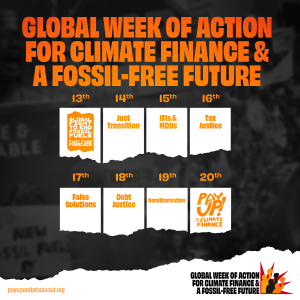
September sees two major Global Weeks of Action – the Global Week of Action for Climate Finance and a Fossil-Free Future (13-20 Sept) and the first Global Week of Action for Peace and Climate Justice (21-28 Sept). Both address the global military’s role and responsibility in both GHG emissions and runaway military spending as an urgent source to tap for climate finance.

TPNS’s Transform Defence project released two publications to mark these international weeks of action, and, notably, also to mark the UN Summit of the Future.

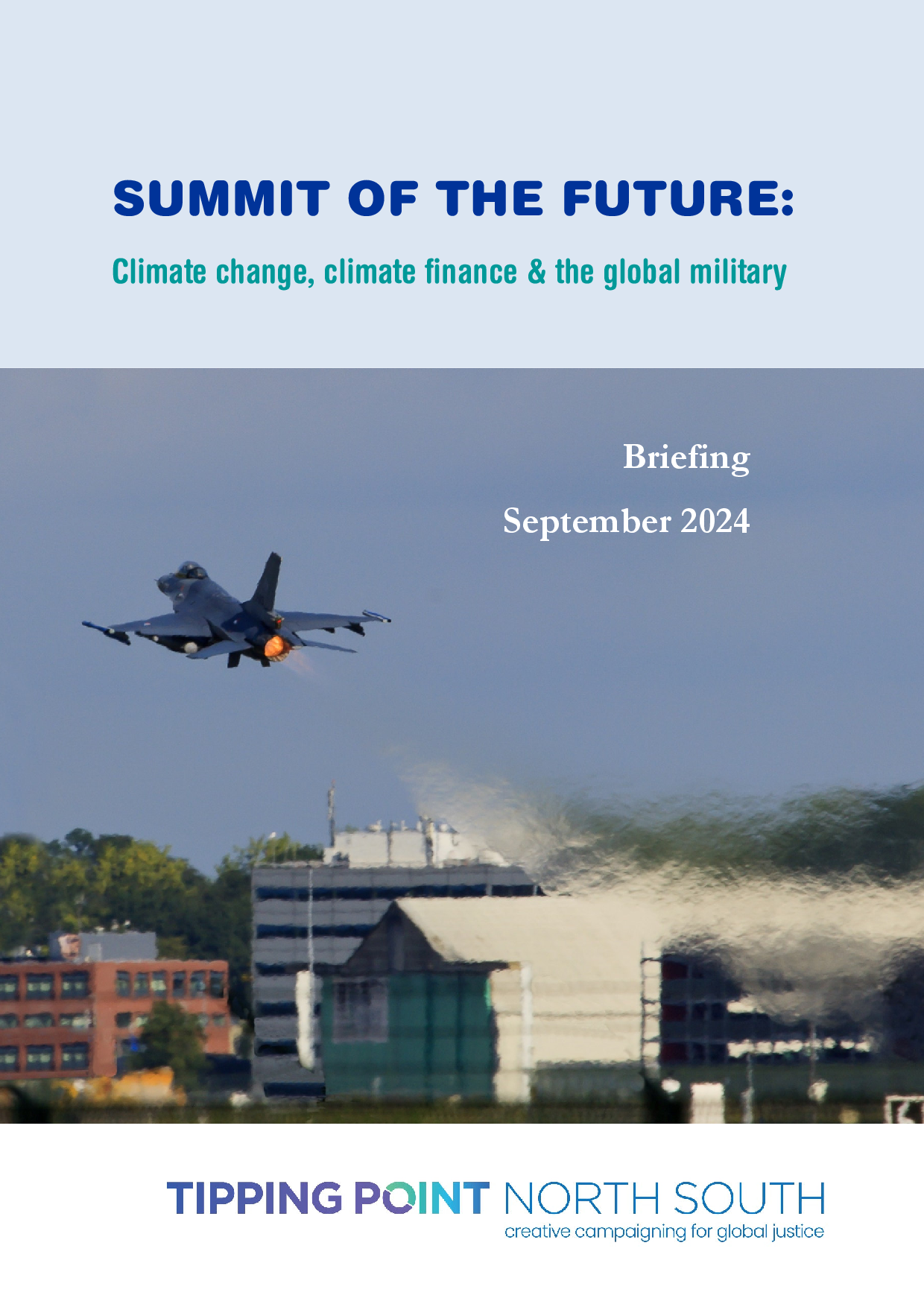
UN SUMMIT OF THE FUTURE: Climate Change, Climate Finance and the Global Military

As the world gathers for the UN Summit of the Future followed by the General Assembly debate, peace and co-operation is at the heart of much of the discussion.

Urgent pressure needed to address the role and responsibility of runaway military expenditure in the climate emergency through the allocation of trillions of dollars to fossil-fuel reliant militaries and associated (supply-chain) industries instead of climate finance.  This briefing was prepared and shared with many of the delegates to the Summit.

WORKING NOTES JOURNAL

‘War and Peace—Exploring Irish Neutrality

Published by the Jesuit Centre for Faith and Justice

Overturning the economics of war to deliver a co-operative future and peaceful green prosperity

This essay was commissioned by Working Notes and explores the ecological aspects of conflict—with a particular focus on the carbon dioxide emissions associated with the military—through an economic lens. It asks what must be done to change course if humanity and our home planet is to reverse the current trajectory.

Global Week Of Action For Peace & Climate Justice

Global Week Of Action For Peace & Climate Justice

21-28 September 2024

This first annual week of action for peace and climate justice runs from 21-28 September. More than 50 events are planned in countries including Australia, the Democratic Republic of Congo, Germany, Malawi, Mexico, India, the Netherlands, Sweden, the UK and the USA, as well as many online.

The week of action aims to raise awareness of the links between war, militarism and climate injustice. It also coincides with the UN Summit of the Future.

Find out more and how to take part https://climatemilitarism.org/weekofaction/.

THIS YEAR’S THEME: DIVEST FROM WAR – INVEST IN CLIMATE JUSTICE

The world’s wealthiest countries have consistently failed to meet targets to provide $100 billion in climate finance to help countries suffering the worst impacts of climate breakdown. Meanwhile, there always money for war: in 2023 global military spending rose for the ninth year in a row, reaching a record high of $2.44 trillion (an increase of 6.8 per cent in real terms from 2022). 2023 also saw the hottest day – highest global temperatures – ever recorded.

The week of action is being facilitated by a sub-committee of the Arms, Militarism and Climate Justice Working Group. Continue reading

Global Week Of Action For Climate Finance And A Fossil-Free Future

Global Week Of Action For Climate Finance And A Fossil-Free Future

As we head towards COP29, the issues of climate finance and a fossil fuel phase-out towards a just energy transition are ever more critical for climate action. The upcoming UN General Assembly, the UN Summit of the Future and the Global Renewables Summit all taking place one after the other in September provide an important opportunity to reiterate our demands and escalate public pressure to compel governments, international institutions and corporations to listen and take action.

The governments of the Global North have consistently failed for decades to undertake their fair share of climate action both domestically and internationally. This fair share includes the delivery of climate finance for the Global South, an obligation that they committed to as parties to the UN Framework Convention on Climate Change. Climate finance is also part of reparations for climate debt they owe to the people of the South for historical and continuing harms caused by their disproportionately large contributions to the climate crisis.

https://payupandphaseout.org/

September 19th – Demilitarisation Day of Action

Pay Up and Phase Out.

The global military – in peace and war – is a significant contributor to climate change. And these emissions correlate to ever rising military spending on fossil fuel reliant hardware.

Increasing militarisation of world affairs is not the answer to climate change – it is at the heart of the problem. There can be no secure nation without a climate-secure planet.

Urgent pressure is needed to address the role and responsibility of runaway military expenditure in the climate emergency through the allocation of trillions of dollars to fossil-fuel reliant militaries and associated (supply-chain) industries instead of climate finance.

Global North governments should end public subsidies for fossil fuels. Tax systems should be reformed, so polluters and profiteers pay their dues.

And with the expansion of a fossil fuelled global arms race well underway and new ‘cold war’ rhetoric rising again, the vast amounts of government spending on weapons and military operations that harm people, destroy the environment while also being a massive source of carbon emissions, should be diverted towards programs for climate justice and our planet’s security.

The various materials below mark this Global Week of Action and Day of Action on Demilitarisation

Summit of the Future: briefing & accompanying letter to UN General Secretary

Download: “TPNS BRIEFING SUMMIT OF THE FUTURE 2024 [PDF]

Released September 18th with an accompanying letter to the UN Secretary General. Continue reading

Summer e-news

Summer e-news

Dear friends and supporters,

The world still waits for ceasefire in Gaza even as Benjamin Netanyahu is welcomed to the heart of USA government; the war in Ukraine still sees no end in sight; and commentary about the new axis powers and looming WW3  is getting more and more media coverage.This is the state we are in. World leaders knowingly asleep at the wheel as climate chaos looms, teaching us what we know already – that climate change has no respect for national borders.

We are in desperate need of substantially more international co-operation, not conflict. Vastly increased levels of diplomacy, not war. We need massive cuts to GHG emissions (military emissions in peace and war included) and vastly increased investment in climate finance across the board  if we are to avoid the  continued overshooting of 1.5 degrees of warming on planet earth.

As Antonio Guterres is repeatedly saying:
At a time when we see rising hunger, growing poverty & a lack of financing to address the climate crisis, it’s shocking to see military expenditure reaching an unprecedented high—$2443 billion in 2023, according to @SIPRIorg. It’s time to stop running towards mutual destruction.

We live in hope.
Deb & Ho-Chih Continue reading

Presenting military emissions and spending to the Degrowth community

Presenting military emissions and spending to the Degrowth community

It was a pleasure to be part of the Joint Conference of the International Degrowth Research Networks and the European Society for Ecological Economics in Pontevedra, Spain 18 to 21 June 2024.

With an attendance of more than 1100 people from 48 different countries, the conference had the participation of academics, activists, students and teachers of secondary education.

Deborah Burton joined Corinne Lamain to present the sessionDegrowing the military: reducing military emissions and rethinking responses to socio-ecological conflicts.’ Continue reading

Bonn Climate Conference attendance + arms industry tax & military spending filtering through

Bonn Climate Conference attendance + arms industry tax & military spending filtering through

The Bonn UN Climate Change Conference is a midway point in each year in the lead up to the annual COP. It serves as the mid-year meeting of the Subsidiary Body for Implementation and the Subsidiary Body for Scientific and Technological Advice. This year, 7000 delegates attended from governments, UN, civil society and media.

For our work on military emissions and military spending, it has become an important calendar moment and we attended our second Bonn conference in June 2024. We were able to deepen conversations started at previous gatherings (COP, Bonn, CAN International) as well as develop new climate finance conversations. Both military emissions and military spending were widely referenced and the latter gives hope we are making progress in getting it included in the climate finance debate.

However, overall, Bonn concluded after two weeks of intensive work across a range of issues where the urgent progress needed on GHG reductions and climate finance failed.

“We’ve taken modest steps forward here in Bonn,” said UN Climate Change Executive Secretary Simon Stiell in his closing speech. “[But] too many items are still on the table… We’ve left ourselves with a very steep mountain to climb to achieve ambitious outcomes in Baku.”

Genocide in Gaza

For civil society attending Bonn, the war on Gaza could not be ignored. It became centre stage when a protest was made inside the opening plenary to draw attention and which was picked up by media around the world.

Anabella Rosemberg and Tasneem Essop protest at the opening plenary (Photo: Kiara Worth/IISD ENB)

Military emissions

Given Gaza and Ukraine, it was concerning – and surprising – that Bonn did not accept any one or more of the four side events proposals on military emissions submitted by parties (governments) or civil society NGOs , bringing an abrupt halt to the progress we and others had hoped to build on at Bonn. This as the world has witnessed genocide in Gaza, and the was in Ukraine still ongoing. Side events remain vital to the introduction of new research and advocacy to delegates and this Bonn saw new emissions work released on both Gaza and Ukraine.

Nevertheless, military emissions are now being noted inside the formal negotiations and more widely, in general conversation, including as context for an arms industry sales tax (more below).

Climate finance, military spending + a sales tax on the arms industry

Arms industry tax proposal

‘At Bonn talks, G77 group floats a 5% sales tax on tech, fashion and defence firms to fund green spending in the Global South.’  Climate Home News

Early on in the conference, the debate about how to fill the coffers of the new climate finance goal – in other words, how to move from billions to trillions (and fast) – was clearly taking priority.  While rich nations are obligated to pay for international climate finance under the Paris Agreement, they are now saying they are struggling to find the funds to do so and are calling on countries like China to step up also. To take the initiative back, Saudi Arabia, endorsed by Arab Group and G77+China offered a proposal whereby developed countries can raise $441 billion “without compromising spending on other priorities entirely by adopting targeted domestic measures” such as a “financial transaction tax”, a defence company tax, a fashion tax and a “Big Tech Monopoly Tax”.

‘Referring to the document in talks on the new finance goal yesterday, Saudi Arabia’s negotiator justified a tax on arms manufacturers by saying that military emissions of planet-heating gases represent 5% of global historical emissions.“One… potential idea is to have a tax on defence companies in developed countries,” he said, suggesting it could be put forward….  Around $21 billion a year could come from a 5% tax on the annual sales of the top 80 defense firms in developed countries, the paper says.’  Climate Home News

A proposal on an arms industry tax from one of the world’s biggest arms buyers, not to mention oil producers, certainly raised eyebrows in some quarters. It is supported by the Arab Group and G77+China and one can only wonder if the war on Gaza played some role in the inclusion of arms in this proposal.

The Saudi /Arab Group Sales Tax proposal resonated with our newly released report and reinforced the value of the call. We believe the inclusion of the arms industry in the sales tax proposal is a significant step in the right direction and will watch its progress closely. We remain committed to our excess profits tax idea which taxes 100% excess profits, not just 5% on sales, and which is universal, not just levied on rich world arms companies.

Military Spending at Bonn

Press Conferences

TPNS has worked hard to advocate for military spending to be part of the climate finance demands within the larger climate networks. Several of the Climate Action Network press conferences saw military spending & climate finance referenced to a packed media room.

Mohamed Adow, Director of Powershift Africa and a leading media spokesperson on climate and climate finance referenced military emissions and spending at a CAN Int’l press conference on Gaza.

Side Events

Military spending as (a) a comparison with and/or (b) a potential source to tap for climate finance was also referenced in a good number of NGO hosted climate finance side events.

Interfaith dialogue / strategy group

TPNS was able to make a presentation to this important group in their discussion on preparing for COP29.  Deborah was invited to speak about the links between war, climate and military spending.

Media

TPNS and publications at Bonn


Our attendance at Bonn is made possible with support from the Movement for Abolition of War and the Quaker UN office.

Press Commentary

https://www.theguardian.com/environment/article/2024/jun/21/climate-activists-bemoan-scant-progress-on-finance-as-cop29-looms

https://climatenetwork.org/2024/06/13/sb60-press-release-climate-action-network-outcome-reaction/

https://www.climatechangenews.com/2024/06/10/bonn-bulletin-crunch-time-for-climate-finance/

COP28 to COP29: Webinar for Movement for Abolition of War

COP28 to COP29: Webinar for Movement for Abolition of War

Deborah was invited to share her experience of the recent COP28 in Dubai with specific reference to TPNS events on military emissions and spending, and to reflect on the activities throughout 2024 which will deepen awareness and action on both issues as we move towards COP29 in Azerbaijan.

MAW is a supporter of TPNS activities at the annual climate conferences in Bonn and COP.

Webinar here: https://abolishwar.net/From-COP28-to-COP29/

Continue reading

TPNS at Climate Action Network annual meeting

TPNS at Climate Action Network annual meeting

TPNS was delighted to be invited to speak and participate at the Climate Action Network’s Annual Strategy Meeting, held in February in Mombasa, Kenya. We took the issue of military emissions, spending and climate finance into a number of key spaces at the conference including a panel presentation on new issues to be potentially considered as part of CAN’s climate finance ‘escalation’ work in 2024.

The conference hosted approx 120 participants, representing member organisations, CAN Int’l regional networks (Asia, Latin America, Africa, Europe) and the CAN Secretariat. Continue reading

Our COP28 round-up: TPNS events, presentations & media

Our COP28 round-up: TPNS events, presentations & media

This COP28 was the one that finally recognised fossil fuels as the primary culprit in the climate crisis. But it held back from calling for a phase-out, and instead called for a “transition away”. Not enough since the consensus at COP was this: we are headed for 2° Celsius or more of warming by 2100.

On climate finance the Loss and Damage fund was officially made operational, with $700m committed at COP28. The Green Climate Fund (GCF) received a boost to its second replenishment with six countries pledging new funding at COP28 with total pledges now standing at a record USD 12.8 billion from 31 countries, with further contributions expected. Eight donor governments announced new commitments to the Least Developed Countries Fund and Special Climate Change Fund totalling more than USD 174 million to date, while new pledges, totalling nearly USD 188 million so far, were made to the Adaptation Fund at COP28.

But these new climate finance numbers still pale into insignificance when compared to the $13trillion the big fossil fuel reliant militaries will receive between now and 2030 – the year when we must also hit 45% cuts to global annual GHG emissions.

As Russia’s invasion of Ukraine brought attention to this issue at COP27 in Egypt, so Israel’s bombardment of Gaza meant our message was loudly heard at COP28. The excessively funded fossil-fuel-reliant big militaries of the world – and the arms industry that supply them – are now in the climate change frame for all to see. As a result, COP28 saw the climate justice movement begin to include this issue in their broader analysis.

TPNS took its message to civil society, country delegates, UN departments and media. We built on our presence at COP27 as part of an ever growing civil society movement calling for this issue to be centre-stage. We look forward to building on both existing and new connections in our work to get military emissions and spending on the UNFCCC and climate finance agendas respectively.

We are indebted to the following for their support of our COP28 attendance: Jam Today, Movement for the Abolition of War, Quaker UN Office, Perspectives Climate Group.

Meantime, as the holiday season nears, we send you the very best Season’s Greetings and wish everyone a peaceful Christmas.

Deb, Ho-Chih, Dionne & all at TPNS.


COP28 ATTENDANCE 2nd-11th DECEMBER

SIDE EVENTS

December 4th  Official Side Event

Watch here. December 6th  Green x Digital Pavilion

Watch here.

December 10th Official Side Event

Watch here.

December 12th    SDGs Pavilion

Watch here.

COP28 Live Webinar
Hosted by IPB, TPNS, TNI, Scientists for Global Responsibility (SGR), Stop Wapenhandel, WILPF

Watch here.

MEDIA – CLIMATE CROSSFIRE REPORT & SIDE EVENTS

HIGHLIGHTS

Democracy Now with Amy Goodman at COP28

Guardian: Climate Crossfire Report and the 5% cut call
Divert military spending to fund climate aid, activists urge Cop28

Climate Home News
Wars are closing down the window for climate action (Op Ed)

Twitter
Our COP28 Feed https://twitter.com/TransformDef
UNCS News

Full media listing here.

COP28: Military Spending Enters the Climate Finance Debate

President Lula De Silva of Brazil

It is unacceptable that the promise of 100 billion dollars a year made by the developed countries will not come to fruition while, in 2021 alone, military spending reached 2 trillion and 200 billion dollars.

Climate Action Network COP28 Policy Document

“At the same time, it is important to point out that the world’s militaries contribute at least 5.5% of global emissions and reporting is voluntary and mostly lacking. We ask leaders to reduce and re-allocate military spending to reduce emissions and to provide adequate, scaled-up finance as this is a critical enabler of ambitious climate action.”

Mohamed Adow, director of Power Shift Africa, a Nairobi-based climate and energy think-tank.

The war on Gaza is also affecting how much funding can be diverted to climate initiatives. Adow says wars and conflict are using up much needed climate cash that could have otherwise been very useful to help protect vulnerable communities from climate disaster. He used the example of Ukraine, where he says trillions of dollars were sent at a time that the international community was struggling to mobilize a hundred billion for climate finance.“Demilitarization across the world must be a key component of climate justice,” Adow said.

Mitzi Jonelle Tan Convenor and international spokesperson of Youth Advocates for Climate Action Philippines (YACAP), the Fridays For Future (FFF) of the Philippines.  Mitzi has long pushed for the climate movement to address militarism. She co-ordinated this action at COP28 before heading over to join our 4 December official side event.


Yasmine Sherif, Executive Director of Education Cannot Wait, the UN global fund for education in emergencies

“Don’t tell me that there are no resources. If we took 5 per cent of military expenditures and move them towards a education and to address climate crisis… We would have $100 billion a year to address climate change. So, the message is that you need to start reprioritizing.”

COP28 – OUTCOMES

Below are links to various commentaries on COP28 conclusion.

COP28: Side Events + New Report & Webinar

COP28: Side Events + New Report & Webinar

TAKING MILITARY EMISSIONS & SPENDING
INTO THE BLUE ZONE AT COP28 UAE

Dear friends, supporters, colleagues,

As COP28 looms, despite some positive commentary (the recent Biden/XI meeting), the ever-rising sense that COP28 will not deliver the action we so urgently need is everywhere. Whether cuts to emissions, no new oil and a rapid move away from fossil fuels across all sectors, there is still so far to go if we are not to overshoot the 1.5 degrees of warming that will further accelerate runaway climate change.

And critically, governments also need to commit to massively scaling up climate finance to countries in the global south on the ever expanding frontline of climate change. Finance rich countries are legally bound to deliver.

Nevertheless, we feel it is right to attend COP28 because of the windows of opportunity to speak at official side events to delegates (UN, governments, media, NGOs) on the still relatively new topic of military emissions, linked to spending and climate finance and Loss and Damage.

And sadly, with this vital COP so close, the climate community is mourning the unexpected death of Professor Saleemul Huq – a driving force at every climate negotiation and the beating heart of the Loss and Damage movement. He was a brilliant, generous man. His support of our work on military emissions and spending was invaluable.  His spirit will be felt everywhere the loss and damage cause is debated and our side event on 6th December is dedicated to him.

Below is our COP28 events listing plus news on our latest report & associated webinar. Also some thoughts on how the war on Gaza will impact COP28.  All official COP side events inside the Blue Zone are live-streamed on the UNFCCC youtube channel. Continue reading

Media release: NATO 2% SPENDING GOAL COULD DIVERT $2.6 TRILLION FROM CLIMATE FINANCE BY 2028

Media release: NATO 2% SPENDING GOAL COULD DIVERT $2.6 TRILLION FROM CLIMATE FINANCE BY 2028

Embargoed: 00:01am CET, 17 October

NEW RESEARCH: NATO 2% SPENDING GOAL COULD DIVERT $2.6 TRILLION FROM CLIMATE FINANCE BY 2028 

NATO’s goal of 2% spending of GDP on the military will accelerate climate breakdown by diverting millions of dollars from climate finance and increasing greenhouse gas emissions, concludes a new report that urgently calls for a ‘climate dividend’ similar to the ‘peace dividend’ that was won with the end of the Cold War.

The report, Climate Crossfire, produced by Tipping Point North South (UK), together with Transnational Institute (International) and Stop Wapenhandel (Netherlands), estimates the likely financial implications as well as increased greenhouse gas emissions that would result if all NATO members meet their commitment to increase military spending to a minimum of 2% of GDP. 

The report finds that:

  • NATO’s military spending this year – $1.26 trillion-  would pay for 12 years of promised climate finance of $100 billion a year.
  • If all NATO members meet its 2% military spending targets, it would divert an estimated additional US$2.57 trillion by 2028 away from climate spending, enough to pay for climate adaptation costs for all low- and middle-income countries for seven years.
  • NATO’s estimated military carbon footprint this year – 205 million tCO2e – is comparable to the total annual greenhouse gas emissions of many countries. If NATO’s militaries were a country, it would rank 40th in the world in terms of greenhouse gas emissions.
  • If all NATO members meet its 2% military spending targets, this would lead to an estimated additional 467 million tonnes of greenhouse gas emissions.
  • NATO members export arms to 39 of the 40 most climate-vulnerable countries, fuelling conflict and repression at a dangerous moment of climate breakdown.

Continue reading

New article published in Degrowth Journal

New article published in Degrowth Journal

We are delighted to be included in the inaugural volume of  Degrowth Journal organised as a free, open-access, international, trans-disciplinary, and peer-reviewed journal that focuses on advancing the goals of degrowth. Our article wanted to draw largely unaddressed connections between degrowth and the global military. Continue reading