We published the following two publications for COP30:
Report “Climate Reparations for Military Emissions” and
Briefing “Climate Collateral (2025 update): Why the military’s impact on climate change can no longer be ignored” Continue reading
We published the following two publications for COP30:
Report “Climate Reparations for Military Emissions” and
Briefing “Climate Collateral (2025 update): Why the military’s impact on climate change can no longer be ignored” Continue reading
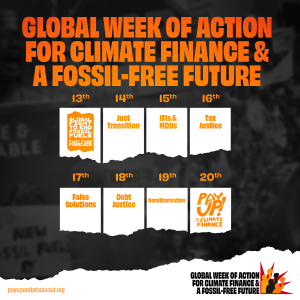
September sees two major Global Weeks of Action – the Global Week of Action for Climate Finance and a Fossil-Free Future (13-20 Sept) and the first Global Week of Action for Peace and Climate Justice (21-28 Sept). Both address the global military’s role and responsibility in both GHG emissions and runaway military spending as an urgent source to tap for climate finance.
TPNS’s Transform Defence project released two publications to mark these international weeks of action, and, notably, also to mark the UN Summit of the Future.
As the world gathers for the UN Summit of the Future followed by the General Assembly debate, peace and co-operation is at the heart of much of the discussion.
Urgent pressure needed to address the role and responsibility of runaway military expenditure in the climate emergency through the allocation of trillions of dollars to fossil-fuel reliant militaries and associated (supply-chain) industries instead of climate finance. This briefing was prepared and shared with many of the delegates to the Summit.
‘War and Peace—Exploring Irish Neutrality‘
Published by the Jesuit Centre for Faith and Justice
‘Overturning the economics of war to deliver a co-operative future and peaceful green prosperity’
This essay was commissioned by Working Notes and explores the ecological aspects of conflict—with a particular focus on the carbon dioxide emissions associated with the military—through an economic lens. It asks what must be done to change course if humanity and our home planet is to reverse the current trajectory.
21-28 September 2024
This first annual week of action for peace and climate justice runs from 21-28 September. More than 50 events are planned in countries including Australia, the Democratic Republic of Congo, Germany, Malawi, Mexico, India, the Netherlands, Sweden, the UK and the USA, as well as many online.
The week of action aims to raise awareness of the links between war, militarism and climate injustice. It also coincides with the UN Summit of the Future.
Find out more and how to take part https://climatemilitarism.org/weekofaction/.
The world’s wealthiest countries have consistently failed to meet targets to provide $100 billion in climate finance to help countries suffering the worst impacts of climate breakdown. Meanwhile, there always money for war: in 2023 global military spending rose for the ninth year in a row, reaching a record high of $2.44 trillion (an increase of 6.8 per cent in real terms from 2022). 2023 also saw the hottest day – highest global temperatures – ever recorded.
The week of action is being facilitated by a sub-committee of the Arms, Militarism and Climate Justice Working Group. Continue reading
As we head towards COP29, the issues of climate finance and a fossil fuel phase-out towards a just energy transition are ever more critical for climate action. The upcoming UN General Assembly, the UN Summit of the Future and the Global Renewables Summit all taking place one after the other in September provide an important opportunity to reiterate our demands and escalate public pressure to compel governments, international institutions and corporations to listen and take action.
The governments of the Global North have consistently failed for decades to undertake their fair share of climate action both domestically and internationally. This fair share includes the delivery of climate finance for the Global South, an obligation that they committed to as parties to the UN Framework Convention on Climate Change. Climate finance is also part of reparations for climate debt they owe to the people of the South for historical and continuing harms caused by their disproportionately large contributions to the climate crisis.
The global military – in peace and war – is a significant contributor to climate change. And these emissions correlate to ever rising military spending on fossil fuel reliant hardware.
Increasing militarisation of world affairs is not the answer to climate change – it is at the heart of the problem. There can be no secure nation without a climate-secure planet.
Urgent pressure is needed to address the role and responsibility of runaway military expenditure in the climate emergency through the allocation of trillions of dollars to fossil-fuel reliant militaries and associated (supply-chain) industries instead of climate finance.
Global North governments should end public subsidies for fossil fuels. Tax systems should be reformed, so polluters and profiteers pay their dues.
And with the expansion of a fossil fuelled global arms race well underway and new ‘cold war’ rhetoric rising again, the vast amounts of government spending on weapons and military operations that harm people, destroy the environment while also being a massive source of carbon emissions, should be diverted towards programs for climate justice and our planet’s security.
The various materials below mark this Global Week of Action and Day of Action on Demilitarisation

Download: “TPNS BRIEFING SUMMIT OF THE FUTURE 2024“ [PDF]
Released September 18th with an accompanying letter to the UN Secretary General. Continue reading
Embargoed: 00:01am CET, 17 October
NEW RESEARCH: NATO 2% SPENDING GOAL COULD DIVERT $2.6 TRILLION FROM CLIMATE FINANCE BY 2028
NATO’s goal of 2% spending of GDP on the military will accelerate climate breakdown by diverting millions of dollars from climate finance and increasing greenhouse gas emissions, concludes a new report that urgently calls for a ‘climate dividend’ similar to the ‘peace dividend’ that was won with the end of the Cold War.
The report, Climate Crossfire, produced by Tipping Point North South (UK), together with Transnational Institute (International) and Stop Wapenhandel (Netherlands), estimates the likely financial implications as well as increased greenhouse gas emissions that would result if all NATO members meet their commitment to increase military spending to a minimum of 2% of GDP.
The report finds that:
We are delighted to be included in the inaugural volume of Degrowth Journal organised as a free, open-access, international, trans-disciplinary, and peer-reviewed journal that focuses on advancing the goals of degrowth. Our article wanted to draw largely unaddressed connections between degrowth and the global military. Continue reading
To mark UN International Day of Peace TPNS is releasing its latest publication How to Transform Defence for Sustainable Human Safety: 10 Talking Points for a Difficult Conversation.
It is an attempt to offer up a framework that tries to envision how we get a much better deal for the world’s citizens from the abject failure of past and current foreign and defence policies that sees us stagger from one war to the next; the world carved up according to spheres of influence; stupid narrow mindsets prevailing over catastrophic climate change and more than 6 million dead due to the COVID-19 pandemic.
It is an attempt to think through the ‘how, what and why’ of a difficult conversation – the move from 19th and 20th century framing of foreign and defence policy such that it really is fit for purpose in a 21st and 22nd century climate changed world, all the time fully recognising that every person, community, society, nation, region needs protection from aggressors and terrorists and it is the job of government to defend its citizens from such threats.
But change it must. Continue reading
To mark the UN gathering Stockholm+50, Transform Defence has published its briefing Stockholm+50 and Global Military Emissions: Ideas for Discussion. We are honoured to have the foreword written by Professor Saleemul Huq , Chair of the Expert Advisory Panel for the Climate Vulnerable Forum. Continue reading
The controversial cross-government fund behind the British aid project in Syria which has today been suspended amid claims that money was reaching jihadist groups should be shut down, according to campaign group Global Justice Now, which has released a new report on the fund.
The report lifts the lid on one of the British government’s most secretive funds, which is behind military and security projects in around 70 countries including Bahrain, Egypt, Sudan, Ethiopia, Iraq and Nigeria. The billion-pound pot, known as the Conflict, Stability and Security Fund, spends over £500 million of British aid and is overseen by the National Security Council, chaired by the Prime Minister. Neither the public nor MPs are able to properly scrutinise the fund due to a serious lack of transparency, the report finds.
Continue reading
Valuable resource from Centre Delàs:
Interactive map « European weapons and refugees »
The purpose of this interactive map is to highlight the link between European arms export and flows of refugees and internally displaced persons, in order to determine whether there is any direct or indirect responsibility of EU Member States for situations of insecurity and violence that drive millions of people to flee their homes every year.
A second objective of this tool is to stress their (ir)responsibility in European arms export authorization or realization as well as their inadequate compliance of the existing legislation, established by the Common Position 2008/944/CFSP of December 8, 2008, which sets up 22 weapons categories including ammunition, light weapons, aircraft and warships, military transport vehicles and all types of military technology for military purposes. On the basis of the criteria set out in the Common Position, the relationship between the European legislation on arms export and situations of insecurity leading to movements of refugees and displaced persons can be established.
http://www.centredelas.org/en/database/arms-trade/interactive-map-arms-trade-and-refugees
The U.S. military has signaled that it might cancel essential upgrades for more than 100 early model F-35 stealth fighters flown by the Air Force, rendering the radar-evading jets incompatible with many of the latest weapons.
In that case, some 6 percent of the flying branch’s planned 1,700-strong F-35 fleet would be unfit for combat, sticking U.S. taxpayers with a $20 billion tab for fighters… that can’t fight. Continue reading
In short, this is straight-up propaganda for the military-industrial complex. It would have looked and sounded identical had it been scripted by a joint team from the Pentagon and the Israel Defense Forces.
My reticence to review the film has lifted after reading the latest investigations of Tom Secker and Matthew Alford into the manifold ways the U.S. military and security services interfere in Hollywood, based on a release of 4,000 pages of documents under Freedom of Information requests.
In their new book “National Security Cinema,” the pair argue that the Pentagon, CIA and National Security Agency have meddled in the production of at least 800 major Hollywood movies and 1,000 TV titles. That is likely to be only the tip of the iceberg, as they concede:
“It is impossible to know exactly how widespread this military censorship of entertainment is because many files are still being withheld.” Continue reading
It was only a matter of time before local entrepreneurs figured out they could channel Israel’s vast experience in war and counterterrorism in this direction. Today, about half a dozen facilities around the country offer tourists the opportunity to learn from Israeli combat officers, in most cases graduates of elite units. (Understanding that they have nothing to sell the locals because military service is compulsory in Israel, these businesses only target tourists.)
At Caliber 3, the two-hour “shooting adventure” – for which the group from Hong Kong has signed up – includes a simulation of a suicide bombing in a Jerusalem marketplace, immediately followed by a stabbing attack, a live demonstration with attack dogs and a sniper tournament. The cost of this basic package is $115 per adult and $85 per child, with discounts available for large groups. Continue reading
After authorising the firing of 59 Tomahawk missiles (each costing around $1.5 million) at a Syrian airbase with no apparent consequential strategic purpose and diminishing none of the Syrian regime’s chemical weapons capability, the maker of the Tomahawk missiles, Raytheon’s stock rose sharply, adding more than $1 billion to its market capitalisation. Other missile and weapons manufacturers, Boeing, Lockheed Martin, Northrop Grumman and General Dynamics, also saw their stock rose considerably – collectively gaining nearly $5 billion in market value. This on its own may not matter much, after all, which president of the USA has not dropped expensive bombs on some ‘remote’ nations of the world. But this time may be different.
Trump used anti-establishment and anti-corporate language during his election campaign to distinguish himself from all other candidates – he opposed neoconservative foreign policy, financial and corporate interests, notably Goldman Sachs. Now, after his inauguration, you can hardly see much difference between his foreign policy plans and policies proposed by neoconservatives. His cabinet looks like a ‘who’s who’ of Goldman Sachs alumni. He ratcheted up the military tension in the South China Sea, ordered a failed major special force operation in Yemen, and now seems to be pushing the USA to the edge of nuclear war with North Korea. The more he uses militaristic confrontational rhetoric and actions, the more ‘presidential’ he looks in the eyes of the mainstream media. He seems ‘unstoppable’.
But is he, really?
Throughout those conversations, there was consensus that the contemporary peace movement was not nearly powerful enough to mount a serious challenge to the forces of American empire and militarism. As the challenges facing that movement came into focus for me, so did their scale. It is hard to imagine a more difficult target, from an organizing perspective, than military policy. The US empire today leaves a great deal of ruin in its wake, but its cost is only vaguely felt by most Americans, while its gargantuan profits are pocketed by a few and its most recognized organization—the military itself—is widely celebrated as the most trusted public institution.
In the wake of the election, as the need for a constituency to challenge American militarism grows in urgency, how might such challenges be met? Doing so will require reimagining the constituency, strategy, and purpose of the movement itself. It is not at all clear that a “peace movement” or even an “antiwar movement,” as those have generally been conceived, will suffice. Rather, we need a movement that can speak to the anger that so many Americans feel toward the corporate powers that dominate our politics. Such a movement would expose how militarism is not immune to that influence but is particularly beholden to it. Can such a movement be organized? …
Continue reading
And while Trump says increased military spending will reassert America’s strength, the United States already is the world’s 800-pound gorilla. In 2015, it was responsible for more than one third of all military spending on the planet. China and Russia, the United States’ main military competitors, don’t even come close.
Trump’s budget plans also feature drastic cuts to international and environmental spending. He’s reportedly pushing for a 24 percent cut to the EPA budget and a 37 percent cut to the State Department and USAID budget. While such reductions would have profound effects on these agencies, they are a drop in the bucket compared with the Pentagon budget. In 2016, the Department of State and USAID received an estimated $50.6 billion, or 1.3 percent of all federal spending. The EPA received $8.3 billion, or 0.2 percent of all federal spending. Meanwhile, the Pentagon got 15 percent.
Continue reading
Sales of the world’s 100 largest arms-producing and military services companies totalled $370.7 billion in 2015. Compared with 2014, this is a slight decline of 0.6 per cent. While this continues the downward trend in arms sales that began in 2011, it signals a significant slowdown in the pace of decline. However, despite the decrease, Top 100 arms sales for 2015 are 37 per cent higher than those for 2002, when SIPRI began reporting corporate arms sales.
Companies headquartered in the United States and Western Europe have
dominated the list of Top 100 arms-producing and military services companies
since 2002. And, true to form, this was the case for 2015: with sales reaching $305.4 billion, companies based in the USA and Western Europe accounted for 82.4 per cent of the Top 100 arms sales. Continue reading
At one point, there were something like 1,000 installations in Iraq and Afghanistan alone, from bases large enough to be small American towns to tiny combat outposts. In 2015, there were at least 800 significant U.S. bases in foreign countries (and more small camps and places where U.S. military equipment was pre-positioned for future use). No great power, not even Britain at its imperial height, had ever had such a global military “footprint,” such an “empire of bases,” and yet in this country it was as if no one noticed, as if it were of no importance at all.
Let’s start with a baseline look at the Pentagon’s finances at this moment. At $600 billion-plus per year, the government is already spending more money on the Pentagon than it did at the peak of the massive military buildup President Ronald Reagan initiated in the 1980s. In fact, despite what you might imagine, the Obama administration has pumped more tax dollars into the military in its two terms than did George W. Bush. According to the London-based International Institute for Strategic Studies, the U.S. currently spends four times what China does and 10 times what the Russians sink into their military. Continue reading
Take the current budget. It’s down slightly from its peak in 2011, when it reached the highest level since World War II, but this year’s budget for the Pentagon and related agencies is nothing to sneeze at. It comes in at roughly $600 billion—more than the peak year of the massive arms buildup initiated by President Ronald Reagan back in the 1980s. To put this figure in perspective: Despite troop levels in Iraq and Afghanistan dropping sharply over the past eight years, the Obama administration has still managed to spend more on the Pentagon than the Bush administration did during its two terms in office. Continue reading