
Lesson One. Physics Trumps Politics and Economics. Every Time.
The first lesson I learned from the planet is about the absurdity of our “real world” politics and economics.
Despite what many people claim, politics and economics are arbitrary systems of belief that people in power have invented over the years. And regardless of what we have been brought up to believe, the planet does not actually obey the rules of politics and economics. It never has.
Lesson Two. Thermodynamics and Systems Thinking are Powerful Tools.
The next lesson I’ve learned over the years is that thermodynamics and systems thinking are very powerful tools for understanding and describing the workings of our planet.
Tag Archives: Climate change
What Brexit teaches us about communications
- Facts alone are not enough to win the argument
- Relying on expert opinion to build public engagement can sometimes backfire
- Tell a good story
- Identify messages of hope
Military and the Climate Change
Sara Flounders’ remarkable 2009 article on the Copenhagen climate meeting tied together the military and climate change, but delinking of the two persists. She wrote that “with more than 15,000 participants from 192 countries, including more than 100 heads of state, as well as 100,000 demonstrators in the streets – it is important to ask: How is it possible that the worst polluter of carbon dioxide and other toxic emissions on the planet is not a focus of any conference discussion or proposed restrictions? …the Pentagon has a blanket exemption in all international climate agreements.”
Overall, environmentalists pay little attention to the military, and the anti-war movement does not address the climate. Both squander precious time. At a slow pace, industrialized countries have been “transitioning” to clean energy since the 1960s, without any specified and enforceable time frame. Renewables remain a very small part of the energy mix and will not remedy the carbon-intensive military or industrial agriculture. Transition fuels like natural gas and biofuels have proven to be disastrous to human communities and to the climate. By contrast is the fast pace rapidly rising temperature, accelerating greenhouse gas concentration (due to amplifying feedbacks), increased military spending including nuclear weapons, and new weapons/surveillance/pacification technology.[1] At some point recently, the climate goal shifted from elimination of greenhouse gases to mitigation. Continue reading
Monthly global temperatures from 1850-2016
 Monthly global temperatures from 1850-2016.Ed Hawkins
Continue reading
Last Hours: Methane
Sleepwalking into the 6th Mass Extinction.
More than 1 year old, but the situation has only got worse, much worse.
$2.5 trillion at risk if global temperature increase 2.5°C by 2100
An average $2.5 trillion (£1.76trn) of the world’s financial assets would be at risk from climate change impacts if global temperatures are left to increase by 2.5°C by 2100, warns a new study by the Grantham Research Institute on Climate Change and the Environment at the London School of Economics. Continue reading
Climate change is not just about carbon dioxide – the dangerously high level of methane leak to the atmosphere
In February, Harvard researchers published an explosive paper in Geophysical Research Letters. Using satellite data and ground observations, they concluded that the nation as a whole is leaking methane in massive quantities. Between 2002 and 2014, the data showed that US methane emissions increased by more than 30 percent, accounting for 30 to 60 percent of an enormous spike in methane in the entire planet’s atmosphere.
Continue reading
2°C too high – Climate catastrophe decades not centuries away
“We’re in danger of handing young people a situation that’s out of their control,” said James E. Hansen, the retired NASA climate scientist who led the new research. The findings were released Tuesday morning by a European science journal, Atmospheric Chemistry and Physics. Continue reading
Green investment bank loses its green purpose
What a joke!
The bank set up by the government to to fund green infrastructure and cited frequently by David Cameron as evidence of the UK’s leadership on climate change will no longer be required by law to invest in green schemes, under moves put forward by ministers.
Campaigners said that changes proposed on Tuesday by small business minister Anna Soubry effectively delete the clause enshrined in legislation that gives the green investment bank its green purpose.
MoD accounts half of all government carbon emissions
Ministers had targeted a 25% cut in carbon emissions from government buildings and travel in 201 4-15 , compared to 2009-10, but achieved 22%. The failure was largely due to the Ministry of Defence, which accounts for half of all government emissions and cut its emissions by 19%.
Security-led approach to climate change and complex emergencies
Dystopian preparations by the state are reflected in the corporate arena. Where we see a future climate crisis, many companies see only opportunity: oil firms looking forward to melting ice caps delivering new accessible fossil fuels; security firms touting the latest technologies to secure borders from ‘climate refugees’; or investment fund managers speculating on weather-related food prices – to name but a few. In 2012, Raytheon, one of the world’s largest defence contractors, announced “expanded business opportunities” arising from “security concerns and their possible consequences,” due to the “effects of climate change” in the form of “storms, droughts, and floods”. The rest of the defence sector has been quick to follow. Continue reading
5% Digest (Week 23/03/15)
Gregory D. Johnsen wrote a detailed account of the rise of Huthis in Yemen. Adam Baron argued that the power struggle is primarily local and foreign intervention will be a very bad idea.
But what is abundantly clear at the moment is that this remains, by and large, an internal Yemeni political conflict—one that, despite frequent sectarian mischaracterizations and potential regional implications, remains deeply rooted in local Yemeni issues.
And if history is a guide, foreign intervention will only stand to exacerbate the situation. Ironically, talk now centers on a potential Saudi Arabian and Egyptian military intervention in Yemen, a scenario that immediately brought to mind the memory of North Yemen’s 1960s Civil War which saw both sides intervene—albeit on different sides—in a matter which only appeared to draw the conflict out further. This is not to say that there isn’t a place for foreign powers to aid Yemeni factions in negotiating some new political settlement. But any nation that aims to make Yemen’s fight their own is more than likely to come out on the losing side.
November Reading List
- Fracking could carry unforeseen risks as thalidomide and asbestos did, says report
- This headline will subtly mislead you and science says that probably matters
- 5 Key Takeaways From the Latest Climate Change Report
- Why Ebola hit West Africa hard
- Nuclear Arms Control in China Today
- Texas oil town makes history as residents say no to fracking
- The secular stagnation hoax
- The Pentagon’s Arguments for Runaway Arms Trading Are Indefensible
- World’s first solar cycle lane opening in the Netherlands
- Raytheon acquires cyber firm for $420 million
- America’s New Mercenaries
- What’s the environmental impact of modern war?
- Petraeus joins pro-fracking choir at Harvard’s Belfer Center
- Stakes are high as US plays the oil card against Iran and Russia
- Foundation of US nuclear system showing cracks
- Midterms 2014: The Red Wedding for Democrats
- Can (green) energy policy create jobs?
- Death Wears Bunny Slippers
- It is the 0.01% who are really getting ahead in America
- The Transatlantic Trade and Investment Partnership and UK healthcare
- Is neoliberalism at last unravelling in Britain?
- For Whom the Wall Fell? A balance-sheet of transition to capitalism
- Ministers’ shale gas ‘hype’ attacked
- Some Very Initial Thoughts on the US-China Deal
- The social, political and ecological pathologies of the Ebola Crisis cannot be ignored
- F’d: How the U.S. and Its Allies Got Stuck with the World’s Worst New Warplane
- Spied on by BP
- How did the first world war actually end?
- Don’t Throw Billions at an Obsolete Nuclear Arsenal
- Hard Evidence: are we facing another financial crisis?
- Growth: the destructive god that can never be appeased
- Cameron is right to warn of another recession, but wrong to blame the world
- The Top 5 Foreign Policy Lessons of the Past 20 Years
- The .01 Percent Blow Their Fortunes on Yachts, Personal Jets and America’s Politicians
- How much is owed to Gaza? Does anyone know? This is not a rhetorical question. I’m really asking!
- International arms firm Lockheed Martin in the frame for £1bn NHS contract
- We Love the Pentagon’s ‘Encyclopedia of Ethical Failure’
- Massive Rail Deal Gives China’s Push Into Africa a Major Win
- Exaggeration Nation
- Barclays boycotted over Israel arms trade shares
- Firms invested £17bn in companies making cluster bombs, report says
- There is Nothing Natural about Gentrification
- 41 men targeted but 1,147 people killed: US drone strikes – the facts on the ground
- The ‘crass insensitivity’ of Tower’s luxury dinner for arms dealers, days after poppy display
- Fracking firm’s plans to look for gas in North Yorkshire criticised by environmental groups
- House Republicans just passed a bill forbidding scientists from advising the EPA on their own research
- Justifying War: “Just” Wars
September Reading List
- How the west created the Islamic State
- Who’s Paying the Pro-War Pundits?
- The Pentagon’s $800-Billion Real Estate Problem
- Lefties and liberals still don’t do enough to stop wars
- How the super rich got richer: 10 shocking facts about inequality
- ISIS’s Enemy List: 10 Reasons the Islamic State Is Doomed
- Why the Ukraine Crisis Is the West’s Fault
- Democracy in the Twenty-First Century
- Israeli drone conference features weapons used to kill Gaza’s children
- New Report on Water Impacts of Shale Gas Development
- Behind the headlines: Fracking and water contamination
- Story of a War Foretold: Why we’re fighting ISIS
- Richard Brooks and Andrew Bousfield, 19th September 2014. Shady Arabia and the Desert Fix. Private Eye.
- “My childhood was not an episode from Downton Abbey”
- Russell Tribunal finds evidence of incitement to genocide, crimes against humanity in Gaza
- ‘Blood on their hands’: Glasgow activists shut down drone manufacturer
- Inequality is a choice: U.S. inequality in two shocking graphics
- Europe Tries to Stop Flow of Citizens Joining Jihad
- On the streets with the People’s Climate March
- The Great Frack Forward
- The Unaffordable Arsenal
The rise of disaster militarism
Annie Isabel Fukushima, Ayano Ginoza, Michiko Hase, Gwyn Kirk, Deborah Lee, Taeva Shefler, “Disaster Militarism: Rethinking US Relief in the Asia-Pacific,” 14 March 2014, The Nation and Foreign Policy In Focus
… Paralleling these disasters has been the disaster response of the US military. According to this “disaster militarism”—which is a pattern of rhetoric, beliefs and practices—the military should be the primary responder to large-scale disasters. Disaster militarism is not only reflected in the deployment of troops but also in media discourse that naturalizes and calls for military action in times of environmental catastrophes.
Continue reading
Global industrial civilisation could collapse in coming decades
Nafeez Ahmed, “Nasa-funded study: industrial civilisation headed for ‘irreversible collapse’?,” 14 March 2014, Guardian
A new study sponsored by Nasa’s Goddard Space Flight Center has highlighted the prospect that global industrial civilisation could collapse in coming decades due to unsustainable resource exploitation and increasingly unequal wealth distribution.
Continue reading
Global warming culprits, judged by size
Kate Ravilious, “The seven deadly sinners driving global warming,” New Scientist, 15 January 2014

US Department of Defense is the Worst Polluter on the Planet
“US Department of Defense is the Worst Polluter on the Planet,” Project Censored
The US military is responsible for the most egregious and widespread pollution of the planet, yet this information and accompanying documentation goes almost entirely unreported. In spite of the evidence, the environmental impact of the US military goes largely unaddressed by environmental organizations and was not the focus of any discussions or proposed restrictions at the recent UN Climate Change Conference in Copenhagen. This impact includes uninhibited use of fossil fuels, massive creation of greenhouse gases, and extensive release of radioactive and chemical contaminants into the air, water, and soil.
Continue reading
Just 90 companies caused 2/3 of man-made global warming emissions
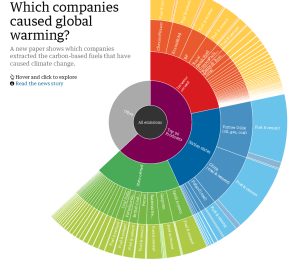
“Just 90 companies caused two-thirds of man-made global warming emissions,” Guardian, 20 November 2013
The climate crisis of the 21st century has been caused largely by just 90 companies, which between them produced nearly two-thirds of the greenhouse gas emissions generated since the dawning of the industrial age, new research suggests.
The companies range from investor-owned firms – household names such as Chevron, Exxon and BP – to state-owned and government-run firms. …
Continue reading
Defense Contractor: Climate Change Could Create “Business Opportunities”
Jeremy Schulman, “Defense Contractor: Climate Change Could Create ‘Business Opportunities‘,” Mother Jones, 14 August 2013
Of all the business opportunities presented by global warming, Raytheon Company may have found one of the most alarming. The Massachusetts-based defense contractor—which makes everything from communications systems to Tomahawk missiles—thinks that future “security concerns” caused by climate change could mean expanded sales of its military products. …
Continue reading
 Tipping Point North South