
Kate Ravilious, “The seven deadly sinners driving global warming,” New Scientist, 15 January 2014

Kate Ravilious, “The seven deadly sinners driving global warming,” New Scientist, 15 January 2014
“US Department of Defense is the Worst Polluter on the Planet,” Project Censored
The US military is responsible for the most egregious and widespread pollution of the planet, yet this information and accompanying documentation goes almost entirely unreported. In spite of the evidence, the environmental impact of the US military goes largely unaddressed by environmental organizations and was not the focus of any discussions or proposed restrictions at the recent UN Climate Change Conference in Copenhagen. This impact includes uninhibited use of fossil fuels, massive creation of greenhouse gases, and extensive release of radioactive and chemical contaminants into the air, water, and soil.
Continue reading
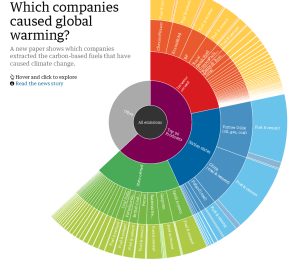
“Just 90 companies caused two-thirds of man-made global warming emissions,” Guardian, 20 November 2013
The climate crisis of the 21st century has been caused largely by just 90 companies, which between them produced nearly two-thirds of the greenhouse gas emissions generated since the dawning of the industrial age, new research suggests.
The companies range from investor-owned firms – household names such as Chevron, Exxon and BP – to state-owned and government-run firms. …
Continue reading
Jeremy Schulman, “Defense Contractor: Climate Change Could Create ‘Business Opportunities‘,” Mother Jones, 14 August 2013
Of all the business opportunities presented by global warming, Raytheon Company may have found one of the most alarming. The Massachusetts-based defense contractor—which makes everything from communications systems to Tomahawk missiles—thinks that future “security concerns” caused by climate change could mean expanded sales of its military products. …
Continue reading
Kiley Kroh, “New Research Finds Melting Arctic May Cost Global Economy $60 Trillion,” TP Climate Progress, July 24 2013
In findings published in the journal Nature, economists and polar scientists from the University of Cambridge and Erasmus University Rotterdam found that the ripple effects of climate change in the Arctic — unlocking frozen reserves of methane that speed global warming and cause destructive and costly climactic changes across the planet — could deal a severe blow to the global economy.
The release of methane from thawing permafrost beneath the East Siberian Sea, off northern Russia, alone comes with an average global price tag of $60 trillion in the absence of mitigating action — a figure comparable to the size of the world economy in 2012 (about $70 trillion). The total cost of Arctic change will be much higher.
Paul Rogers , “The global climate cliff,” openDemocracy, 18 July 2013
The events in Uttarakhand closely follow a report from the World Meteorological Organisation (WMO) on weather trends in the first decade of the 21st century, which focuses in part on the increased intensity of severe weather events and their likely link to carbon emissions and climate change. The WMO report – The Global Climate 2001-2010: A Decade of Climate Extremes – is particularly useful because it examine a whole decade and compares it with earlier ones, a process that puts smaller fluctuations in perspective and gives a clearer picture of underlying trends (see Alex Kirby, “Unprecedented climate extremes marked last decade, says UN”, Guardian Environment Network, 3 July 2013).
Continue reading

