
- How the west created the Islamic State
- Who’s Paying the Pro-War Pundits?
- The Pentagon’s $800-Billion Real Estate Problem
- Lefties and liberals still don’t do enough to stop wars
- How the super rich got richer: 10 shocking facts about inequality
- ISIS’s Enemy List: 10 Reasons the Islamic State Is Doomed
- Why the Ukraine Crisis Is the West’s Fault
- Democracy in the Twenty-First Century
- Israeli drone conference features weapons used to kill Gaza’s children
- New Report on Water Impacts of Shale Gas Development
- Behind the headlines: Fracking and water contamination
- Story of a War Foretold: Why we’re fighting ISIS
- Richard Brooks and Andrew Bousfield, 19th September 2014. Shady Arabia and the Desert Fix. Private Eye.
- “My childhood was not an episode from Downton Abbey”
- Russell Tribunal finds evidence of incitement to genocide, crimes against humanity in Gaza
- ‘Blood on their hands’: Glasgow activists shut down drone manufacturer
- Inequality is a choice: U.S. inequality in two shocking graphics
- Europe Tries to Stop Flow of Citizens Joining Jihad
- On the streets with the People’s Climate March
- The Great Frack Forward
- The Unaffordable Arsenal
Category Archives: What interests us
No body messes with the Pentagon budget
Dave Gilson, “Can’t Touch This,” December 2013, Mother Jones
One out of every five tax dollars is spent on defense.
The $3.7 trillion federal budget breaks down into mandatory spending—benefits guaranteed the American people, such as Social Security and Medicare—and discretionary spending—programs that, at least in theory, can be cut. In 2013, more than half of all discretionary spending (and one-fifth of total spending) went to defense, including the Pentagon, veterans’ benefits, and the nuclear weapons arsenal.
Continue reading
Over-exposure to Plasticizers Causes Breast Cancer
“Plasticizers overexposure a breast cancer risk: study,” 21 July 2014, Taipei Times
Overexposure to plasticizers nearly doubles women’s risk of contracting breast cancer, with that likelihood rising among those who have a poor metabolism, a comprehensive study by local researchers has found.
Continue reading
Interventions. The Arms Race
John Scales Avery, “UKRAINE AND THE DANGER OF NUCLEAR WAR,” 14 March 2014, Nuclear Age Peace Foundation
… During the period from 1945 to the present, the US interfered, militarily or covertly, in the internal affairs of a large number of nations: China, 1945-49; Italy, 1947-48; Greece, 1947-49; Philippines, 1946-53; South Korea, 1945-53; Albania, 1949-53; Germany, 1950s; Iran, 1953; Guatemala, 1953-1990s; Middle East, 1956-58; Indonesia, 1957-58; British Guiana/Guyana, 1953-64; Vietnam, 1950-73; Cambodia, 1955-73; The Congo/Zaire, 1960-65; Brazil, 1961-64; Dominican Republic, 1963-66; Cuba, 1959-present; Indonesia, 1965; Chile, 1964-73; Greece, 1964-74; East Timor, 1975-present; Nicaragua, 1978-89; Grenada, 1979-84; Libya, 1981-89; Panama, 1989; Iraq, 1990-present; Afghanistan 1979-92; El Salvador, 1980-92; Haiti, 1987-94; Yugoslavia, 1999; and Afghanistan, 2001-present, Syria, 2013-present. Egypt, 2013-present. Most of these interventions were explained to the American people as being necessary to combat communism (or more recently, terrorism), but an underlying motive was undoubtedly the desire to put in place governments and laws that would be favorable to the economic interests of the US and its allies.
For the sake of balance, we should remember that during the Cold War period, the Soviet Union and China also intervened in the internal affairs of many countries, for example in Korea in 1950-53, Hungary in 1956, Czechoslovakia in 1968, and so on; another very long list. These Cold War interventions were also unjustifiable, like those mentioned above. Nothing can justify military or covert interference by superpowers in the internal affairs of smaller countries, since people have a
right to live under governments of their own choosing even if those governments are not optimal. …
Continue reading
UK military operations since cold war have cost £35bn
Richard Norton-Taylor, “UK military operations since cold war have cost £34bn, says study,” 23 April 2014, The Guardian
Britain’s military operations since the end of the cold war have cost £34.7bn and a further £30bn may have to be spent on long-term veteran care, according to an authoritative study.
Continue reading
Gaza bombings
This poem was written as Israel’s attack on Gazans took its toll.
Tonight, the bombs fall down in Gaza.
As an African voice croons from my kitchen radio,
And the garden breathes through the open door,
And I sip this whisky
And my thumb throbs, caught just now in a cupboard hinge,
Wrapped handkerchief-tight against the pain,
The bombs fall down in Gaza.
Abolishing Mammography Screening Programs?
Nikola Biller-Andorno, M.D., Ph.D., and Peter Jüni, M.D., “Abolishing Mammography Screening Programs? A View from the Swiss Medical Board,” 23 April 2014, The New England Journal of Medicine
DOI: 10.1056/NEJMp1401875
… The Swiss Medical Board’s report was made public on February 2, 2014 (www.medical-board.ch). It acknowledged that systematic mammography screening might prevent about one death attributed to breast cancer for every 1000 women screened, even though there was no evidence to suggest that overall mortality was affected. At the same time, it emphasized the harm — in particular, false positive test results and the risk of overdiagnosis. For every breast-cancer death prevented in U.S. women over a 10-year course of annual screening beginning at 50 years of age, 490 to 670 women are likely to have a false positive mammogram with repeat examination; 70 to 100, an unnecessary biopsy; and 3 to 14, an overdiagnosed breast cancer that would never have become clinically apparent.5 The board therefore recommended that no new systematic mammography screening programs be introduced and that a time limit be placed on existing programs. In addition, it stipulated that the quality of all forms of mammography screening should be evaluated and that clear and balanced information should be provided to women regarding the benefits and harms of screening.
Continue reading
The military-industrial revolving door
Bryan Bender, “From the Pentagon to the private sector,” 26 December 2010, The Boston Globe

National Security Iron Triangle
Franklin C. Spinney, “The Best Government Money Can Buy,” 11 February 2014, CounterPunch

USA’s 2015 budget for ‘defence’ is $1 trillion not $496 billion
Winslow T. Wheeler, “America’s $1 Trillion National Security Budget,” 16 March 2014, Truthout
Scarcity of money is not their problem. Pentagon costs, taken together with other known national security expenses for 2015, will exceed $1 trillion. How can that be? The trade press is full of statements about the Pentagon’s $495.6 billion budget and how low that is.
There is much more than $495.6 billion in the budget for the Pentagon, and there are piles of national security spending outside the Pentagon-all of it as elemental for national security as any new aircraft and ships and the morale and well-being of our troops.
Continue reading
The UK’s unfair austerity cuts
Simon Duffy, “Counting the Cuts,” 18 February 2014, Campaign for a Fair Society and The Centre for Welfare Reform

Continue reading
MoD’s secret cyberwarfare programme
Ben Quinn, “Revealed: the MoD’s secret cyberwarfare programme,” 16 March 2014, Guardian
The Ministry of Defence is developing a secret, multimillion-pound research programme into the future of cyberwarfare, including how emerging technologies such as social media and psychological techniques can be harnessed by the military to influence people’s beliefs.
Continue reading
The rise of disaster militarism
Annie Isabel Fukushima, Ayano Ginoza, Michiko Hase, Gwyn Kirk, Deborah Lee, Taeva Shefler, “Disaster Militarism: Rethinking US Relief in the Asia-Pacific,” 14 March 2014, The Nation and Foreign Policy In Focus
… Paralleling these disasters has been the disaster response of the US military. According to this “disaster militarism”—which is a pattern of rhetoric, beliefs and practices—the military should be the primary responder to large-scale disasters. Disaster militarism is not only reflected in the deployment of troops but also in media discourse that naturalizes and calls for military action in times of environmental catastrophes.
Continue reading
Top income shares in the US and UK
David Blanchflower, “Bankers don’t deserve their bonuses. They should be taxed and the money used to help our struggling young people,” 16 March 2014, The Independent

Five richest families in the UK are wealthier than the poorest 20%
Ricardo Fuentes-Nieva, “A Tale of Two Britains: Inequality in the UK,” 17 March 2014, Oxfam GB
Today, the five richest families in the UK are wealthier than the bottom 20 per cent of the entire population. That’s just five households with more money than 12.6 million people – almost the same as the number of people living below the poverty line in the UK.
Continue reading
Massive war budget remains despite Afghanistan pullout
Stephanie Gaskell, “Pentagon Wants to Keep Controversial War Budget Beyond Afghanistan,” 5 March 2014, Defense One
… But despite the massive drawdown, Pentagon officials want to keep a comparably oversized war chest funded well into next year, quickly raising eyebrows among members of Congress.
The fiscal year 2015 budget calls for $79 billion for Overseas Contingency Operations, or OCO, which funds the war in Afghanistan and other overseas operations. Although the U.S.footprint in Afghanistan has shrunk over the past couple of years, the war budget has stayed robust. This year Congress approved $85 billion for the account.
Continue reading
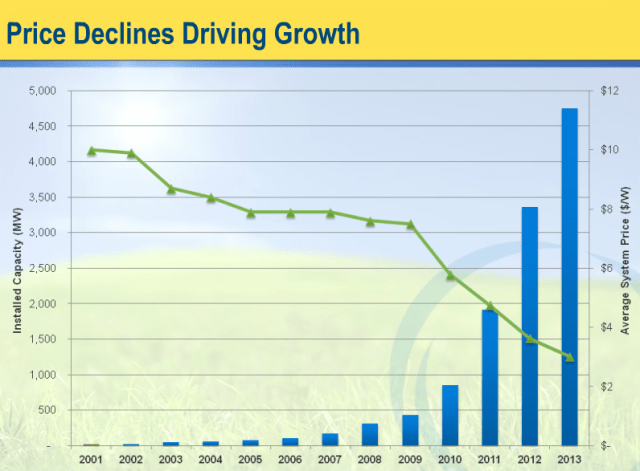
More solar has been installed in the U.S. in the last 18 months than in the 30 years prior
Emily Hois, “More Solar Installed In 18 Months Than Past 30 Years,” 7 March 2014, Clean Energy Collective
Economic cost of widening inequality in the UK
Tracy McVeigh, “Inequality ‘costs Britain £39bn a year’,” 16 March 2014, Guardian
The ever-increasing gulf between rich and poor in Britain is costing the economy more than £39bn a year, according to a report by the EqualityTrust thinktank. The effects of inequality can be measured in financial terms through its impact on health, wellbeing and crime rates, according to statisticians at the independent campaign group.
Researchers pointed to the fact that the 100 wealthiest people in the UK have as much money as the poorest 18 million – 30% of all people – and said that the consequences of such unusually high rates of inequality needed to be acknowledged by politicians.
Continue reading
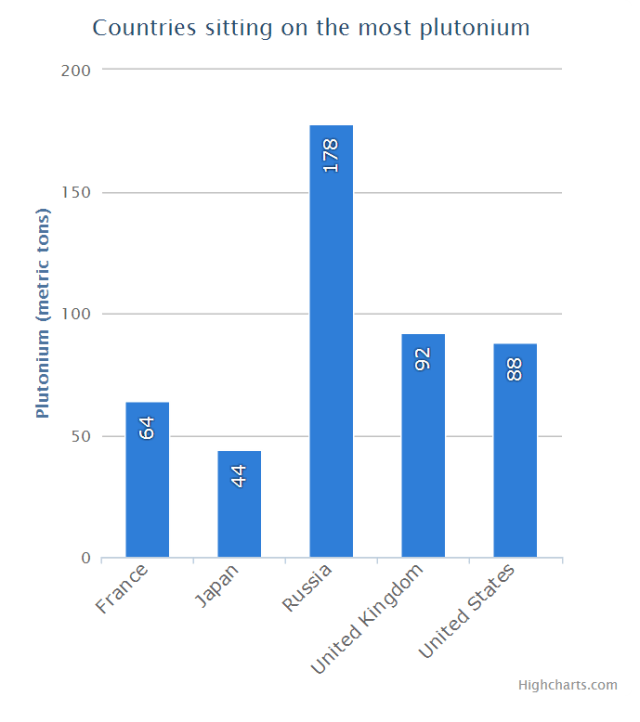
Countries sitting on the most plutonium
“Japan could be building an irresistible terrorist target, experts say,” 11 March 2014, The Center for Public Integrity
Prohibition and the war on drugs
Sanho Tree, “An Inside Look at the Drug War Vs. Civilization,” 5 February 2014, The Fix
We unfortunately live in a society that likes to talk in simple dichotomies—good or bad, yes or no, black or white. It carries over very often into the way we talk about drug policy. Historically, when I would debate drug warriors, because I would be critical of prohibition and the war on drugs, they would say, “Oh, so you want to sell heroin in candy machines to children.” No. I actually want more control over these substances. The myth of prohibition is that prohibition doesn’t mean you control drugs. It means you give up the right to control drugs.
Continue reading
 Tipping Point North South