
Category Archives: The 5% Campaign
News and analysis
The UN is not paying its peacekeepers
The United Nations owes countries that send troops to serve under its baby-blue banner a huge debt — a literal one.
As of March 31, 2016, the world body owed troop-contributing countries a total of $827 million in back-compensation, Under-Secretary-General for Management Yukio Takasu told Indian reporters on May 4.
The way the U.N. peacekeeping systems works is this — member states donate funds to the United Nations and the world body then passes a portion of that money onward to countries that offer up their troops to peace missions.
Military and the Climate Change
Sara Flounders’ remarkable 2009 article on the Copenhagen climate meeting tied together the military and climate change, but delinking of the two persists. She wrote that “with more than 15,000 participants from 192 countries, including more than 100 heads of state, as well as 100,000 demonstrators in the streets – it is important to ask: How is it possible that the worst polluter of carbon dioxide and other toxic emissions on the planet is not a focus of any conference discussion or proposed restrictions? …the Pentagon has a blanket exemption in all international climate agreements.”
Overall, environmentalists pay little attention to the military, and the anti-war movement does not address the climate. Both squander precious time. At a slow pace, industrialized countries have been “transitioning” to clean energy since the 1960s, without any specified and enforceable time frame. Renewables remain a very small part of the energy mix and will not remedy the carbon-intensive military or industrial agriculture. Transition fuels like natural gas and biofuels have proven to be disastrous to human communities and to the climate. By contrast is the fast pace rapidly rising temperature, accelerating greenhouse gas concentration (due to amplifying feedbacks), increased military spending including nuclear weapons, and new weapons/surveillance/pacification technology.[1] At some point recently, the climate goal shifted from elimination of greenhouse gases to mitigation. Continue reading
Basic Income, Bullshit Jobs, Poverty and Military Spending
To begin with, basic income would give us all genuine freedom. Nowadays, numerous people are forced to spend their entire working lives doing jobs they consider to be pointless. Jobs like telemarketer, HR manager, social media strategist, PR advisor, and a whole host of administrative positions at hospitals, universities, and government offices. “Bullshit jobs,” the anthropologist David Graeber calls them. They’re the jobs that even the people doing them admit are, in essence, superfluous.
And we’re not talking about just a handful of people here. In a survey of 12,000 professionals by the Harvard Business Review, half said they felt their job had no “meaning and significance,” and an equal number were unable to relate to their company’s mission. Another recent poll among Brits revealed that as many as 37% think they have a bullshit job. Continue reading
Corruption in military aid programs
One issue that is ripe for attention is the effect corruption has on military aid programs. Providers of such assistance need to take more care to ensure that their partners are not subverting the purpose of these programs by engaging in corrupt practices.
U.S. military aid programs are a case in point. According to data compiled by the Security Assistance Monitor, this year the United States is providing over $8 billion in arms and training to 50 of the 63 nations that Transparency International has identified as being at “high” or “critical” risk of corruption in their defense sectors. …
Widespread corruption poses other serious challenges to providers of military assistance. There is a danger that tilting aid too heavily toward the defense sector can strengthen it at the expensive of civilian institutions, undermining civilian control of the military. There is a significant risk that this may be occurring among key recipients of U.S. security assistance. The Security Assistance Monitor’sassessment of dependence on U.S. military aid demonstrates that, for 2014, U.S. military aid accounted anywhere from 15% to 20% of defense expenditures of recipient countries like Egypt, Pakistan, and Burundi; over 50% in Liberia; and over 90% in Afghanistan. …
Corruption in defense assistance programs is about more than just a diversion of funds. It is also a threat to local, regional, and global security. Any effort to reduce global corruption must make cleaning up corruption in military aid programs a top priority.
Corruption in Military Aid Undermines Global Security
http://lobelog.com/corruption-in-military-aid-undermines-global-security/
Trident to cost £205bn in total, 6% of defence budget a year
The total cost of replacing the Trident nuclear missile system will come to at least £205bn, far more than previously estimated, according to figures drawn up by the Campaign for Nuclear Disarmament (CND).
It has calculated the total on the basis of official figures, answers to parliamentary questions and previous costs of items including nuclear warheads and decommissioning nuclear reactors. It says it has not taken into account that past Ministry of Defence projects have frequently gone well over budget. …
The most expensive item would be the cumulative running costs, estimated by the government to be about 6% of the total defence budget. Crispin Blunt, Tory chair of the Commons foreign affairs committee, has calculated, on the basis of parliamentary answers, that a new Trident system would cost £167bn over a 30-year lifespan.
Replacing Trident will cost at least £205bn, campaigners say
http://www.theguardian.com/uk-news/2016/may/12/replacing-trident-will-cost-at-least-205-billion-campaign-for-nuclear-disarmament
40 million people internally displaced by conflict & violence
Highest figure ever

Beltwayland: The heartland of the military-industrial complex class
For them, a two-front war and Washington’s newly enlarged national-security state, much of which is hidden in plain sight, have ushered in a 21st-century gilded age only replicated in America’s few, most privileged enclaves. As Lofgren explains:
It is common knowledge that Wall Street and its inflated compensation packages have remade Manhattan into an exclusive playground for the rich, just as tech moguls have made San Francisco unaffordable for the middle class. It is less well known that the estimated $4 trillion spent since 9/11 on the war on terrorism and billions spent on political campaigns ($6 billion on the 2012 elections alone) have trickled down so extravagantly to the New Class settled around Washington’s Beltway that they have remade the landscape of our capital.
Arms sale for ‘peace’
The chairman of BAE Systems has claimed his company’s weapons sales encourage peace, as he responded to questions from peace activists who infiltrated the arms maker’s shareholder meeting.
Sir Roger Carr was forced on the defensive by a salvo of questions probing BAE’s dealings with Saudi Arabia, which is currently at war in Yemen. According to a UN panel, Saudi forces have conducted “widespread and systematic” attacks on civilian targets. Continue reading
The Arms Trade Treaty won’t stop controversial arms deals
The Arms Trade Treaty won’t mean an immediate end to controversial arms deals like Canada’s $15 billion sale of light armoured vehicles to Saudi Arabia, says the United Nations disarmament chief.
Kim Won-soo, the UN’s High Representative on Disarmament Affairs, offered that assessment in an exclusive interview with The Canadian Press following his Monday meeting with Foreign Affairs Minister Stephane Dion. Continue reading
$40 billion military aid to Israel
President Obama has proposed granting Israel the largest package of military aid ever provided by the United States to another nation, but he and Prime Minister Benjamin Netanyahu remain deeply at odds over a figure for the assistance despite months of negotiations.
“The brains and blood” of F-35s is not ‘critical’/working
Last summer, F-35 program officer Lt. Gen. Christopher Bogdan said the F-35’s logistics system was “the brains and blood of operating this weapons system.”
Despite many fixes, the aircraft’s Autonomic Logistics Information System (ALIS) is so flawed that government auditors believe the computer system may not be deployable. These problems may also delay the Air Force’s declaration of Initial Operational Capability. And now, in a surprising twist, Bogdan is saying ALIS is not really critical after all, insisting the F-35 can fly without it for 30 days. Continue reading
The 5% and the Universal Basic Income
The idea of universal basic income is rapidly gaining traction among people who are worried about (or looking forward to, depending on your view) an ever-more automated future (where workers are replaced by robots and computers) and rising inequality in our society gets ever more acute. However, the idea of a basic income goes back centuries – from Thomas More, Johannes Ludovicus Vives, Marquis de Condorcet, to Thomas Paine and John Stuart Mill, they have all argued a basic income, in its various forms, as a way to solve some social ills and improve social welfare, resulting in a more civilised and equal society.[i]
The danger that we would be underwriting the failures is trivial compared with the benefits the guaranteed annual income would provide us. It would provide dignity for every citizen and choice for every citizen.
Margaret Mead
Health vs military spending as a share of GDP
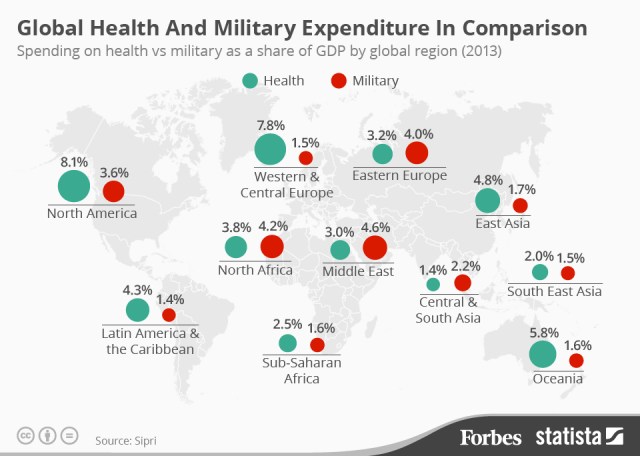
The US military is smaller than it was on 9/11, but costs 50% more

UK Court dismisses charges against arms fair protesters
Great news.
District judge Angus Hamilton, sitting at Stratford magistrates court, said the defence had presented clear and credible evidence that illegal activity had been conducted at the Defence Systems and Equipment International (DSEI) arms fair in previous years, and that police arresting the activists had failed to investigate to ensure it was not happening again.
TPP, New Balance and the Pentagon
New Balance is renewing its opposition to the far-reaching Pacific Rim trade deal, saying the Obama administration reneged on a promise to give the sneaker maker a fair shot at military business if it stopped bad-mouthing the agreement. Continue reading
F35: Better Ways to Spend a Trillion Dollars
The Pentagon’s waste and why we should do something about it
Please go on to read the whole article, link at the end.
From spending $150 million on private villas for a handful of personnel in Afghanistan to blowing $2.7 billion on an air surveillance balloon that doesn’t work, the latest revelations of waste at the Pentagon are just the most recent howlers in a long line of similar stories stretching back at least five decades. Other hot-off-the-presses examples would include the Army’s purchase of helicopter gears worth $500 each for $8,000 each and the accumulation of billions of dollars’ worth of weapons components that will never be used. And then there’s the one that would have to be everyone’s favorite Pentagon waste story: the spending of $50,000 to investigate the bomb-detecting capabilities of African elephants. (And here’s a shock: they didn’t turn out to be that great!) The elephant research, of course, represents chump change in the Pentagon’s wastage sweepstakes and in the context of its $600-billion-plus budget, but think of it as indicative of the absurd lengths the Department of Defense will go to when what’s at stake is throwing away taxpayer dollars. Continue reading
US Defense Secretary: TTP is all about US interests
TTP should be ratified because of its economic and strategic benefits, and because we must recognize what the alternative to TPP really is: a regional economy with standards that don’t serve American interests, and one that’s carved up by lop-sided, coercively negotiated, lower-standard deals. That’s why I’ve said that TPP is as strategically important to the rebalance as an aircraft carrier, and I strongly urge Congress to approve TPP this year.
Militarily, the Department of Defense is operationalizing the next phase of the rebalance, and cementing it for the long term.
 Tipping Point North South