
Total 2015 defense revenues for the Top 100 companies came in at $356.7 billion, down more than 7 percent from the 2014 Top 100 total of $385.8 billion. The top 25 companies accounted for 73 percent of total defense revenues in the year, and the Top 10 firms accounted for 54 percent of total defense revenues in the year, an improvement from the last two cycles, which saw that percentage drop a point each in 2013 and 2014.
Geographically, 41 of the Top 100 firms are based in the US, which accounted for 60 percent of total defense revenue, up from 54 percent in 2014 – a sign that even as other nations expand their defense industries, American companies remain dominant on the global stage. Europe has 27 companies featured, which increases if Russia’s six major defense companies are included, while the Asia-Pacific region has 17 companies. In contrast, Africa and South America were represented by a single firm each. …
Continue reading
Category Archives: The 5% Campaign
News and analysis
Super Power, Global Power, Regional Power and Local Power
The United States took the top slot as the world’s super power, while Britain took the only Global Power slot, bringing her in second behind America.
Regional powers include France, China, India and Germany, while local powers were those such as Italy, Brazil, and Turkey.
Continue reading
UK, the second biggest arms dealer in the world
Britain is now the second biggest arms dealer in the world, official government figures show – with most of the weapons fuelling deadly conflicts in the Middle East.
Since 2010 Britain has also sold arms to 39 of the 51 countries ranked “not free” on the Freedom House “Freedom in the world” report, and 22 of the 30 countries on the UK Government’s own human rights watch list.
Continue reading
The U.S. Army Lost Track of $6.5 Trillion
The Army made headlines in mid-August 2016 when a Defense Department Inspector General report landed with a heavy thud. The 75-page reportdetailed all the ways the Army screwed up its accounting of the Army General Fund in 2015.
According to the report, Army bookkeepers screwed up the budget to the tune of … $6.5 trillion dollars.
U.S. Defense Contractors: Russian Threat Is Great for Business
Retired Army Gen. Richard Cody, a vice president at L-3 Communications, the seventh largest U.S. defense contractor, explained to shareholders in December that the industry was faced with a historic opportunity. Following the end of the Cold War, Cody said, peace had “pretty much broken out all over the world,” with Russia in decline and NATO nations celebrating. “The Wall came down,” he said, and “all defense budgets went south.”
Now, Cody argued, Russia “is resurgent” around the world, putting pressure on U.S. allies. “Nations that belong to NATO are supposed to spend 2 percent of their GDP on defense,” he said, according to a transcript of his remarks. “We know that uptick is coming and so we postured ourselves for it.”
Continue reading
The mission of the F-35
The F-35 Joint Strike Fighter is possibly one of the most useless jets and biggest waste of taxpayer money ever conceived by the US military. In fact, according to Pierre Sprey, one of the three men that created the F-16, the point of this plane is “to spend money.” He clarifies, “that is the mission of the airplane, is for the US Congress to send money to Lockheed [Martin].”
£1bn of weapons flow from Europe to Middle East
Thousands of assault rifles such as AK-47s, mortar shells, rocket launchers, anti-tank weapons and heavy machine guns are being routed through a new arms pipeline from the Balkans to the Arabian peninsula and countries bordering Syria.
The suspicion is that much of the weaponry is being sent into Syria, fuelling the five-year civil war, according to a team of reporters from the Balkan Investigative Reporting Network (BIRN) and the Organised Crime and Corruption Reporting Project (OCCRP).
Arms export data, UN reports, plane tracking, and weapons contracts examined during a year-long investigation reveal how the munitions were sent east from Bosnia, Bulgaria, Croatia, Czech Republic, Montenegro, Slovakia, Serbia and Romania.
Continue reading
Trident
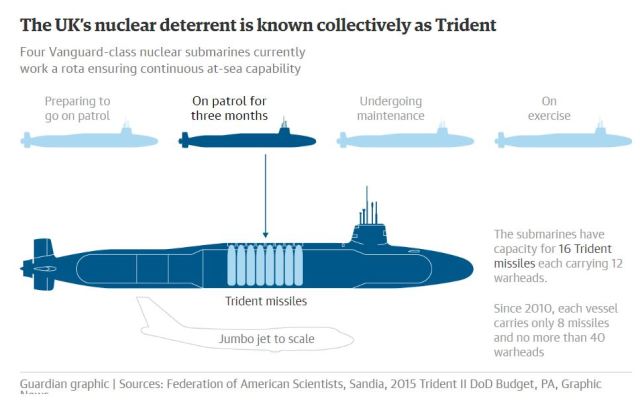
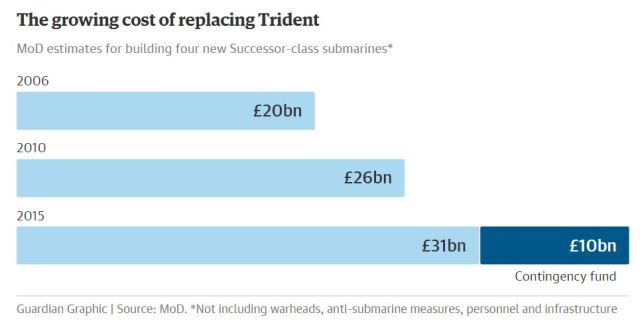
Cripin Blunt on Trident
Cripin Blunt, the Conservative chair of the Commons foreign affairs committee, spoke after Angus Robertson in the debate and he said he would not be voting for Trident renewal.
Earlier, in an intervention, he said that his current estimate was that Trident renewal would have a lifetime cost of £179bn.
- Blunt said Trident renewal would be “the most egregious act of self-harm to our conventional defence”.
USA, Militization, Japan
TNI: War Profiteers Are Now Refugee Profiteers
The report (pdf), Border Wars: The Arms Dealers Profiting from Europe’s Refugee Tragedy, released jointly by the European Stop Wapenhandel and Transnational Institute (TNI) on Monday, outlines arms traders’ pursuit of profit in the 21st century’s endless conflicts.
“There is one group of interests that have only benefited from the refugee crisis, and in particular from the European Union’s investment in ‘securing’ its borders,'” the report finds. “They are the military and security companies that provide the equipment to border guards, the surveillance technology to monitor frontiers, and the IT infrastructure to track population movements.”
Continue reading

What Brexit teaches us about communications
- Facts alone are not enough to win the argument
- Relying on expert opinion to build public engagement can sometimes backfire
- Tell a good story
- Identify messages of hope
Former CIA Officer Amaryllis Fox’s lesson from undercover life
Illegal drug profits, Washington’s foreign military outflows of dollars, and US balance of payments deficit
Hudson’s next task was to estimate the amount of money from crime going into Switzerland’s secret banking system. In this investigation, his last for Chase, Hudson discovered that under US State Department direction Chase and other large banks had established banks in the Caribbean for the purpose of attracting money into dollar holdings from drug dealers in order to support the dollar (by raising the demand for dollars by criminals) in order to balance or offset Washington’s foreign military outflows of dollars. If dollars flowed out of the US, but demand did not rise to absorb the larger supply of dollars, the dollar’s exchange rate would fall, thus threatenting the basis of US power. By providing offshore banks in which criminals could deposit illicit dollars, the US government supported the dollar’s exchange value.
Continue reading
Cerberus and the profits of mass murder
But Cerberus is also very big in guns. It is run by people for whom everything is just business, from firesales to firearms, from Irish property deals to selling weapons of war to anyone who wants them. The connection between Belfastand Orlando reminds us of a truth that is easily forgotten – behind every mass shooting by a deranged psychopath in the US is a very profitable industry owned by Ivy League graduates with clean hands and manicured nails, respectable people who fund politicians in Congress and host charity galas inManhattan. If they had a slogan it would be the old Roman adage, pecunia non olet – money has no smell.
Continue reading
F-18 fighter jet – a “nice margin generator.”
“F-18 has been a great program for this company and continues to be,” CFO Ken Bedingfield told investors this week at Citi’s Industrials Conference in Boston, adding that it’s also a “nice margin generator.”
Continue reading
“Sabre-rattling and war-mongering” was not the way to treat Russia
An extraordinary demarche came at the weekend from the German foreign minister, Frank-Walter Steinmeier. In an interview with Bild am Sonntag newspaper, he accused Nato – an alliance, lest we forget, of which Germany is a member – of “sabre-rattling and war-mongering” by staging military manoeuvres close to Russia’s borders. This, he said, was not the way to treat Russia; it was time to restart dialogue.
Continue reading
Global nuclear weapons 2016
At the start of 2016 nine states—the United States, Russia, the United Kingdom, France, China, India, Pakistan, Israel and North Korea—possessed approximately 4,120 operationally deployed nuclear weapons. If all nuclear warheads are counted, these states together possessed a total of approximately 15,395 nuclear weapons compared with 15,850 in early 2015 (see table 1).
Continue reading

Big increases in small arms trade
But from 2012 to 2013, the global small arms trade jumped to a total of USD 6 billion worth of small arms, an increase of 17 per cent/ $1 billion in only one year, according to the report titled “Trade Update 2016: Transfers and Transparency”
The United States was, by far, both the largest exporter and importer. It exported $1.1 billion, while only two other countries – Italy and Germany – surpassed the $500 million mark in exports.
Transfers of small arms to the U.S. accounted for 42 per cent of all imports.
Sixteen exporters surpassed $100 million in 2013, the largest number since the survey began in 2001.
And although this is the most comprehensive data set on small arms transfers, these numbers are most likely much higher, since 40% of information on imports and exports were concealed by states, said Senior Researcher for the Small Arms Survey, Nicolas Florquin. Continue reading
Health workers say stop arms sales to Saudi!
The Medact Arms Control Group:
Open letter to the Secretary of State of Business, Innovation and Skills (BIS), Sajid Javid. BIS are in charge of licensing arms sales.
STOP FUELLING THE YEMEN CONFLICT
End all UK arms sales to Saudi Arabia
It is now over a year since the recent outbreak of armed conflict in Yemen began, forcing 2.4 million people to flee their homes, and leaving over 22 million people in need of humanitarian support. The conflict has killed over six thousand people, and left the health care system on its knees.
Humanitarian agencies are struggling to respond and the country stands on the brink of famine. A senior representative of Médecins Sans Frontières (MSF) has described the current level of humanitarian assistance in Yemen as a “drop in the ocean.”
Continue reading
 Tipping Point North South