
As explained by William Davies in his “Neoliberalism: A Bibliographic Review“:
Definitions of neoliberalism across these literatures are various. But they tend to share four things:
Continue reading
As explained by William Davies in his “Neoliberalism: A Bibliographic Review“:
Definitions of neoliberalism across these literatures are various. But they tend to share four things:
Continue reading
This from Karl Smith, a professor of public economics and government at the University of North Carolina-Chapel Hill:
A good rule of thumb – I believe – for epidemics economic, biological or social is this: If it spreads along lines of communication its entropic information. If it travels along major transportation routes its microbial. If it spreads out like a fan, its an arthropod. If its everywhere, all at once, its a molecule.
I read this commentary article about the news that
In early March, Taiwan’s defense minister Yen Ming estimated the island nation could resist a Chinese onslaught “at least one month”—and that’s assuming other countries aid in Taipei’s defense.
The point of the article is that Taiwan has only itself to blame for its hopelessness against a Chinese invasion because why have Taiwan not kept up their military spending with China’s ever increasing military budget.
Continue reading
Tony Benn’s Five Questions:
Ask the powerful five questions
- What power have you got?
- Where did you get it from?
- In whose interests do you exercise it?
- To whom are you accountable?
- How can we get rid of you?
Ukraine is now divided and Russia has occupied Crimea. The following information and analyses were quite helpful for me to understand the situation and shape my thoughts.
Continue reading
Guardian had put together an interactive timeline of Britain’s 100 years of conflict. It shows that the UK has been at wars or involved in military conflicts with at least one other country/opposing group every year since 1914.
This is in addition to the revelation in 2012 that only 22 countries in the world have not been invaded by Britain in its history.
Continue reading
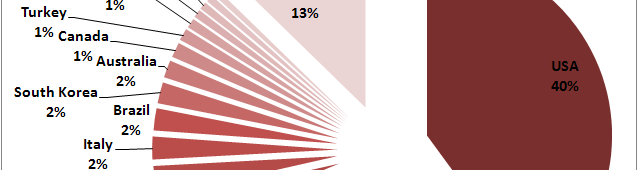
There is a huge imbalance of national military spending around the world. Just the top 10 spenders alone account for 76% of the total global military spending. If we add in the next 10 top spenders, the top 20 spenders together spend 87% of the global total, that’s nearly 7 times as much as the rest of the world combined. In SIPRI’s research, they consider 170 countries out of nearly 200 independent countries in the world, no data is available for 34 countries in 2012. Nevertheless, that still leave us more than 100 countries in the rest of the world group.
Continue reading
In addition to removing the universal right to healthcare, which has existed since 1948, the HSC Act also opens the door for charges without limit for NHS services. It permits private providers to take over any NHS services. And it allows up to 49% of the business of NHS hospitals to be private. Quite apart from the fact that the intention is almost certainly to eventually increase this percentage to 100% – ie: create a US-style insurance-based system – this will create a health system with two queues: one for the poor and one for the rich. In a cash-strapped system, a rich person with a minor ailment will be treated over a poor person with a more serious ailment. “Care will never again be according to need but ability to pay,” says Dr Clare Gerada, Chair of the Royal College of GPs. Continue reading
 Tipping Point North South