Man has put the vast majority of carcinogens into the environment and he can, if he wishes, eliminate many of them. The most determined effort should be made to eliminate those carcinogens that now contaminate our food, our water supplies, and our atmosphere, because these provide the most dangerous types of contact – minute exposure repeated over and over throughout the years.
Silent Spring 1962
RACHEL CARSON marine biologist, writer and conservationist
In the year 1962, Rachel Carson was not only another breast cancer statistic, but the woman whose writing skills and scientific acumen shocked the world upon publication of ‘Silent Spring’ in which her research findings of irreversible reproductive and genetic damage to aquatic-life forms resulting from the use of pesticides were presented in her signature narrative style. Her attention to smaller aquatic life forms at the bottom of the food-chain revealed the multiplier effect for life forms at higher levels, with major predictable effects for we humans in our position at the top of the chain. The changes being observed and recorded by Carson were an early warning of the future scenario for all life forms. As such they still stand as the first scientifically-based predictions of both real and potential harm to life from manmade chemicals.
Fifty years on and the shocking difference between then and now is that there are many thousands more manmade chemicals being produced and released into the environment than the number developed by the smaller scale post-war chemicals industry of Carson’s time. Many of these are linked to breast cancer risk and right now there is a battle to ensure that post-Brexit UK remains within existing EU chemicals legislation (REACH), which is regarded as the best in the world. Continue reading →
The UK House of Commons Environmental Audit Committee (EAC) has today published the report of its inquiry on chemicals regulation after the EU referendum, which particularly focussed on the EU’s world-leading REACH system for regulating chemicals. The EAC criticise the UK Government’s lack of openness about its post-Brexit plans, and point out that most respondents want the UK to remain ‘as closely aligned to REACH as possible‘.
The EAC’s main conclusions
The chemicals regulation framework established by the EU through REACH is difficult to transpose directly into UK law. Writing EU regulations into UK law could not be done simply by having a line in the “Great Repeal Bill” deeming REACH to apply in the UK. REACH was written from the perspective of participants being within the EU, with much of it also relating to Member State co-operation and mutual obligations, oversight and controls, and freedom of movement of products
From Balfour to the present day: a century of colonialism in Palestine
This year’s November 2nd marks the centenary of the Balfour Declaration of 1917. It signifies 100 years of suffering of the Palestinian people and the colonisation of their land.
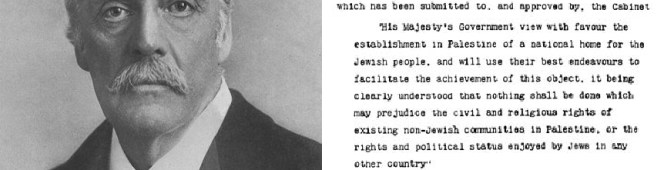
In 1917 the British Foreign Secretary Arthur Balfour wrote a letter to the wealthy British banker and Zionist Lord Rothschild, in which he declared :
“His Majesty’s government view with favour the establishment in Palestine of a national home for the Jewish people, and will use their best endeavours to facilitate the achievement of this object, it being clearly understood that nothing shall be done which may prejudice the civil and religious rights of existing non-Jewish communities in Palestine, or the rights and political status enjoyed by Jews in any other country.”
This short letter had no legal status, but was later incorporated within the terms of Britain’s Mandate for Palestine. Thus it became one of the most significant documents leading eventually to the creation of the state of Israel and the on-going quagmire of the Israel-Palestine conflict.
From the outset the Declaration was controversial, and almost all the opposition came from within the Jewish community itself, because very few Arabs were even aware the existence of such a proposal. The Declaration was seen largely as a means for diverting Jewish immigration from Britain to Palestine. The most prominent British Jewish politician of the day, Sir Edwin Montagu, opposed it vigorously. Later, when the language of the Balfour Declaration was included in the Mandate for Palestine, the House of Lords voted to reject this in a motion passed by 60 to 29, on the ground that the Declaration was opposed to the “wishes of the great majority of the people of Palestine”.
The spate of calls for Jeremy Corbyn to quit since last week’s byelections in Stoke and Copeland has been as predictable as it was premeditated. It says everything about the political agenda of the media, and nothing about people’s real needs and experiences.
I went to Stoke and Whitehaven, in Cumbria, a few days before polling. Momentum arranged screenings of Daniel Blake. We went to Labour clubs in neglected areas, old estates away from the centre. At one club I was asked: “Why have you come here? No one comes here.”
Joe Bradley and Georgie Robertson, the organisers, were a model of how Labour activists should work: full of energy, hard-working and brilliantly efficient. They had a warm greeting for everyone, checked the screening facilities, made space for local contributors so people from that community felt it was their event and that they were being heard. This is how Labour can reconnect.
Both screenings were packed. The discussions were passionate, informed and invigorating, a world away from the tired cliches of the public discourse. This was not a marketing exercise but a real engagement with people and their concerns.
The failure of Labour governments – and, importantly, Labour councillors – was a common theme. It is not hard to see the neglect around Stoke. Solid Labour, for sure, but what good has it done them? A 2015 report into the area found 60,000 people in poverty, 3,000 households dependent on charity food, and £25m in council tax arrears. The presence of the BNP, now replaced by Ukip, shows how Labour’s failure left space for the far right.
It was a similar story in Copeland. Industries have been lost – steel, mines, a chemical factory – without any plan to replace them. Labour is seen to be as culpable as the Tories. Someone said that in Copeland it was an anti-establishment vote, and Labour is the local establishment. It was a vote against Tony Blair, Gordon Brown and previous MPs Jack Cunningham and Jamie Reed.
In both constituencies the Labour candidates, neither from the left of the party, were invited, but both candidates ignored the meetings. With coverage on television, radio and the press, this is bizarre. Could it be because Momentum were the organisers? We were there to support Labour. There was not even the courtesy of a reply. Continue reading →
PROJECT 2018 Poor People’s Call to Action – Dr. King’s work re-envisioned fifty years on
Next April 2018 will mark the 50th anniversary of the assassination of Dr. Martin Luther King. His ‘last great exertion’ in 1967/68 was The Poor People’s Campaign – a march on Washington DC that was a more radical effort than 1963. Its aim was to get racial and economic justice for all poor Americans. He was becoming an ever greater threat to anti-progressive forces as he realised that, in addition to race, class was becoming an equally critical part of the struggle. At what was to become the end of his life, he was now mobilising black and white Americans.
At the heart of this campaign was an Economic Bill of Rights, addressing employment, health, education, land, finance and participatory government. Today in the USA, there is a renewed push to mark and re-envision the Poor People’s Campaign.
We think the time is right to build on those USA efforts and today we launch a new project to ‘internationalise’ Dr. King’s Poor People’s Campaign and place a renewed vision for the Economic Bill of Rights at its heart.
Why? Because 50 years since Dr. King’s death
The USA, UK and many other rich nations are more unequal now than in 1968 with greater levels of poverty – and in the USA with far greater levels of incarceration and war spending.
The richest 85 people across the globe share a combined wealth of £1trillion, as much as the poorest 3.5 billion of the world’s population.
And 69 out of the world’s top 100 economies are corporations.
Dr. King’s calls in 1967/68 speak to the present day, not least in his ever growing critique of capitalism, poverty and inequality.
“You can’t talk about solving the economic problem of the Negro without talking about billions of dollars. You can’t talk about ending the slums without first saying profit must be taken out of slums. You’re really tampering and getting on dangerous ground because you are messing with folk then. You are messing with captains of industry. Now this means that we are treading in difficult water, because it really means that we are saying that something is wrong with capitalism.”
Speech to staff, 1966
“If America does not use her vast resources of wealth to end poverty and make it possible for all of God’s children to have the basic necessities of life, she too will go to hell.”
Bishop Charles Mason Temple of the Church of God in Christ in support of the Memphis sanitation workers’ strike on March 18th, 1968, two weeks before he was assassinated.
Over the coming year PROJECT 2018 A Poor People’s Call to Action is reaching out to partners across the secular and non-secular spectrum to call for April 2018 as the first of five major mobilisations between 2018 and 2028 with King’s updated Economic Bill of Rights at their heart – mobilisations that link USA social justice movements with other social justice movements around the world.
This is the time for a global call-out of governments, institutions, big corporations and business. The 50-year anniversary of the life and work left by Dr King presents us with an opportunity to join hands, voices and actions together in our shared quest for peace and justice
In solidarity
Dionne, Deborah, Yolande and Ho-Chih.
In 2018 it will be 50 years since Martin Luther King was assassinated. His ‘last great exertion’ in 1967/68 was the Poor People’s Campaign and Economic Bill of Rights.
Project April 2018 proposes the internationalising of the 1968 Poor People’s campaign with the first of 5 global mobilisations over the coming decade 2018-2028 linking USA social justice movements with other social justice movements around the world
Project April 2018 proposes linking these mobilisations with a renewed international recognition and call for Dr King’s ambitious 1968 Economic Bill of Rights – updated for today, it offers a universal economic bill of rights fit for the 21stcentury that will reverse economic inequalities, racism, militarism and climate change. All these factors combined are destroying families, communities, nations and the very planet we live on.
Project April 2018 – international mobilisations and a renewed Economic Bill of Rights
PROJECT 2018 Poor People’s Call to Action – Dr. King’s work re-envisioned fifty years on
Next April 2018 will mark the 50th anniversary of the assassination of Dr. Martin Luther King. His ‘last great exertion’ in 1967/68 was The Poor People’s Campaign – a march on Washington DC that was a more radical effort than 1963. Its aim was to get racial and economic justice for all poor Americans. He was becoming an ever greater threat to anti-progressive forces as he realised that, in addition to race, class was becoming an equally critical part of the struggle. At what was to become the end of his life, he was now mobilising black and white Americans.
At the heart of this campaign was an Economic Bill of Rights, addressing employment, health, education, land, finance and participatory government. Today in the USA, there is a renewed push to mark and re-envision the Poor People’s Campaign.
We think the time is right to build on those USA efforts and today we launch a new project to ‘internationalise’ Dr. King’s Poor People’s Campaign and place a renewed vision for the Economic Bill of Rights at its heart. Continue reading →
Dear colleagues and friends, supporters and funders,
Season’s Greetings
It’s been a tough year. We end 2016 with the June Brexit vote and Trump election win in November; devastating conflicts in Syria and Yemen and news that has seen Arctic temperatures rising far higher and faster than scientists had predicted.
After Trump’s USA election win, there were some in the USA who drew strength from the idea that it’s ‘darkest just before the dawn’ and that now is the time for progressives to rise to the challenge with policies and campaigns that can push the far-right back. Let’s hope this observation proves to be the case as we do all we can to support those ever-growing justice movements around the world who are fighting to make this a reality.
Below is our 2016 round-up. Please be in touch if you want to know more, get involved or help our work in any way. Where-ever we are, what-ever we do, there’s a lot to ‘push back’ in the coming months and years.
Open Bethlehem continues its journey with releases across the Middle East and North America and we were thrilled that our partners Development & Peace hosted our Canadian premiere in Montreal. “A ninety-minute epic that transcends politics andnormal cinema” wrote Daoud Kuttab, Middle East Monitor. The film is now on demand at Vimeo https://vimeo.com/ondemand/openbethlehem and DVD (£15.99) can be purchased here
CAMPAIGNS
Make Apartheid History Our December 2015 calendar was very well received and our WALL video went viral . In July, we marked MANDELA DAY with our first year video highlight loop and in August, we were delighted to showcase MAH at the Edinburgh Fringe and on the opening night of the Greenbelt Festival
From Pink to Prevention & environmental links to breast cancer A busy year! In February we finally secured a meeting with the CEO of UK’s leading breast cancer charity Breast Cancer Now (formerly Breakthrough Breast Cancer) and a blog of this important meeting is here. In May, we shared our Rachel Carson Day communication and we had a very active October Breast Cancer Awareness Month with interactive posters; an Early Day Motion tabled by Caroline Lucas; and book launch of writing by the late USA activist Barbara Brenner, hosted by UNISON. We ended the year with an article published in ‘Women & Environments’- a leading international magazine celebrating its 40th anniversary and illustrated by our campaign colleague Di Ward.
Five Percent Campaign – military spending is a ‘development issue’. In October, we attended the International Peace Bureau’s annual global gathering in Berlin. Subsequent to our presentation, strong new Five Per Cent campaign contacts were secured in East Africa, Australia and USA and in November, we were invited to present the campaign to a regional East African peace movement gathering in Uganda.
EVENTS
Martin Luther King’s Economic Bill of Rights from 1968 to 2018 and beyond. Marking the 50th anniversary of the assassination of Dr Martin Luther King, Project April 2018 puts his 1968 Economic Bill of Rights at the heart of a renewed global call for us all to march on power with a progressive manifesto for transformative change. Working with partners in the USA, key founding documents are now being finalised. We aim to soft launch in the USA on MLK Day January 2017.
Attlee Festival October 2017 Reviving the much under-valued story of Clement Attlee with a fresh, contemporary cultural project looking at his legacy. This year we have been refining the project and discussing with potential partners, venues and contributors. The Attlee Nation and Unity Festival will explore how, 70 years before, politicians did push back powerful vested interests for a caring social democracy and what lessons we can bring forward for today’s vision for the future.
Next year…
Alongside the projects above, next year will see us embark on several new film partnerships which connect to our three campaigns (5%, From Pink to Prevention and Make Apartheid History).
We will also develop next-stage development of a TPFF-led documentary ‘Generosity towards the Future’. This is a project designed to lift the level of political understanding through high quality ‘essay’ or ‘vision’ films on critical issues facing ordinary British people today – rising poverty; Dickensian levels of inequality; the utter failure of housing policy; crisis across the NHS.
Finally, a big thank-you to our funders
The Ratcliff Foundation, Polden-Puckham Charitable Foundation, Amiel and Melburn Trust, Trust Greenbelt; major donors and regular givers.
Dear colleagues and friends, supporters and funders,
Season’s Greetings
It’s been a tough year. We end 2016 with the June Brexit vote and Trump election win in November; devastating conflicts in Syria and Yemen and news that has seen Arctic temperatures rising far higher and faster than scientists had predicted.
After Trump’s USA election win, there were some in the USA who drew strength from the idea that it’s ‘darkest just before the dawn’ and that now is the time for progressives to rise to the challenge with policies and campaigns that can push the far-right back. Let’s hope this observation proves to be the case as we do all we can to support those ever-growing justice movements around the world who are fighting to make this a reality.
Below is our 2016 round-up. Please be in touch if you want to know more, get involved or help our work in any way. Where-ever we are, what-ever we do, there’s a lot to ‘push back’ in the coming months and years. Continue reading →
When you watch Trump surrogates or key Brexiteers on TV – and I have, painfully, for hours – some common tactics immediately emerge. One is dedication. The populist right has no qualms over hogging airtime, talking continuously and batting off attempted interruptions and just relentlessly, repeatedly hammering the case on and on until their political opponent is exhausted and overwhelmed and gives up trying. To nice progressives, this approach seems rude – it feels aggressive. This will be 10 times truer for women, who are already battling all kinds of biases and who, however little they speak, will often be viewed as monopolising airtime.
But there is something to be said for taking up more space – politely, while making clear that your point deserves and commands attention. Continue reading →
Indeed, a revolution had occurred. But the contours of that revolution would not be clear for decades. In 1974, young liberals did not perceive financial power as a threat, having grown up in a world where banks and big business were largely kept under control. It was the government—through Vietnam, Nixon, and executive power—that organized the political spectrum. By 1975, liberalism meant, as Carr put it, “where you were on issues like civil rights and the war in Vietnam.” With the exception of a few new members, like Miller and Waxman, suspicion of finance as a part of liberalism had vanished.
Over the next 40 years, this Democratic generation fundamentally altered American politics. They restructured “campaign finance, party nominations, government transparency, and congressional organization.” They took on domestic violence, homophobia, discrimination against the disabled, and sexual harassment. They jettisoned many racially and culturally authoritarian traditions. They produced Bill Clinton’s presidency directly, and in many ways, they shaped President Barack Obama’s.
The result today is a paradox. At the same time that the nation has achieved perhaps the most tolerant culture in U.S. history, the destruction of the anti-monopoly and anti-bank tradition in the Democratic Party has also cleared the way for the greatest concentration of economic power in a century. This is not what the Watergate Babies intended when they dethroned Patman as chairman of the Banking Committee. But it helped lead them down that path. The story of Patman’s ousting is part of the larger story of how the Democratic Party helped to create today’s shockingly disillusioned and sullen public, a large chunk of whom is now marching for Donald Trump. Continue reading →
From Pink to Prevention activities & toolkit this Breast Cancer Prevention Month
Dear friends, supporters and colleagues,
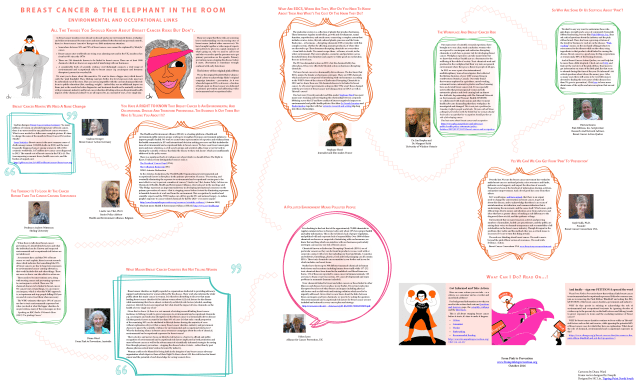
As we find ourselves mid-way through the global fundraising phenomena that is Breast Cancer Awareness Month, we askare environmental and occupational links to the disease ‘an elephant in the room’?
We want to draw attention to a breast cancer narrative that is excluded from the ‘pink’ limelight.
For decades now, scientists and activists alike have argued that the persistent exclusion of environmental and occupational risk factors for breast cancer (eg carcinogens and hormone disrupting chemicals) by government, breast cancer charities and industry is, at the very least baffling and, at worst, obstructing a basic public health right to know. We argue that the time has come for policy-makers to explain why they are refusing to acknowledge the evidence that links these risk factors to breast cancer.
We hope you find something of interest in our activities listed below – from our new online toolkit, to our book launch on 31st October, to our calls for action on breast cancer charities and politicians alike. Help us widen the breast cancer risk-factor debate – and let everyone know about this ‘elephant in the room’ each and every October.
Best wishes
Deb, Diana, Helen & Ho-Chih From Pink to Prevention Campaign
ONLINE TOOLKIT TO HELP WIDEN THE DEBATE ON BREAST CANCER RISK FACTORS
From Pink to Prevention has produced an online ‘tool-kit’ to help you understand the nature of the problem we are facing – both in terms of the links between environmental and occupational risk factors as well as the inaction of those with the power to address it. It includes an interactive webpage, PDF and poster which brings together some of the leading experts, writers and campaigners from across Europe (Belgium, France, Germany, UK), USA, Canada, Australia and the Philippines; it also includes films to watch, in-depth resources and how to take action. Please share as widely as you can.
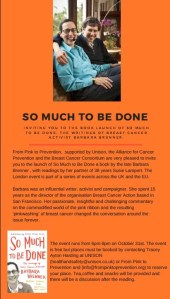
BOOK LAUNCH MONDAY 31ST OCTOBER 6PM-8PM.
From Pink to Prevention supported by Unison, the Alliance for Cancer Prevention and the Breast Cancer Consortium, are hosting the launch of So Much to Be Done, a book of writings by the late Barbara Brenner, with readings by her partner of 38 years Susie Lampert. Barbara was 15 years as the director of the hugely influential organisation Breast Cancer Action based in San Francisco and was a leading contributor to the film Pink Ribbons, Inc.
Venue: UNISON Café 130 Euston Road London NW1 2 AY
Event is free. Please RSVP to info@frompinktoprevention.org
Tea, coffee and snacks will be provided.
SPREAD THE WORD AND SIGN OUR BIG QUESTION PETITION
We advocate that better diagnostics and treatment is not mutually exclusive with looking at how our profoundly polluted environment, homes and workplaces impact on our bodies and health, while also taking into consideration the ‘precautionary principle’ – better safe than sorry. https://www.change.org/p/breast-cancer-charities-remove-the-pink-ribbon-blindfold-and-ask-the-big-question-3
EARLY DAY MOTION
We are delighted that Caroline Lucas MP will table an Early Day Motion to Parliament calling upon the Government to act upon the urgent inclusion of environmental and occupational risk factors into all National Cancer Plans and strategies.
It will run until spring 2017. We would like to get as many MPs signing as possible. Once our EDM is live, we will let you know!
From Pink to Prevention activities & toolkit this Breast Cancer Prevention Month
Dear friends, supporters and colleagues,
As we find ourselves mid-way through the global fundraising phenomena that is Breast Cancer Awareness Month, we askare environmental and occupational links to the disease ‘an elephant in the room’?
We want to draw attention to a breast cancer narrative that is excluded from the ‘pink’ limelight.
For decades now, scientists and activists alike have argued that the persistent exclusion of environmental and occupational risk factors for breast cancer (eg carcinogens and hormone disrupting chemicals) by government, breast cancer charities and industry is, at the very least baffling and, at worst, obstructing a basic public health right to know. We argue that the time has come for policy-makers to explain why they are refusing to acknowledge the evidence that links these risk factors to breast cancer. Continue reading →
Everyone knows that wealth is unequally distributed. The work of Thomas Piketty has made this a mainstream concern. But the magnitude of the gap between white and black Americans is on a different scale. According to a recent report from two progressive think tanks, CFED and the Institute for Policy Studies, white households own, on average, seven times as much wealth as African-American households (and six times as much as Latino ones). The Forbes 100 billionaires are collectively as rich as all black Americans combined. At current growth rates, it would take black Americans two hundred and twenty-eight years to have as much wealth as white Americans have today.
Some of the reasons are clear: the unemployment rate among black Americans is roughly twice that of whites, and black people earn, on average, between twelve and twenty-two per cent less than white people with similar education and experience. But the wealth gap between black and white Americans is much bigger than the income gap, thanks to a toxic combination of institutionalized discrimination, persistent racism, and policies that amplify inequality. As Thomas Shapiro, a sociologist at Brandeis and the co-author of the seminal book “Black Wealth/White Wealth,” told me, “History and legacy created the racial gap. Policies have maintained it.” Together, they contribute to what he’s called “the hidden cost of being African-American.” Continue reading →
Of the features of modern society that exacerbate that fear and threaten that hope, the distribution of wealth may not be the most important. Money matters to people, but status matters more, and precisely because status is something you cannot buy. Status is related to identity as much as it is to income. It is also, unfortunately, a zero-sum game. The struggles over status are socially divisive, and they can resemble class warfare.
Dear friends, supporters and colleagues,We hope there is something here for everyone in our autumn round-up, whether film related, campaign related – or both.
It’s been a summer where we have seen no let-up of the horrors inflicted by all sides on the people of Syria; calls to halt the sales of UK arms to Saudi Arabia as it continues its attacks on Yemen’s civilian population; Donald Trump seemingly rising in the polls; confusion after Brexit; and an unhealthy media preoccupation with Jeremy Corbyn resulting in attention to deeper domestic issues inevitably being sidelined.
But we are seeing progress in one hugely significant area. TTIP is now on the ropes. It has been a long battle – and it’s not over yet – but it proves that civil society’s determination to take on huge vested interests can pay off, as hundreds of thousands citizens across the EU who took part in the effort to stop TTIP can testify to.
We are working across a variety of projects that connect with many of the issues above. A short round-up is below. As always, a big thanks to ALL our funders – individuals and grant-makers alike.
Best wishes
From all at Tipping Point North South
FILMS TO WATCH
We Are Many is now available to buy on iTunes and DVD. The release of the Chilcot Report led to a second wave of interest in Amir’s film with numerous screenings across the UK. This included a special TPFF hosted post-Chilcot Report event at Friends Meeting House in London, home to the first anti-Iraq war movement meeting; and a special Oxford city screening with Larry Sanders, brother of Bernie, who joined Amir for the post film debate. And with the ongoing attention on Jeremy Corbyn, a contributor throughout the film, WeAre Many also remains pertinent to current Labour Party debates as well as wider public debate, on the subject of UK foreign and military policy-making.
Open Bethlehem We are delighted that the English language version can now be streamed here on Vimeo. Leila’s film is now on release in Canada and the Montreal premiere was made possible with support from our Candian funding partners, Development and Peace. This follows on the heels of a successful spring /summer tour of Middle East countries, including several very special screenings in Bethlehem itself. Here’s a review describing Open Bethlehem as one of the five films to help you understand the modern Arab world. Finally, as of this month, we welcome Sara Apps, formerly Palestine Solidarity Campaign, to the Open Bethlehem team.
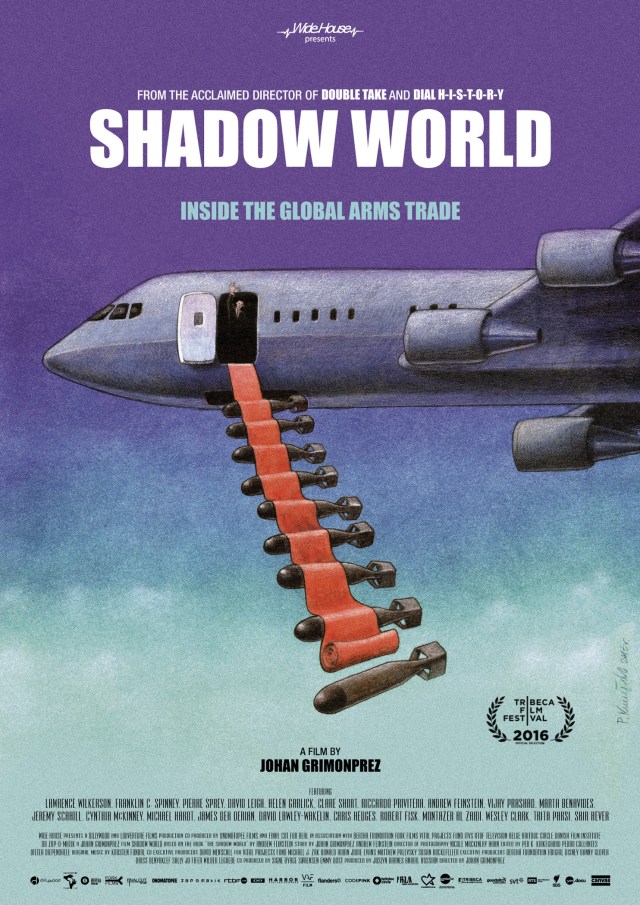
The Shadow World The Edinburgh Film Festival’s Best Cinema Documentary prize went to this eye-opening documentary about the shocking realities of the global arms trade. Director Johan Grimonprez and writer Andrew Feinstein pose the question ‘will we be allowed to choose peace over the business of war’? The film is based on Feinstein’s extraordinary book of the same name which uncovered the real cost of war, the way the arms trade drives it and how weapons are now being turned against the citizens of liberal democracies. We hope to work with this film in 2017 and in relation to our Five Per Cent campaign on runaway military spending.
And connected to our work this coming October Breast Cancer Awareness month, why not take a look at the brilliant work of French investigative journalist and film-maker Stephane Horel.We are looking forward to working with both her films Endocrination and Le Grande Invasion as part of our From Pink to Prevention campaign activity (more below). Stéphane has investigated the links between business, government and public health policy, with a special focus on a class of chemicals called endocrine (hormone) disruptors.
CAMPAIGNS
Make Apartheid History We marked our first year’s activity on Mandela Day (July 18th) and released a short highlights compilation video, which was screened as part of Palestine related events at the Edinburgh Festival (Café Palestina) and Greenbelt Festival, where TPFF hosted an event showcasing our MAH work. Next year sees some significant anniversaries including 100 years since the Balfour Declaration – we are working with our MAH partners on plans to mark this and other key calendar moments in 2017.
The Five Percent Campaign The UK is now number 2 in the world’s arms sales table, thanks largely to the conflicts in Syria and Yemen. The world’s No. 1 arms dealer, the United States alone has sold more than $115 billion in weapons to Saudi Arabia under Obama’s presidency. India is on a $150bn military spending spree. Oxfam and CAAT are keeping up public and political pressure on the issue of UK arms sales to Saudi Arabia. We are calling for runaway military spending to be placed in the same category of international campaigns as debt cancellation, trade, tax and climate justice. While we continue to share 5% with our NGO colleagues here in the UK, we look forward to attending the forthcoming annual International Peace Bureau gathering in Berlin where we can share our ideas with colleagues across the world.
From Pink to Prevention Next month is October Breast Cancer Awareness Month. We will be hosting a special book launch event at UNISON on Mon 31st October with the publication of So Much To Be Done by the late American activist Barbara Brenner. We’re also producing a public awareness tool which we hope will help spread awareness about an elephant in the room – the role of environmental and occupational exposures in the global breast cancer epidemic. More to come in our next Breast Cancer Month October newsletter.
EVENTS
As part of our economic justice work, we have developed several new projects rooted in recent history but with a profound resonance for today. They include Attlee Nation and Attlee Festival for 2017 and Project 2018 based on Martin Luther King’s Poor People’s Campaign and Economic Bill of Rights. Both projects are now moving forward as we secure collaborations with like-minded networks and organisations which can help in the realisation of work that is rooted in the legacy handed to us by those who have come before, in the struggle for social justice.
We hope there is something here for everyone in our autumn round-up, whether film related, campaign related – or both.
It’s been a summer where we have seen no let-up of the horrors inflicted by all sides on the people of Syria; calls to halt the sales of UK arms to Saudi Arabia as it continues its attacks on Yemen’s civilian population; Donald Trump seemingly rising in the polls; confusion after Brexit; and an unhealthy media preoccupation with Jeremy Corbyn resulting in attention to deeper domestic issues inevitably being sidelined.
But we are seeing progress in one hugely significant area. TTIP is now on the ropes. It has been a long battle – and it’s not over yet – but it proves that civil society’s determination to take on huge vested interests can pay off, as hundreds of thousands citizens across the EU who took part in the effort to stop TTIP can testify to. Continue reading →
July 18th is International Mandela Day. It asks ‘what will you do to serve your fellow human beings?’.
One of the things you can do to answer this call, is to support Palestinian civil society’s call for boycott, divestment and sanctions on Israel until it complies with international law and to make apartheid history, once and for all. As South Africans, and over many years, Nelson Mandela and his dear friend Archbishop Desmond Tutu, made their support for the Palestinian struggle clear as they saw the parallels between apartheid South Africa and Israel/Palestine.
Make Apartheid History launched one year ago. We are marking this Mandela Day by sharing a short video loop of the highlights of our first year’s activity. We hope you enjoy this compilation of short films, events and performances.
Make Apartheid History is an international project that brings together creative individuals, organisations and networks from around the world – starting with Palestine and the UK; South Africa and USA – for a programme of popular events connecting civil rights, anti-apartheid and Palestinian solidarity movements which commenced summer 2015.
We thank the many artists and campaigners who have supported our activity to date – from Palestine and the UK, USA and South Africa.
If you’d like to find out more about why the term ‘apartheid’ can be applied to Israel’s policies, here is our ‘rationale.’
Together we can MAKE APARTHEID HISTORY once and for all.
Best wishes from everyone on the Make Apartheid History team.
Make Apartheid History is supported by Trust Greenbelt and Amiel & Melburn Trust.
July 18th is International Mandela Day. It asks ‘what will you do to serve your fellow human beings?’.
One of the things you can do to answer this call, is to support Palestinian civil society’s call for boycott, divestment and sanctions on Israel until it complies with international law and to make apartheid history, once and for all. As South Africans, and over many years, Nelson Mandela and his dear friend Archbishop Desmond Tutu, made their support for the Palestinian struggle clear as they saw the parallels between apartheid South Africa and Israel/Palestine.
Make Apartheid History launched one year ago. We are marking this Mandela Day by sharing a short video loop of the highlights of our first year’s activity. We hope you enjoy this compilation of short films, events and performances.
Tipping Point Film Fund is proud to be supporting this project with funding, fundraising and campaign outreach support.
The Context
This film is being made at a time where ‘people power’ is coming into its own, again. The Arab Spring, Occupy Movements around the world, the Indignados in Spain. From Wall Street to Wisconsin, from Madrid to Athens, and all across the Middle East, people are rising up to make their voices heard. We are going through a unique period of popular protest, seeing the start of a mass, global movement, demanding real democracy and justice. The anti-war marches of 2003 played a huge role in laying the ground for much of this global activism.
THE TRAILER
The Film
‘We Are Many is a film about a single day and its aftermath. It is the story of an untold chapter in the history of people power. By turns uplifting and chilling, it reveals both the power and potential of ordinary people, as well as the dark underbelly of the war machine. It also draws a connecting line from 2003 to the present-day global activist networks as well as the wave of citizen protests seen across the world, beginning with the Arab Spring.
On February 15 2003, in a totally unprecedented event, 15 million people, some say up to 30 million, in over 800 cities around the world across all seven continents, marched against the impending war on Iraq. But how did this come about? The film will chronicle the birth, growth and rise of a new kind of movement, from those that built it, participated in it, and those who opposed it. From the stories of mothers who marched while their soldier sons went to war, to stories of men and women who had never marched before in their lives; from scientists protesting in Antarctica, to September Eleventh Families for Peaceful Tomorrows protesting in New York; the story of February 15 2003 is a journey into the heart of a movement that became transformed into a phenomenon. The film recounts the twists and turns of these opposing forces, the revelations and leaks, inquiries and high level hearings which have come to light since the invasion.
Spread the word, see the film and
learn more about the issue
WE ARE MANY will be available on iTunes from July 18th and DVD from August 1st. It has been acquired by UNIVERSAL PICTURES for worldwide distribution (excluding North America). Planning is now underway for the theatrical release of the film in the USA.
The We Are Many website will be a resource on many levels – from story sharing to learning more about how to get involved with some of the many issues raised in the film. We at Tipping Point are also working on our in-house developed campaign focussed on runaway military spending, developed alongside our work on the film.
We hope the film can raise debate on many inter-connected issues that the Iraq War has raised, and will continue to raise – from the value of protest to political accountability; from the costs of war to the bringing of charges of war crimes to those who took us into this disastrous conflict.
‘We Are Many premiere screening takes Sheffield Doc/fest by storm. The reception for Amir’s film about the world’s largest protest – the anti-Iraq invasion protests of 2003 – was incredible, getting a standing ovation from the audience, much feedback on twitter and some brilliant reviews.
Press
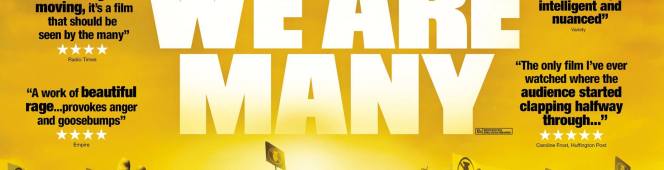
“A work of beautiful rage. Provokes anger and goosebumps”
Empire
“consistently intelligent and nuanced”
Variety
“incredibly ambitious… gripping. The only film I’ve ever watched where the audience started clapping halfway through…” ★★★★★
Huffington Post
“rousing and moving, it’s a film that should be seen by the many” ★★★★☆
Radio Times
Thursday 14th July
Special Public Screening at Friends House
A special screening of Amir Amirani’s film WE ARE MANY will take place at the venue where the anti-Iraq invasion movement started: Friends House in London. It is timed to mark the release of the Chilcot Inquiry the previous week. The post film discussion will include Amir Amirani & guest speakers.
Doors open 6.30pm. Film starts 7.10pm (running time 1hr 50 mins) Panel / Q&A to follow. Event ends 9.30pm. Tickets £5 (no advance ticket sales – buy on the night only) Venue: Friends House 173-177 Euston Road, London NW1 2BJ Continue reading →


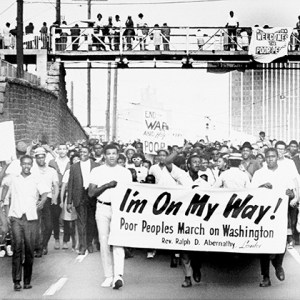 Next April 2018 will mark the 50th anniversary of the assassination of Dr. Martin Luther King. His ‘last great exertion’ in 1967/68 was
  “You can’t talk about solving the economic problem of the Negro without talking about billions of dollars. You can’t talk about ending the slums without first saying profit must be taken out of slums. You’re really tampering and getting on dangerous ground because you are messing with folk then. You are messing with captains of industry. Now this means that we are treading in difficult water, because it really means that we are saying that something is wrong with capitalism.”
 Over the coming year

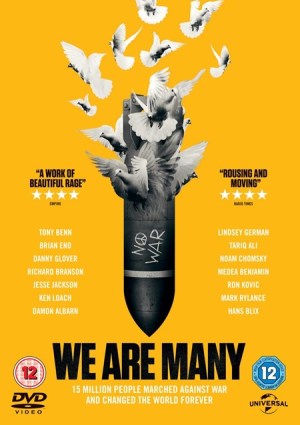 We Are Many The July release of the Chilcot Report led to a second wave of interest in Amir’s film throughout the summer and into the autumn/winter, with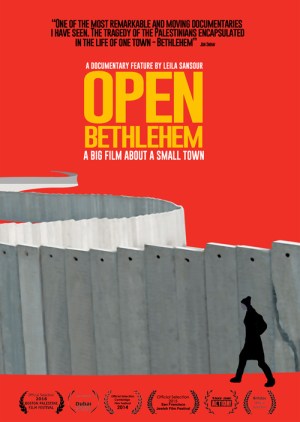
 From Pink to Prevention & environmental links to breast cancer A busy year! In February we finally secured a meeting with the CEO of UK’s leading breast cancer charity Breast Cancer Now (formerly Breakthrough Breast Cancer) and a blog of this important meeting
 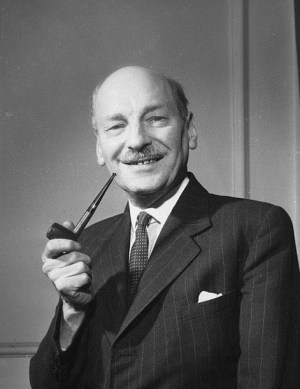 Attlee Festival October 2017 Reviving the much under-valued story of Clement Attlee with a fresh, contemporary cultural project looking at his legacy. This year we have been refining the project and discussing with potential partners, venues and contributors. The