We Need Your Support

We Need Your Support

Funding for our work at Tipping Point North South comes, in part, from concerned individuals who share our belief in the power of ordinary people coming together to push for social justice. All our activities – films, events, campaigns – tackle important, political and often marginalised social, economic and environmental issues. This, in addition to our own ethical requirement, limits our sources of funding, especially in this current climate of austerity. Our main sources of funding to date, namely grants and major donors, have also been hit by the recession. Nevertheless, our belief that our “creative activism” is integral to a healthy civil society is reflected in the feedback we receive about our work. We know it chimes with concerned citizens, many of whom express their admiration and encourage us to carry on. This makes us determined to build on the reputation gained, along with key creative partnerships formed in recent years, to expand the scale and scope of our work.

Become my patron on PatreonThis is why we  are reaching out to you – to ask you to join our core patron base. With your support, we can spend all our time and energy on our core work – executive producing films, managing social-action campaigns and organising campaigning events – and make a difference to the world around us without the need to worry about day-to-day costs and expenses. You can be the ‘tipping point’ to enable our Film Fund to significantly support one or two films in any given year, as well as in-house funding to organise international/national social justice events and campaigns.

We have chosen to use the established international crowdfunding platform Patreon to manage our patrons and their donations. Unlike Kickstarter, it is not one-off project based; rather, it focuses on helping us gain sustainable income so we can concentrate on realising our “creative activism” by continuously making feature documentaries, creating events and taking our social justice campaigns forward. Patrons can pay with Paypal, Credit/Debit cards. Patreon make it much easier for us to manage our relationships with our patrons, to interact with them and to communicate with them more frequently than our regular newsletters.

We need your support, please join now to become our patron. Please visit our Patreon page if you are interested in becoming our patron or reading about our latest activities (we also have a blog there).

We would be delighted to hear from you, discuss further with you about our work and how you can get involved: contact us.

How much military is enough?

Jill Lepore, “The Force,” The New Yorker, January 28 2013

The United States spends more on defense than all the other nations of the world combined. Between 1998 and 2011, military spending doubled, reaching more than seven hundred billion dollars a year—more, in adjusted dollars, than at any time since the Allies were fighting the Axis. …

The long history of military spending in the United States begins with the establishment of the War Department, in 1789. At first, the Secretary of War, a Cabinet member who, from the start, was a civilian, was called the Secretary at War, a holdover from the Revolution but also a prepositional manifestation of an ideological commitment: the department was chiefly to be called upon only if the nation was at war. Early Americans considered a standing army—a permanent army kept even in times of peace—to be a form of tyranny. “What a deformed monster is a standing army in a free nation,” Josiah Quincy, of Boston, wrote in 1774. Instead, they favored militias. About the first thing Henry Knox did when he became George Washington’s War Secretary was to draft a plan for establishing a uniform militia.
Continue reading

Between 2009-2012, Chase paid out over $16 billion in litigation costs

Matt Taibbi, “Chase, Once Considered ‘The Good Bank,’ Is About to Pay Another Massive Settlement,” Rolling Stone, July 18 2013

In the three-year period between 2009-2012, Chase paid out over $16 billion in litigation costs. Noted financial analyst Josh Rosner of Graham Fisher slammed Chase in a report earlier this year, pointing out that these settlements and legal costs represented a staggering 12% of Chase’s net revenue during this time. There couldn’t possibly be a clearer demonstration of the modern banking model, in which companies break rules/laws as a matter of course, and simply pay fines as a cost – a significant cost – of doing business.
Continue reading

Breast cancer awareness is big business

Verónica Bayetti Flores, “Are mainstream breast cancer awareness initiatives hurting more than they’re helping?,” Feministing, April 29 2013

Yesterday the New York Times featured an article in its Sunday magazine about breast cancer, awareness initiatives, and what the real effects these initiatives have had on the lives of women. It’s on the longer side, but one that’s framed around the personal narrative of the author – a breast cancer survivor herself – and well worth a read:

Just about everywhere I go — the supermarket, the dry cleaner, the gym, the gas pump, the movie theater, the airport, the florist, the bank, the mall — I see posters proclaiming that “early detection is the best protection” and “mammograms save lives.” But how many lives, exactly, are being “saved,” under what circumstances and at what cost? Raising the public profile of breast cancer, a disease once spoken of only in whispers, was at one time critically important, as was emphasizing the benefits of screening. But there are unintended consequences to ever-greater “awareness” — and they, too, affect women’s health.

Continue reading

After the War on Drugs: Blueprint for Regulation

After the War on Drugs: Blueprint for Regulation,” Transform Drug Policy Foundation, November 2009

There is a growing recognition around the world that the prohibition of drugs is a counterproductive failure. However, a major barrier to drug law reform has been a widespread fear of the unknown – just what could a post-prohibition regime look like?

For the first time, ‘After the War on Drugs: Blueprint for Regulation’ answers that question by proposing specific models of regulation for each main type and preparation of prohibited drug, coupled with the principles and rationale for doing so.
Continue reading

The global climate cliff

Paul Rogers , “The global climate cliff,” openDemocracy, 18 July 2013

The events in Uttarakhand closely follow a report from the World Meteorological Organisation (WMO) on weather trends in the first decade of the 21st century, which focuses in part on the increased intensity of severe weather events and their likely link to carbon emissions and climate change. The WMO report – The Global Climate 2001-2010: A Decade of Climate Extremes – is particularly useful because it examine a whole decade and compares it with earlier ones, a process that puts smaller fluctuations in perspective and gives a clearer picture of underlying trends  (see Alex Kirby, “Unprecedented climate extremes marked last decade, says UN”, Guardian Environment Network, 3 July 2013).
Continue reading

For a New Approach to Iran

William Luers, Thomas R. Pickering, and Jim Walsh, “For a New Approach to Iran,” The New York Review of Books, August 15, 2013

My administration is now committed to diplomacy…and to pursuing constructive ties among the United States, Iran, and the international community. This process will not be advanced by threats. We seek instead engagement that is honest and grounded in mutual respect.
—President Obama, March 2009

Could this be the year for an engagement with Iran that “is honest and grounded in mutual respect,” as President Obama proposed over four years ago? That goal seems unlikely without a shift in Iranian thinking and without a change in American diplomatic and political strategy. But two developments, one in Iran and one in the region, provide reason to think that diplomatic progress might be possible.
Continue reading

Prince Charles must go public with tax dealings

Prem Sikka, “Prince Charles must go public with tax dealings,” The Conversation, 15 July 2013

The UK House of Commons Public Accounts Committee is examining some of the financial affairs of Prince Charles, heir to the British throne. The Committee should be concerned that the Duchy of Cornwall, Prince’s business arm, is exempt from corporation and capital gains tax. This means that the Duchy does not make any financial contribution towards the social infrastructure used by it. Its tax exemptions also give it unfair advantage over its rivals.
Continue reading

The EU trade and Investment Agenda: quashing the aspirations of the Arab Spring?

Roeline Knottnerus, “The EU trade and Investment Agenda“, Transnational Institute, 26 March 2013

The EU’s launch of negotiations for Deep and Comprehensive Free Trade Agreements (DCFTAs) with four Arab countries in transition – Egypt, Jordan, Morocco and Tunisia – looks set to entrench an economic model that was one of the root causes of the Arab Spring.
Download The EU trade and Investment Agenda: quashing the aspirations of the Arab Spring? (PDF: 221.58 KB)
Continue reading

Military spending and the EU crisis

Frank Slijper, “Guns, Debt and Corruption“, Transnational Institute, 14 April 2013

High levels of military spending played a key role in the unfolding economic crisis in Europe and continues to undermine efforts to resolve it.

Download Guns, Debt and Corruption: Full report (pdf, 525KB)
Download Guns, Debt and Corruption: Executive Summary (pdf, 77KB)
Continue reading

UK co-op membership reaches record high

Aimee Meade, “UK co-op membership reaches record high“, Guardian, 24 June 2013

A record number of entrepreneurs, employers and communities in the UK have opted for the co-operative business model, according to a new report by Co-operatives UK.

The report Homegrown: The Co-operative Economy 2013 which was published today by Co-operatives UK, outlined how local shops, owned and run by members of communities across the UK had a combined turnover of £49m in 2012 with over 50,000 members.
Continue reading

The real cost of getting rid of Trident from Scotland: £150m

The real cost of getting rid of Trident from Scotland: £150m“, HeraldScotland, 14 July 2013

Westminster warnings that the bill for ridding an independent Scotland of Trident would run into billions have been undermined by revelations that the UK Government previously put the cost at £150 million.
Continue reading

Transcript of Jimmy Carter’s Speech at Lafayette College

Jimmy Carter, inaugural Robert and Margaret Pastor Lecture in International Affairs, Lafayette College, April 22

What can we do to improve our own lives? Let me go down the list. Let’s talk about peace. That’s one of the major attributes that a human being would have in his life. I would say that the major religions would also have these same kind of things in mind. It doesn’t matter whether you’re a Christian or Jew or a Muslim or Hindu or Buddhist. The major religions advocate peace. They also advocate taking care of the environment. They also advocate helping people who are in need.
Continue reading

The Korean War: Forgotten, Unknown and Unfinished

H Patricia Hynes, “The Korean War: Forgotten, Unknown and Unfinished“, Truthout, 12 July 2013

On Veterans Day 2011, Korean War veteran Jack Tolbert spoke to a gathering at a Northern California cemetery. After relating his memories of serving in the war, among them covering a hand grenade with his lower body to save soldiers under his command, he remarked, “I’ve never understood why they insisted on calling it the Korean Conflict. After seeing the bodies I’ve seen, it was more like a war than anything else I’ve ever seen.”…

Continue reading

U.S. Wastes Millions On Base In Afghanistan It Will Never Use

Hayes Brown, “U.S. Wastes Millions On Base In Afghanistan It Will Never Use“, ThinkProgress, Jul 10 2013

The United States military spent millions of dollars on a shining new command center in the Helmand province of Afghanistan — a center that will never be used and is now likely to be completely demolished.
Continue reading

Press Release: WHO/UNEP strongly endorse need to regulate as endocrine disrupting chemicals (EDCs) identified as ‘global threat’

Press Release, Immediate release, Alliance for Cancer Prevention20/2/13

WHO/UNEP strongly endorse need to regulate as endocrine disrupting chemicals (EDCs) identified as ‘global threat’.

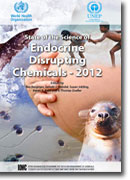
edc_coverA new report from the World Health Organisation (WHO) and United Nations Environment Programme (UNEP) comprehensively reviews the state of the science on endocrine disrupting chemicals (EDCs).  It outlines the very serious and immediate threat to human health and wildlife from EDCs and signals the urgent need for effective regulation and testing of these chemicals.

The report estimates that as much as 24% of human diseases and disorders are due at least in part to environmental factors which include chemical exposures. “Many endocrine diseases and disorders are on the rise and the speed at which they are increasing rules out genetic factors as the sole plausible explanation”.
Continue reading