IMF: ‘Trickle-Down’ economics does not work

If there’s one person most often associated with the origins of of trickle-down economics, it’s President Ronald Reagan. Few people know, however, that the phrase was actually coined by American humorist Will Rogers, whomocked President Herbert Hoover’s Depression-era recovery efforts, saying that “money was all appropriated for the top in the hopes it would trickle down to the needy.” …

Now, nearly 80 years later, Rogers’ quip is getting the punchline it deserves: A devastating new report from the International Monetary Fund has declared the idea of “trickle-down” economics to be as much a joke as he’d imagined.

Increasing the income share to the bottom 20 percent of citizens by a mere one percent results in a 0.38 percentage point jump in GDP growth.

The IMF report, authored by five economists, presents a scathing rejection of the trickle-down approach, arguing that the monetary philosophy has been used as a justification for growing income inequality over the past several decades. “Income distribution matters for growth,” they write. “Specifically, if the income share of the top 20 percent increases, then GDP growth actually declined over the medium term, suggesting that the benefits do not trickle down.”

The IMF Confirms That ‘Trickle-Down’ Economics Is, Indeed, a Joke
http://www.psmag.com/business-economics/trickle-down-economics-is-indeed-a-joke
5% Digest (week 06/04/15)

Director of Central Intelligence John Brennan stated,

It’s a long war, unfortunately. But it’s been a war that has been in existence for millennia, at the same time—the use of violence for political purposes against noncombatants by either a state actor or a subnational group.

Terrorism has taken many forms over the years. What is more challenging now is, again, the technology that is available to terrorists, the great devastation that can be created by even a handful of folks, and also mass communication that just proliferates all of this activity and incitement and encouragement. So you have an environment now that’s very conducive to that type of propaganda and recruitment efforts, as well as the ability to get materials that are going to kill people. And so this is going to be something, I think, that we’re always going to have to be vigilant about. There is evil in the world and some people just want to kill for the sake of killing…This is something that, whether it’s from this group right now or another group, I think the ability to cause damage and violence and kill will be with us for many years to come.”

Micah Zenko summarised Brennan’s whole speech:

To summarize, the war on terrorism is working, compared to inaction or other policies. But, the American people should expect it to continue for millennia, or as long as lethal technologies and mass communication remain available to evil people.

Continue reading

5% Digest (week 30/03/15)

Physicians for Social Responsibility’s (PRS) study concluds that the death toll from 10 years of the “War on Terror” since the 9/11 attacks is at least 1.3 million, and could be as high as 2 million.

It is heavily critical of the figure most widely cited by mainstream media as authoritative, namely, the Iraq Body Count (IBC) estimate of 110,000 dead. According to the PSR study, the much-disputed Lancet study that estimated 655,000 Iraq deaths up to 2006 (and over a million until today by extrapolation) was likely to be far more accurate than IBC’s figures.

Nafeez Ahmed argued that

total deaths from Western interventions in Iraq and Afghanistan since the 1990s – from direct killings and the longer-term impact of war-imposed deprivation – likely constitute around 4 million (2 million in Iraq from 1991-2003, plus 2 million from the “war on terror”), and could be as high as 6-8 million people when accounting for higher avoidable death estimates in Afghanistan.

Continue reading

5% Digest (Week 23/03/15)

Gregory D. Johnsen wrote a detailed account of the rise of Huthis in Yemen. Adam Baron argued that the power struggle is primarily local and foreign intervention will be a very bad idea.

But what is abundantly clear at the moment is that this remains, by and large, an internal Yemeni political conflict—one that, despite frequent sectarian mischaracterizations and potential regional implications, remains deeply rooted in local Yemeni issues.

And if history is a guide, foreign intervention will only stand to exacerbate the situation. Ironically, talk now centers on a potential Saudi Arabian and Egyptian military intervention in Yemen, a scenario that immediately brought to mind the memory of North Yemen’s 1960s Civil War which saw both sides intervene—albeit on different sides—in a matter which only appeared to draw the conflict out further. This is not to say that there isn’t a place for foreign powers to aid Yemeni factions in negotiating some new political settlement. But any nation that aims to make Yemen’s fight their own is more than likely to come out on the losing side.

Continue reading

5% Digest (week 16/03/15)

According to SIPRI’s latest report, there is a 16% increase in the volume of arms transferred around the world. The world’s biggest arms exporters in the past five years were the US, Russia, China, Germany and France. China’s exports of major arms rose by 143% in the five years to 2014 from the previous five years. Germany’s arms exports fell by 43% and France’s dropped 27% in the same time frame.

India was the world’s largest single arms importer. Four other Asian countries, China, Pakistan, South Korea and Singapore, are also among the top 10 largest arms importers.
Continue reading

5% Digest (week 09/03/15)

British MPs voted in favour of keeping defence spending at 2% of GDP. Just 40 MPs voted and the result carries no legal force.

Rory Stewart, Conservative MP for Penrith and the Border and chairman of the defence select committee, warned MPs that Britain could not continue to rely on the military might of America and be a “freeloader”. “This 2% is needed because the threats are real. The world is genuinely getting more dangerous,” he said.

Continue reading

5% Digest (week 02/03/15)

In Seumas Milnes’s piece ‘The demonisation of Russia risks paving the way for war‘, he argues that “Ukraine – along with Isis – is being used to revive the doctrines of liberal interventionism and even neoconservatism, discredited on the killing fields of Iraq and Afghanistan.” Hundreds of US troops are arriving in Ukraine and Britain is sending 75 military advisers of its own. This is a direct violation of last month’s Minsk agreement, negotiated with France and Germany – Article 10 requires the withdrawal of all foreign forces from Ukraine.

But when the latest Minsk ceasefire breaks down, as it surely will, there is a real risk that Ukraine’s proxy conflict could turn into full-scale international war.

Continue reading

5% Digest (January 2015)

It is reported by Guardian that the Pentagon’s internal watchdog has questioned the air force’s increased spending on drones, suggesting its $8.8 billions spending on 46 armed Reaper drones is a waste of money.

As purchases of General Atomics’s MQ-9 Reaper ballooned from 60 aircraft in 2007 to the current 401, air force officials did not justify the need for an expanding drone fleet, the Pentagon said.

During that time, costs for purchasing one of the signature counter-terrorism weapons of Barack Obama’s presidency increased by 934%, from $1.1bn to more than $11.4bn, according to a declassified September report by the Pentagon inspector general. Purchasing costs are a fraction of what the drones cost to operate and maintain over their time in service: in 2012, the Pentagon estimated the total costs for them at $76.8bn.

Continue reading

5% Digest (October 2014)

After the Cold War, the Pentagon needs to find a new way to justify its wasteful spending and the defense and security contractors need to find a new cause to make profits. Bob Hennelly tells the story:

In 1998, President Bill Clinton tasked former Senators Gary Hart, a Colorado Democrat, and the late Warren Rudman, a New Hampshire Republican, to chair the U.S. Commission on National Security/21st Century. The Commission panel was a cross-section of the military-industrial-media complex. Its members included Leslie Gelb, longtime New York Times correspondent and editor; Norman Augustine, former CEO of Lockheed-Martin; and Army General John Galvin.

The panel gave its report and recommendations in January 2001. Both Senators Rudman and Hart concluded that it was not a matter of “if” the U.S. would suffer a mass-casualty terrorist strike but “when.” Among the panel’s recommendations was the massive integration of all of the nation’s domestic security, disaster planning and recovery functions into one behemoth called the Department of Homeland Security (DHS).
Continue reading

5% Digest (September 2014)

Journalist Ahmed provided a brief history of the rise of Islamic State, arguing the complicity of US and British in its creation and rise through deliberate tactical actions, ill-conceived policies and indirect/direct financial support.

Since 2003, Anglo-American power has secretly and openly coordinated direct and indirect support for Islamist terrorist groups linked to al-Qaeda across the Middle East and North Africa. This ill-conceived patchwork geostrategy is a legacy of the persistent influence of neoconservative ideology, motivated by longstanding but often contradictory ambitions to dominate regional oil resources, defend an expansionist Israel, and in pursuit of these, re-draw the map of the Middle East.

Continue reading

The use of defence contractors to spy civilians, monitor activism and manipulate online discourse

70 percent of the entire US intelligence budget is spent on hiring private contractors, and  the U.S. “black budget” (for covert operations) that is allocated to the NSA amounts to over $10 billion (£6 billion). The NSA operates under the jurisdiction of the Department of Defense.
Continue reading

A rule of thumb for categorizing epidemics

This from Karl Smith, a professor of public economics and government at the University of North Carolina-Chapel Hill:

A good rule of thumb – I believe – for epidemics economic, biological or social is this: If it spreads along lines of communication its entropic information. If it travels along major transportation routes its microbial. If it spreads out like a fan, its an arthropod. If its everywhere, all at once, its a molecule.

Taiwan should spend less not more in military expenditure

I read this commentary article about the news that

In early March, Taiwan’s defense minister Yen Ming estimated the island nation could resist a Chinese onslaught “at least one month”—and that’s assuming other countries aid in Taipei’s defense.

The point of the article is that Taiwan has only itself to blame for its hopelessness against a Chinese invasion because why have Taiwan not kept up their military spending with China’s ever increasing military budget.
Continue reading

UK’s century of continuous conflict

Guardian had put together an interactive timeline of Britain’s 100 years of conflict. It shows that the UK has been at wars or involved in military conflicts with at least one other country/opposing group every year since 1914.

100 years of war

This is in addition to the revelation in 2012 that only 22 countries in the world have not been invaded by Britain in its history.
Continue reading

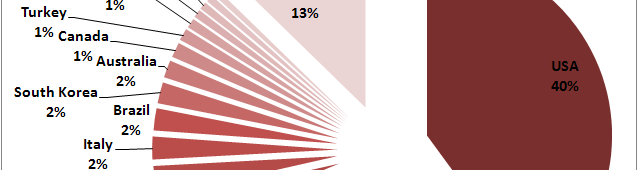
Top 20 spenders together account for 87% of the global military spending

Top 20 spenders together account for 87% of the global military spending

There is a huge imbalance of national military spending around the world. Just the top 10 spenders alone account for 76% of the total global military spending. If we add in the next 10 top spenders, the top 20 spenders together spend 87% of the global total, that’s nearly 7 times as much as the rest of the world combined. In SIPRI’s research, they consider 170 countries out of nearly 200 independent countries in the world, no data is available for 34 countries in 2012. Nevertheless, that still leave us more than 100 countries in the rest of the world group.
Continue reading