Wishing You A Peaceful Holiday Season

Dear colleagues and friends, supporters and funders,

Season’s Greetings

It’s been a tough year. We end 2016 with the June Brexit vote and Trump election win in November; devastating conflicts in Syria and Yemen and news that has seen Arctic temperatures rising far higher and faster than scientists had predicted.

After Trump’s USA election win, there were some in the USA who drew strength from the idea that it’s ‘darkest just before the dawn’ and that now is the time for progressives to rise to the challenge with policies and campaigns that can push the far-right back. Let’s hope this observation proves to be the case as we do all we can to support those ever-growing justice movements around the world who are fighting to make this a reality.

Below is our 2016 round-up.  Please be in touch if you want to know more, get involved or help our work in any way.  Where-ever we are, what-ever we do, there’s a lot to ‘push back’ in the coming months and years.

Best wishes this Christmas,

Deb, Kevin, Justin, Ho-Chih

FILMS
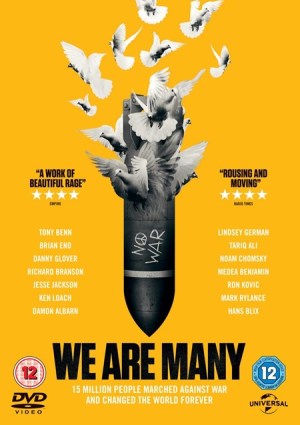
We Are Many The July release of the Chilcot Report led to a second wave of interest in Amir’s film throughout the summer and into the autumn/winter, with dozens of public cinema screenings across the UK We hosted a special TPFF post-Chilcot Report event at Friends Meeting House in London and joined Amir for a special Oxford city screening with Larry Sanders, brother of Bernie, who joined Amir for the post film debate.  It is now available to buy on iTunes and DVD.

Open Bethlehem continues its journey with releases across the Middle East and North America and we were thrilled that our partners Development & Peace hosted our Canadian premiere in Montreal.  “A ninety-minute epic that transcends politics and normal cinema” wrote Daoud Kuttab, Middle East Monitor. The film is now on demand at Vimeo  https://vimeo.com/ondemand/openbethlehem and DVD  (£15.99) can be purchased here

CAMPAIGNS

Make Apartheid History Our December 2015 calendar was very well received and our WALL video went viral . In July, we marked MANDELA DAY with our first year video highlight loop and in August, we were delighted to showcase MAH at the Edinburgh Fringe and on the opening night of the Greenbelt Festival

From Pink to Prevention & environmental links to breast cancer A busy year! In February we finally secured a meeting with the CEO of UK’s leading breast cancer charity Breast Cancer Now (formerly Breakthrough Breast Cancer) and a blog of this important meeting is here. In May, we shared our Rachel Carson Day communication and we had a very active October Breast Cancer Awareness Month with interactive posters; an Early Day Motion tabled by Caroline Lucas; and book launch of writing by the late USA activist Barbara Brenner, hosted by UNISON. We ended the year with an article published in ‘Women & Environments’- a leading international magazine celebrating its 40th anniversary and illustrated by our campaign colleague Di Ward.

Five Percent Campaign – military spending is a ‘development issue’. In October, we attended the International Peace Bureau’s annual global gathering in Berlin.  Subsequent to our presentation, strong new Five Per Cent campaign contacts were secured in East Africa, Australia and USA and in November, we were invited to present the campaign to a regional East African peace movement gathering in Uganda.

EVENTS

Martin Luther King’s Economic Bill of Rights  from 1968 to 2018 and beyond. Marking the 50th anniversary of the assassination of Dr Martin Luther King, Project April 2018 puts his 1968 Economic Bill of Rights at the heart of a renewed global call for us all to march on power with a progressive manifesto for transformative change. Working with partners in the USA, key founding documents are now being finalised. We aim to soft launch in the USA on MLK Day January 2017.

Attlee Festival October 2017 Reviving the much under-valued story of Clement Attlee with a fresh, contemporary cultural project looking at his legacy. This year we have been refining the project and discussing with potential partners, venues and contributors. The Attlee Nation and Unity Festival will explore how, 70 years before, politicians did push back powerful vested interests for a caring social democracy and what lessons we can bring forward for today’s vision for the future.

Next year…

Alongside the projects above, next year will see us embark on several new film partnerships which connect to our three campaigns (5%, From Pink to Prevention and Make Apartheid History).

We will also develop next-stage development of a TPFF-led documentary ‘Generosity towards the Future’. This is a project designed to lift the level of political understanding through high quality ‘essay’ or ‘vision’ films on critical issues facing ordinary British people today – rising poverty; Dickensian levels of inequality; the utter failure of housing policy; crisis across the NHS.

Finally, a big thank-you to our funders

The Ratcliff Foundation, Polden-Puckham Charitable Foundation, Amiel and Melburn Trust, Trust Greenbelt; major donors and regular givers.

Thank you.

Wishing You A Peaceful Holiday Season

Wishing You A Peaceful Holiday Season

Dear colleagues and friends, supporters and funders,

Season’s Greetings
christmas-160950_1280

It’s been a tough year. We end 2016 with the June Brexit vote and Trump election win in November; devastating conflicts in Syria and Yemen and news that has seen Arctic temperatures rising far higher and faster than scientists had predicted.

After Trump’s USA election win, there were some in the USA who drew strength from the idea that it’s ‘darkest just before the dawn’ and that now is the time for progressives to rise to the challenge with policies and campaigns that can push the far-right back. Let’s hope this observation proves to be the case as we do all we can to support those ever-growing justice movements around the world who are fighting to make this a reality.

Below is our 2016 round-up.  Please be in touch if you want to know more, get involved or help our work in any way.  Where-ever we are, what-ever we do, there’s a lot to ‘push back’ in the coming months and years.
Continue reading

Look back, not forward, to connect with conservatives

The scientists theorize that “future framing” may contribute to conservative cynicism, especially “when year after year, we don’t seem to get that close to death,” Baldwin said. “Conservatives might become rather skeptical of the science that led us to the conclusion that we are in trouble. Perhaps focusing on the possible negative future doesn’t drive home the fact that our Earth really has changed a lot.”

This strategy might also counter the argument often invoked by conservatives that today’s global warming is just another example of natural climate variations that have occurred historically. …

In one of the study’s experiments, “We show people pictures of environmental change — for example, an image of a lake full of water, right next to an image of that same lake totally dried up,” he said. “Conservatives really respond to these images of drastic change from the more ‘perfect’ past. I can imagine doing something similar with extreme weather events as the focus. Following a large hurricane, for example, we could focus on how the planet in the past did not experience such events, and then create a contrast by saying something like, ‘Shouldn’t we work hard to return to a state of the planet where we don’t have to experience them anymore?’

Continue reading

British Medical Journal calls for a study of universal basic income

Recently, there have been increasing calls for dialogue on a universal basic income (UBI) from political parties, think tanks (including the Royal Society for the Encouragement of Arts, Manufactures, and Commerce (RSA)), civic activists, trade unions, and leading entrepreneurs such as Tesla chief executive Elon Musk. These calls are a response to growing income insecurity, some sense that welfare systems may be failing, and as a preparation for the potential effects of automation and artificial intelligence on employment prospects in industries that might be better served by machines.3 UBI-style pilots are planned in Finland, the Netherlands, and Canada as a potential answer to these questions and concerns.4

Continue reading

Brexit: British Business and Industries

The UK has long depended on heavy flows of investment from abroad to make up for the weaknesses in its own corporate and financial institutions. In 2015 the UK ran a deficit in its external trade in goods and services of 96 billion pounds ($146 billion in 2015), or 5.2 percent of GDP, the largest percentage deficit in postwar British historyand by far the largest of any of the G-7 group of industrialized economies. By comparison, the US ran a deficit of 2.6 percent of GDP, while Germany earned a surplus of 8.3 percent, Japan a surplus of 3.6 percent, and France broke even. In the memorable words of Mark Carney, the Canadian-born Governor of the Bank of England, the UK must depend on “the kindness of strangers” to remedy its trade gap.

The reason for this unusual dependency is that for decades the UK has been unable to produce enough goods that the rest of the world wants to buy. According to WTO statistics, between 1980 and 2011 the UK’s share of global manufacturing exports was halved, from 5.41 percent to 2.59 percent, so that by 2011, according to UN statistics, the dollar value of UK merchandise exports at $511 billion was not far off the level of Belgium’s at $472 billion, an economy with one six the UK’s population, (and not included in the Belgian figures, the value of German exports routed through Belgium ports).

Looking at export industries such as IT products, automobiles, machine tools, and precision instruments, all strongly dependent on advanced R&D and employee skills at all levels, the UK’s performance looks even worse. The period of 2005-2011 is especially revealing because it includes both the years of the Great Recession and the collapse of trade between the advanced industrial economies, but also years in which their trade with China and other BRIC economies such as India and Brazil grew rapidly. Since one of the chief claims of the Brexit campaigners has been that there are now these exciting new markets in BRIC countries waiting for British exporters to conquer, it is worth looking at how British companies actually performed during those years.

Continue reading

Euro

Unusually perceptive of the political and historical roots of monetary union, the author begins and ends his book by reminding readers of Altiero Spinelli’s call for “the definitive abolition of Europe’s division into national sovereign states” (p. 1). The common currency, even though not specifically mentioned in the Ventotene Manifesto, may be seen as the most radical answer to Spinelli’s call to end the nation state. At the same time, the success or failure of the euro could well turn out to be the ultimate test of Spinelli’s proposition.

The book has little sympathy for objections inspired by a narrow reading of “optimal currency area” theory (interestingly, its original proponent, Robert Mundell, came out in favour of the creation of the euro). In contrast to American economists such as Kenneth Rogoff (“a giant historical mistake”) and, more recently, Joseph Stiglitz (“fatally flawed from birth”), Sandbu argues that the architecture of the common currency has been wrongly blamed for the Eurozone crisis, and has been used as a decoy by policy makers for their own unforced errors.
Continue reading

RAF urged to recruit video game players to operate drones

The commander who oversaw the use of Reaper drones in Syria has said the relentless demand to deploy the unmanned aircraft means the RAF needs to test recruiting “18- and 19-year-olds straight out of the PlayStation bedroom” to operate the weapons.

Air Marshal Greg Bagwell, a former RAF deputy commander of operations, disclosed that the psychological pressure on drone operators in the UK was such that some had quit due to mental stress or illness. Continue reading

In 2011, solar power reached a tipping point.

The scientists found that, from 1975 up to 2011, solar panels were actually a source of greenhouse gases globally. The emissions avoided by existing solar panels were insufficient to offset the amount of emissions being produced by the rapid production of new solar panels.

But in 2011, this flipped. Instead of being a net source of emissions, the solar industry started avoiding more emissions than it emitted, providing a net climate benefit. Continue reading

Pentagon buries evidence of $125 billion administrative waste

The Pentagon has buried an internal study that exposed $125 billion in administrative waste in its business operations amid fears Congress would use the findings as an excuse to slash the defense budget, according to interviews and confidential memos obtained by The Washington Post. …

The report, issued in January 2015, identified “a clear path” for the Defense Department to save $125 billion over five years. The plan would not have required layoffs of civil servants or reductions in military personnel. Instead, it would have streamlined the bureaucracy through attrition and early retirements, curtailed high-priced contractors and made better use of information technology. Continue reading

SIPRI: Top 100 arms sales for 2015 still are 37 per cent higher than those for 2002

Sales of the world’s 100 largest arms-producing and military services companies totalled $370.7 billion in 2015. Compared with 2014, this is a slight decline of 0.6 per cent. While this continues the downward trend in arms sales that began in 2011, it signals a significant slowdown in the pace of decline. However, despite the decrease, Top 100 arms sales for 2015 are 37 per cent higher than those for 2002, when SIPRI began reporting corporate arms sales.

Companies headquartered in the United States and Western Europe have
dominated the list of Top 100 arms-producing and military services companies
since 2002. And, true to form, this was the case for 2015: with sales reaching $305.4 billion, companies based in the USA and Western Europe accounted for 82.4 per cent of the Top 100 arms sales. Continue reading