
Physicians for Social Responsibility’s (PRS) study concluds that the death toll from 10 years of the “War on Terror” since the 9/11 attacks is at least 1.3 million, and could be as high as 2 million.
It is heavily critical of the figure most widely cited by mainstream media as authoritative, namely, the Iraq Body Count (IBC) estimate of 110,000 dead. According to the PSR study, the much-disputed Lancet study that estimated 655,000 Iraq deaths up to 2006 (and over a million until today by extrapolation) was likely to be far more accurate than IBC’s figures.
total deaths from Western interventions in Iraq and Afghanistan since the 1990s – from direct killings and the longer-term impact of war-imposed deprivation – likely constitute around 4 million (2 million in Iraq from 1991-2003, plus 2 million from the “war on terror”), and could be as high as 6-8 million people when accounting for higher avoidable death estimates in Afghanistan.
Gregory D. Johnsen wrote a detailed account of the rise of Huthis in Yemen. Adam Baron argued that the power struggle is primarily local and foreign intervention will be a very bad idea.
But what is abundantly clear at the moment is that this remains, by and large, an internal Yemeni political conflict—one that, despite frequent sectarian mischaracterizations and potential regional implications, remains deeply rooted in local Yemeni issues.
And if history is a guide, foreign intervention will only stand to exacerbate the situation. Ironically, talk now centers on a potential Saudi Arabian and Egyptian military intervention in Yemen, a scenario that immediately brought to mind the memory of North Yemen’s 1960s Civil War which saw both sides intervene—albeit on different sides—in a matter which only appeared to draw the conflict out further. This is not to say that there isn’t a place for foreign powers to aid Yemeni factions in negotiating some new political settlement. But any nation that aims to make Yemen’s fight their own is more than likely to come out on the losing side.
According to SIPRI’s latest report, there is a 16% increase in the volume of arms transferred around the world. The world’s biggest arms exporters in the past five years were the US, Russia, China, Germany and France. China’s exports of major arms rose by 143% in the five years to 2014 from the previous five years. Germany’s arms exports fell by 43% and France’s dropped 27% in the same time frame.
India was the world’s largest single arms importer. Four other Asian countries, China, Pakistan, South Korea and Singapore, are also among the top 10 largest arms importers.
Continue reading
British MPs voted in favour of keeping defence spending at 2% of GDP. Just 40 MPs voted and the result carries no legal force.
Rory Stewart, Conservative MP for Penrith and the Border and chairman of the defence select committee, warned MPs that Britain could not continue to rely on the military might of America and be a “freeloader”. “This 2% is needed because the threats are real. The world is genuinely getting more dangerous,” he said.
In Seumas Milnes’s piece ‘The demonisation of Russia risks paving the way for war‘, he argues that “Ukraine – along with Isis – is being used to revive the doctrines of liberal interventionism and even neoconservatism, discredited on the killing fields of Iraq and Afghanistan.” Hundreds of US troops are arriving in Ukraine and Britain is sending 75 military advisers of its own. This is a direct violation of last month’s Minsk agreement, negotiated with France and Germany – Article 10 requires the withdrawal of all foreign forces from Ukraine.
But when the latest Minsk ceasefire breaks down, as it surely will, there is a real risk that Ukraine’s proxy conflict could turn into full-scale international war.
It is reported by Guardian that the Pentagon’s internal watchdog has questioned the air force’s increased spending on drones, suggesting its $8.8 billions spending on 46 armed Reaper drones is a waste of money.
As purchases of General Atomics’s MQ-9 Reaper ballooned from 60 aircraft in 2007 to the current 401, air force officials did not justify the need for an expanding drone fleet, the Pentagon said.
During that time, costs for purchasing one of the signature counter-terrorism weapons of Barack Obama’s presidency increased by 934%, from $1.1bn to more than $11.4bn, according to a declassified September report by the Pentagon inspector general. Purchasing costs are a fraction of what the drones cost to operate and maintain over their time in service: in 2012, the Pentagon estimated the total costs for them at $76.8bn.
After the Cold War, the Pentagon needs to find a new way to justify its wasteful spending and the defense and security contractors need to find a new cause to make profits. Bob Hennelly tells the story:
In 1998, President Bill Clinton tasked former Senators Gary Hart, a Colorado Democrat, and the late Warren Rudman, a New Hampshire Republican, to chair the U.S. Commission on National Security/21st Century. The Commission panel was a cross-section of the military-industrial-media complex. Its members included Leslie Gelb, longtime New York Times correspondent and editor; Norman Augustine, former CEO of Lockheed-Martin; and Army General John Galvin.
The panel gave its report and recommendations in January 2001. Both Senators Rudman and Hart concluded that it was not a matter of “if” the U.S. would suffer a mass-casualty terrorist strike but “when.” Among the panel’s recommendations was the massive integration of all of the nation’s domestic security, disaster planning and recovery functions into one behemoth called the Department of Homeland Security (DHS).
Continue reading
Journalist Ahmed provided a brief history of the rise of Islamic State, arguing the complicity of US and British in its creation and rise through deliberate tactical actions, ill-conceived policies and indirect/direct financial support.
“Since 2003, Anglo-American power has secretly and openly coordinated direct and indirect support for Islamist terrorist groups linked to al-Qaeda across the Middle East and North Africa. This ill-conceived patchwork geostrategy is a legacy of the persistent influence of neoconservative ideology, motivated by longstanding but often contradictory ambitions to dominate regional oil resources, defend an expansionist Israel, and in pursuit of these, re-draw the map of the Middle East.“
Franklin C. Spinney, “The Best Government Money Can Buy,” 11 February 2014, CounterPunch

Winslow T. Wheeler, “America’s $1 Trillion National Security Budget,” 16 March 2014, Truthout
Scarcity of money is not their problem. Pentagon costs, taken together with other known national security expenses for 2015, will exceed $1 trillion. How can that be? The trade press is full of statements about the Pentagon’s $495.6 billion budget and how low that is.
There is much more than $495.6 billion in the budget for the Pentagon, and there are piles of national security spending outside the Pentagon-all of it as elemental for national security as any new aircraft and ships and the morale and well-being of our troops.
Continue reading
Annie Isabel Fukushima, Ayano Ginoza, Michiko Hase, Gwyn Kirk, Deborah Lee, Taeva Shefler, “Disaster Militarism: Rethinking US Relief in the Asia-Pacific,” 14 March 2014, The Nation and Foreign Policy In Focus
… Paralleling these disasters has been the disaster response of the US military. According to this “disaster militarism”—which is a pattern of rhetoric, beliefs and practices—the military should be the primary responder to large-scale disasters. Disaster militarism is not only reflected in the deployment of troops but also in media discourse that naturalizes and calls for military action in times of environmental catastrophes.
Continue reading
Stephanie Gaskell, “Pentagon Wants to Keep Controversial War Budget Beyond Afghanistan,” 5 March 2014, Defense One
… But despite the massive drawdown, Pentagon officials want to keep a comparably oversized war chest funded well into next year, quickly raising eyebrows among members of Congress.
The fiscal year 2015 budget calls for $79 billion for Overseas Contingency Operations, or OCO, which funds the war in Afghanistan and other overseas operations. Although the U.S.footprint in Afghanistan has shrunk over the past couple of years, the war budget has stayed robust. This year Congress approved $85 billion for the account.
Continue reading
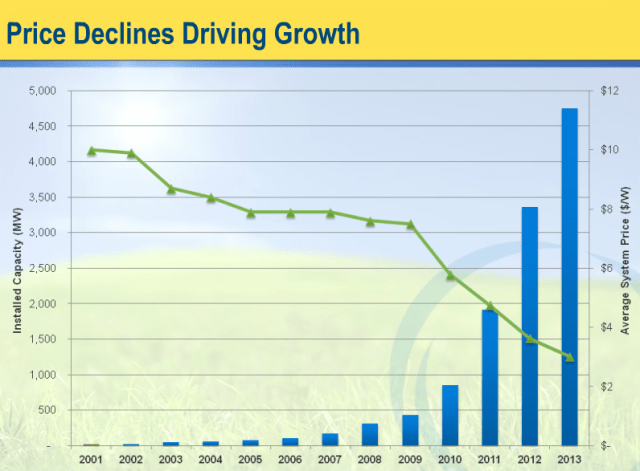
Emily Hois, “More Solar Installed In 18 Months Than Past 30 Years,” 7 March 2014, Clean Energy Collective
Nick Turse, “Washington’s Back-to-the-Future Military Policies in Africa,” 13 March 2014, TomDispatch
Since 9/11, the U.S. military has been making inroads in Africa, building alliances, facilities, and a sophisticated logistics network. Despite repeated assurances by U.S. Africa Command (AFRICOM) that military activities on the continent were minuscule, a 2013 investigation by TomDispatch exposed surprisingly large and expanding U.S. operations — including recent military involvement with no fewer than 49 of 54 nations on the continent. Washington’s goal continues to be building these nations into stable partners with robust, capable militaries, as well as creating regional bulwarks favorable to its strategic interests in Africa. Yet over the last years, the results have often confounded the planning — with American operations serving as a catalyst for blowback (to use a term of CIA tradecraft).
Continue reading
 Tipping Point North South