
Over the next few years spending on the NHS increased substantially, pushing total (public plus private) spending to 8.8 per cent of GDP by 2009. By then, however, the EU-14 spend (weighted for size of GDP and health spend, and minus the UK) had moved on to 10.1 per cent of GDP. Still, the gap between the UK and its European neighbours was closing.
Since then, however, the gap has started to widen (particularly against countries that weathered the global financial crisis better than the UK) and looks set to grow further. UK GDP is forecast to grow in real terms by around 15.2 per cent between 2014/15 and 2020/21. But on current plans, UK public spending on the NHS will grow by much less: 5.2 per cent. This is equivalent to around £7 billion in real terms – increasing from £135 billion in 2014/15 to £142 billion in 2020/21. As a proportion of GDP it will fall to 6.6 per cent compared to 7.3 per cent in 2014/15. But, if spending kept pace with growth in the economy, by 2020/21 the UK NHS would be spending around £158 billion at today’s prices – £16 billion more than planned.
Continue reading
Tag Archives: UK
UK government is cutting Police number guarding nuclear plants
The Tories are axing 200 frontline staff from the Civil Nuclear Constabulary this Parliament. This amounts to a 16 per cent cut in numbers, Continue reading
London is de-privatising its rail services
This is intereting. We know that the Conservatives have been ridiculing the idea to re-nationalising the national railways, but when the elections come calling and leadership ambitions to be fulfilled, free market/privatisation will have to take back seat. The Tansport for London is in the process of taking over the running of most if not all of London’s rail network routes. Continue reading
UN Human Development Report: UK most unequal Western country
The United Nations Development Programme, which published the Human Development Report, said last week: “The United Kingdom, unfortunately, has an exceptionally high degree of inequality.”
Continue reading
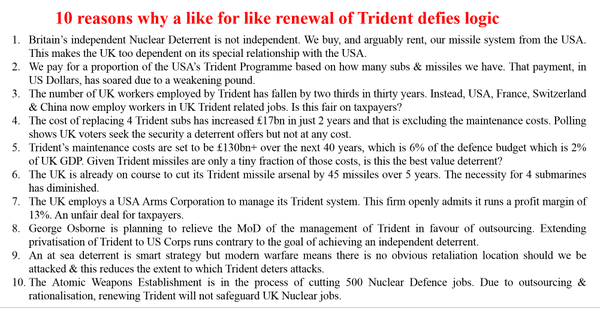
Why we should not renew Trident
‘diplomatic relations and arms sales trump the lives of Yemen’s children’
According to the Campaign Against Arms Trade (CAAT), the UK has sold more than £5.6 billion of arms to Saudi Arabia since 2010, including combat aircraft worth £1.7 billion last May.
The arms trade also receives generous state backing. The UK Trade and Industry Defence and Security Organisation, which exists to promote arms sales, gets far more funding than other UKTI sectors, even though the arms trade is responsible for only 1.5 per cent of UK exports.
Continue reading
Corbyn is right on Trident
Simon Jenkins is spot on on this:
Corbyn was right on Iraq. He was right on Syria. He is right on Islamic State. On the idiocy, waste and vacuous drivel that constitutes “the case for Trident”, he has been right. Fighting him on it just to make Labour seem macho makes no sense.
Political influence on the decision to drop FCA’s banking inquiry
This from Financial Times:
A Bank of England official oversaw the move by the City regulator to scrap a review into Britain’s banks, it emerged on Tuesday, just a day after the Financial Conduct Authority insisted external pressure had not influenced its decision.
Continue reading
Age of Dissent: more protests in 2015 than any time since the late 70s
The year 2011 is widely viewed as the peak of protest and dissent in the wake of the 2008 financial crisis and the austerity agenda that followed it. It was the year of the Arab Spring, Occupy, UK Uncut, indignados, urban riots and anti-austerity and tuition fee protests – and in which Time magazine famously named “The Protester” as its person of the year.
Yet in the UK, protests continue to occur at a rate rarely seen prior to the global economic crisis in 2008. Indeed, 2015 seems to have confirmed the suggestion, made at the beginning of the year, that 2011 was “really only just the beginning”. …
Continue reading
Pakistan’s annual $20m arms sales to over 40 countries, incl. UK and USA
Pakistan has been selling weapons to many countries of the world including United States and Britain.
Minister for Defence Production, Rana Tanveer Hussain, while answering questions in the National Assembly session, said that during 2013, UK bought 69 Pakistan-made sub-machine guns (SMG MP5) and 250 G-3 rifles. … Continue reading
London is a floodplain
According to David Cameron, London is a floodplain.
This from Miles King:
[The PM] rejected the idea that it was a bad idea to build on floodplains claiming that London was a floodplain. Only a tiny proportion of London sits in the floodplain of the Thames, perhaps he was confusing Westminster with London.
MoD accounts half of all government carbon emissions
Ministers had targeted a 25% cut in carbon emissions from government buildings and travel in 201 4-15 , compared to 2009-10, but achieved 22%. The failure was largely due to the Ministry of Defence, which accounts for half of all government emissions and cut its emissions by 19%.
Basic Income, an idea whose time has come
A wide array of different approaches to a Basic Income have been proposed over the years. But perhaps one of the most credible and immediately possible proposals has recently emerged in a new report by the RSA.
Continue reading
Use of Drones by Non-State Actors
“The Hostile Use of Drones by Non-State Actors Against British Targets,” a new report by the Oxford Research Group’s Remote Control Project.
Chris Abbott, the lead author of the report and visiting research fellow at Bradford University’s School of Social and International Studies, said: “The use of drones for surveillance and attack is no longer the purview of state militaries alone. A range of terrorist, insurgent, criminal, corporate and activist groups have already shown their desire and ability to use drones against British targets.”
Continue reading
UK MoD won’t investigate drone deaths in the Middle East
The Ministry of Defence told the Sunday Herald that it will not investigate reports of deaths on the ground in Syria and Iraq – from anyone but UK military personnel, and ‘local forces’ deemed friendly.
The UK Government is being urged to launch an immediate investigation after independent monitoring group Airwars reported between 72 and 81 civilian deaths in Iraq could be linked to British air strikes.
CAAT: £5.6 Billion Arms Sale to Saudi Arabia since 2010
David Cameron’s governments have overseen the sale of over £5.6 billion of military licences to Saudi Arabia since 2010, according to new research published by Campaign Against Arms Trade.
Continue reading
The Great Recession and the Housing Bubble
When the bubble burst housing construction fell back not just to its normal levels, but to its lowest share of GDP on record. The reason is that the construction from the bubble led to enormous overbuilding, which meant record high vacancy rates. The loss of $8 trillion in housing wealth led to an end of the bubble driven consumption boom. Taken together, the falloff in residential construction and the drop in consumption implied a loss in annual demand of more than 6 percentage points of GDP (@ $1.1 trillion in today’s economy).
There was no easy way to replace this loss in demand. Investment was not about to jump by 50 percent. Net exports could and did increase, but this is a slow process. In short, when the bubble burst we were destined to have a serious recession with or without the financial crisis.
The priority for the NHS is healthcare not balancing the books
I would add, before commenting, that Sir Amyas Morse was previously a senior partner at PWC.
Maybe that is what informs his view. I cannot, of course, be sure, but what is offered here is quite extraordinary. First there is surprise that:
Running a deficit seems to be becoming normal practice for acute trusts.
Of course it is! Why on earth would an NHS trust want to underspend the money it has been given? When its job is to provide health services why would it decide not to do that? These are not private sector activities run for gain. They are public sector services run to meet need. In that case of course deficits are what they should expect. That Sir Amyas does not comprehend that leads to doubt as to his fitness for the task given to him.
Continue reading
The MOD’s £178 billion equipment plan
The review promises nine new maritime patrol aircraft for surveillance, two new Army strike brigades, an additional F-35 Lightning II squadron, and extending the service of Typhoon jets by 10 years through to 2040. …
The MOD will spend £178 billion on equipment over the next decade, an increase of £12 billion on previous plans. The Defence budget will increase by 0.5% above inflation for the rest of this Parliament allowing investment in people, equipment and the MOD estate.
 Tipping Point North South