
One of Britain’s most respected thinktanks, the Resolution Foundation, has been digging through the government’s own figures and given me exclusive access to its analysis for the capital. Perhaps its single biggest finding is this: the proportion of Londoners who own a home with a mortgage has been sliding since the early 90s – and has now dipped below the number who rent privately. In John Major’s time, less than 20% of all Londoners rented privately, now that is in the mid-30s, and marching up to 40%.
In other words, the idea that Generation Rent is the one with the problem is for the birds: London is becoming a city of renters. Nor is that trend likely to reverse. The consultancy PricewaterhouseCoopers predicts that, in less than 10 years, 60% of the capital will be renting from a private landlord or a housing association. Continue reading
Tag Archives: UK
The UK housing crisis
UK Court dismisses charges against arms fair protesters
Great news.
District judge Angus Hamilton, sitting at Stratford magistrates court, said the defence had presented clear and credible evidence that illegal activity had been conducted at the Defence Systems and Equipment International (DSEI) arms fair in previous years, and that police arresting the activists had failed to investigate to ensure it was not happening again.
Worker Cooperatives Are More Productive
The term “co-op” evokes images of collective farming or crunchy craft breweries. But Virginie Perotin of Leeds University Business Schoolsynthesized research on “labor-managed firms” in Western Europe, the United States and Latin America, and found that, aside from the holistic social benefits of worker autonomy, giving workers a direct stake in managing production enables a business to operate more effectively. On balance, Perotin concludes, “worker cooperatives are more productive than conventional businesses, with staff working ‘better and smarter’ and production organized more efficiently.” Continue reading
Estate Tax
One aspect of the mystery remains, however. Not every member of the super-rich elite supported repeal. There were some who hated the idea, including William Gates Sr (father of Bill), Steven Rockefeller, George Soros and Warren Buffet. What is more, the Democratic Party was squarely against the proposal, and wanted to prevent it. Given that the alliance that had been formed to push repeal through was so obviously flaky, and vulnerable to the skilful exploitation of the differences between its members, why didn’t the opposition do more to break it up? The answer is a mix of complacency, incompetence and ideological slippage. Continue reading
The News For Idiots: The Panama Papers
NHS doctors’ open letter
After five years of a government which pledged to protect the NHS, this election campaign makes it timely to assess its stewardship, since 2010, of England’s most precious institution. Our verdict, as doctors working in and for the NHS, is that history will judge that this administration’s record is characterised by broken promises, reductions in necessary funding, and destructive legislation, which leaves health services weaker, more fragmented, and less able to perform their vital role than at any time in the NHS’s history.
In short, the coalition has failed to keep its NHS pledges.
The 2012 Health and Social Care Act is already leading to the rapid and unwanted expansion of the role of commercial companies in the NHS. Lansley’s Act is denationalising healthcare because the abolition of the duty to provide an NHS throughout England abdicates government responsibility for universal services to ad hoc bodies (such as clinical commissioning groups) and competitive markets controlled by private-sector-dominated quangos.
In particular, the squeeze on services is hitting patients. People may be unaware that under the coalition, dozens of Accident & Emergency departments and maternity units have been closed or earmarked for closure or downgrading. In addition, 51 NHS walk-in centres have been closed or downgraded in this time, and more than 60 ambulance stations have shut and more than 100 general practices are at risk of closure.
The core infrastructure of the NHS is also being eroded with the closure of hospitals and thousands of NHS beds since 2010.
Mental health and primary care are faring no better – with both in disarray due to funding cuts and multiple reorganisations driven by ideology, not what works. Public health has been wrenched out of the NHS, where it held the ring for coordinated and equitable services for so long.
In September 2014, the Royal College of General Practitioners said that the wait to see a GP is a “national crisis”.
In England the waiting list to see a specialist stands at 3 million people, and in December 2014 NHS England estimated that nearly 250,000 more patients were waiting for treatment across England who are not on the official waiting list.
Throughout England, patients have been left queueing in ambulances and NHS trusts have resorted to erecting tents in hospital car parks to deal with unmet need.
A&E target waiting times have not been met for a year, and are at the worst levels for more than a decade; and elderly, vulnerable patients are marooned in hospital because our colleagues in social care have no money or staff to provide much-needed services at home.
Funding reductions for local authorities (in some places reductions as high as 40%) have undermined the viability of many local authority social care services across England. This has resulted in more patients arriving at A&E and more patients trapped in hospital as the necessary social care support needed to ensure their safe discharge is no longer there.
The NHS is withering away, and if things carry on as they are then in future people will be denied care they once had under the NHS and have to pay more for health services. Privatisation not only threatens coordinated services but also jeopardises training of our future healthcare providers and medical research, particularly that of public health.
Given the obvious pressures on the NHS over the last five years, and growing public concern that health services now facing a very uncertain future, we are left with little doubt that the current government’s policies have undermined and weakened the NHS.
The way forward is clear: abolish all the damaging sections of the Health and Social Care Act 2012 that fragment care and push the NHS towards a market-driven, “out-for-tender” mentality where care is provided by the lowest bidder. Reversing this costly and inefficient market bureaucracy alone will save significant sums. Above all, the secretary of state’s duty to provide an NHS throughout England must be reinstated, as in Scotland and Wales.
As medical and public health professionals our primary concern is for all patients.
We invite voters to consider carefully how the NHS has fared over the last five years, and to use their vote to ensure that the NHS in England is reinstated.
Continue reading
The King’s Fund: Tackling the growing crisis in the NHS
The King’s Fund has identified three big challenges for the NHS in England:
UK arms sales to oppressive regimes
More than £3bn of British-made weaponry was licensed for export last year to 21 of the Foreign Office’s 30 “human rights priority countries” – those identified by the government as being where “the worst, or greatest number of, human rights violations take place”, or “where we judge that the UK can make a real difference”. Listed countries that last year bought British arms and military equipment include:
■ Saudi Arabia, which has been accused of perpetrating war crimes in Yemen.
■ Bahrain, which used troops to quell protests following the Arab spring.
■ Burundi, which is being investigated by the UN for human rights violations.
■ The Maldives, which in 2015 jailed its former president, Mohamed Nasheed, for 13 years following what critics said was a politically motivated show trial.
Continue reading
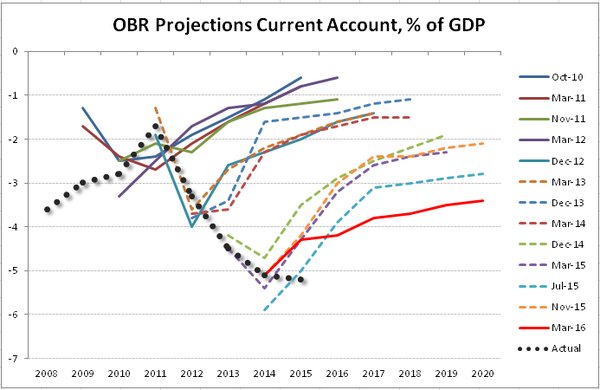
UK’s ever worsening current account since 2010
Austerity and the Housing Bubble
The reason for this that everyone focuses on, understandably, is stagnant housing supply. However, housing can also be seen as an asset. Just as low real interest rates boost the stock market because a given stream of expected future dividends looks more attractive, much the same is true of housing (where dividends become rents). Stock prices can rise because expected future profitability increases, but they can also rise because expected real interest rates fall. With housing increasingly used as an asset for the wealthy, or even as a way of saving for retirement, house prices will behave in a similar way. A shortage of housing supply relative to demand raises rents, but even if rents stayed the same falling expected real interest rates raise house prices because those rents become more valuable compared to the falling returns from alternative forms of wealth.
Continue reading
Austerity myths
We already know that real households do not live within their means; if they did, the economy would grind to a halt. Modern prosperity is built upon debt, and the main aim of economic recovery is to get the banks lending again to both households and businesses.
It is a myth, and it is propping up austerity politics. Another myth is that there is a shortage of money. This implies that there is a fixed pool of money, or some other external factor limiting supply. …
The austerity myth that damaged the public sector most significantly was the claim that states could not create money, they could only borrow from the banking sector. …
Continue reading
Hinkley Point: EDF’s own engineers oppose the construction
That is the point we have reached in the tortuous saga of Hinkley Point. The latest judgment from EDF’s engineers is not surprising. Internal opposition to the project to build another reactor to the same design as those under construction in Flamanville in northern France and Olkiluoto in Finland has always been strong. If those projects have not been completed, why take on all the risks of another? Hinkley has never had the support of a majority of the EDF board. The difference now is that the doubts are out in public and can hardly be dismissed as coming from anti-nuclear campaigners or people hostile to all things French. The simple fact is that serious professional engineers do not believe that Hinkley can be built to the present design.
Arts and group work is waste of time accoring to this government
A child’s education is too important to be messed about by people like these.
Schoolchildren who spend lessons watching DVDs, designing posters and doing “group work” are not being taught properly, the Government’s behaviour czar has warned.
Tom Bennett, the Department for Education’s discipline expert, said some teachers fill lessons with pointless activities that keep children busy but do not constitute proper teaching.
Continue reading
Bahraini snipers received training from British armed forces
The revelation that elite Royal Navy commandos are running week-long training courses for Bahraini personnel has outraged human rights campaigners, who accuse the regime of using snipers to target protesters during anti-government protests in 2011.
Continue reading
Public perceptions of economy, shocks and elections
Perceptive.

Regime change – the Libya intervention
Remember this next time there is another talk of ‘interventions.’
In truth, the Libyan intervention was about regime change from the very start. The threat posed by the Libyan regime’s military and paramilitary forces to civilian-populated areas was diminished by NATO airstrikes and rebel ground movements within the first 10 days. Afterward, NATO began providing direct close-air support for advancing rebel forces by attacking government troops that were actually inretreat and had abandoned their vehicles. Fittingly, on Oct. 20, 2011, it was a U.S. Predator drone and French fighter aircraft that attacked a convoy of regime loyalists trying to flee Qaddafi’s hometown of Sirte. The dictator was injured in the attack, captured alive, and then extrajudicially murdered by rebel forces.
Continue reading
Tories’ deception: NHS massively underfunded
The doctors’ union points out that the Department of Health’s budget to fund health in England will only have gone up by £4.5bn by 2020-21 compared to the current financial year, well below the £10bn extra the government has pledged to increase it by. …
The BMA bases its claim on joint projections by the King’s Fund, Nuffield Trust and Health Foundation thinktanks. They found that Osborne’s spending reviewlast November means that the Department of Health’s budget will rise by just £4.5bn during this parliament – to £120.9bn by 2020 – but that NHS England’s share of it to pay for frontline services will go up by £7.6bn to £108.9bn. Continue reading
Finlnd, Sweden, UK – Privatisation of Education
All Scandinavian education gets branded as excellent but this is not the case. Finland’s education system is world class but Sweden’s isn’t and there is a reason: privatisation.
One of the main operators of Swedish education services – JB Education – owned by private equity company Axel – went bust in June 2013 leaving around 10,000 students without a school. In the words of the Swedish education minister, Jan Bjorklund: ‘We had a venture capital company that didn’t know much about education taking over Swedish schools… They thought they were going to make big money, discovered it wasn’t easy, got tired quickly and quit.’ Continue reading
The biggest appropriation of Church land since the 1530s.
George Osborne just announced the biggest appropriation of Church land since the 1530s. …
Now the state isn’t quite stealing that land. The land on which academies sit is generally leased to the new academy trusts on long term leases (125 years, for example). But that is basically compulsory: it’s not as if the councils which are losing their schools get any say over whether to sign those leases or not. And to quote some lawyers, fromBrowne Jacobson:
Where the diocese own the land, it is usual for the diocese to grant the academy trust a licence to use the land under the church supplemental agreement
 Tipping Point North South