Global industrial civilisation could collapse in coming decades

Nafeez Ahmed, “Nasa-funded study: industrial civilisation headed for ‘irreversible collapse’?,” 14 March 2014, Guardian

A new study sponsored by Nasa’s Goddard Space Flight Center has highlighted the prospect that global industrial civilisation could collapse in coming decades due to unsustainable resource exploitation and increasingly unequal wealth distribution.
Continue reading

US Military Operations in Africa

Nick Turse, “Washington’s Back-to-the-Future Military Policies in Africa,” 13 March 2014, TomDispatch

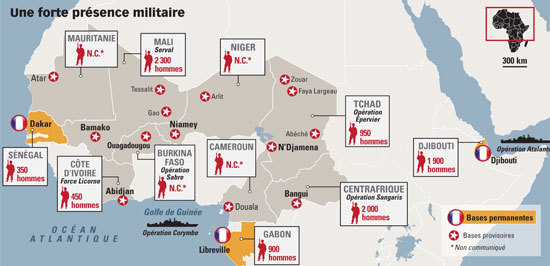
Since 9/11, the U.S. military has been making inroads in Africa, building alliances, facilities, and a sophisticated logistics network.  Despite repeated assurances by U.S. Africa Command (AFRICOM) that military activities on the continent were minuscule, a 2013 investigation by TomDispatch exposed surprisingly large and expanding U.S. operations — including recent military involvement with no fewer than 49 of 54 nations on the continent.  Washington’s goal continues to be building these nations into stable partners with robust, capable militaries, as well as creating regional bulwarks favorable to its strategic interests in Africa.  Yet over the last years, the results have often confounded the planning — with American operations serving as a catalyst for blowback (to use a term of CIA tradecraft).
Continue reading

U.S. Air Force is redundant

Kyle Mizokami, “The Independent Air Force Is a Mistake,” War is Boring

… In Grounded: The Case for Abolishing the United States Air Force, Farley argues that the Air Force is redundant. And, he claims, its existence actually hurts American national security.

Now, Farley doesn’t suggest getting rid of air power. Instead, he recommends the Pentagon dismantle the Air Force and hand its missions—and aircraft—over to the Army and Navy. …
Continue reading

Technology, not policy, will make it easier to conduct the ‘forever war’

Micah Zenko, “The True Forever War,” 24 January 2014, Foreign Policy

Technology, not policy, will make it easier for U.S. leaders to kill people, blow things up, and disrupt computer networks around the world.

… Many correctly highlight that the AUMF does not reflect the scope of the conflict that the United States is now engaged in, and that its elasticity assures that America will remain on a war footing in perpetuity. However, those concerned with the prospects of a “forever war” should be concerned less about the irrelevant post-9/11 legislative mandate, and more about the revolutionary expansion of military assets that have been made available to the president since then. These technologies and processes that have reduced the costs and risks of using force have permanently changed how Americans conceive of military operations. As killing people, blowing things up, and disrupting computer networks will only get easier, it is worthwhile to take stock of where we are today.
Continue reading

The Pentagon’s use of euphemisms

Tom Ackerman, “The Pentagon’s war on words,” 12 March 2014, Al Jazeera English

He calls the treatment of hunger-striking prisoners at Guantanamo “force-feeding”.

But in a just declassified Pentagon document, many of the detainees are described as engaging in “long term non-religious fasting”.

It’s the latest linguistic leavening from the US Department of Defence, a title in itself emblematic of the culture of euphemism at an agency that for 150 years proudly called itself the Department of War. …
Continue reading

Japan’s ‘nuclear deterrence without building a bomb’

Robert Windrem, “Japan Has Nuclear ‘Bomb in the Basement,’ and China Isn’t Happy,” 12 March 2014, NBC News

… But government officials and proliferation experts say Japan is happy to let neighbors like China and North Korea believe it is part of the nuclear club, because it has a “bomb in the basement” -– the material and the means to produce nuclear weapons within six months, according to some estimates. And with tensions rising in the region, China’s belief in the “bomb in the basement” is strong enough that it has demanded Japan get rid of its massive stockpile of plutonium and drop plans to open a new breeder reactor this fall. …
Continue reading

China’s richest 10% of families own 64% of all family wealth

27 February 2014, 京华时报

宜信财富与联办财经研究院共同推出《2014中国财富报告:展望与策略》,报告撰写人之一西南财经大学经济与管理研究院院长甘犁在会上对报告中关于中国家庭财富的成长与风险部分时称,中国家庭资产的分布非常不均,最高资产10个百分点的中国家庭拥有63.9%的资产。
Continue reading

The Sorry State of Corporate Taxes

The Sorry State of Corporate Taxes,” February 2014, Citizens for Tax Justice

Profitable corporations are supposed to pay a 35 percent federal income tax rate on their U.S. profits. But many corporations pay far less, or nothing at all, because of the many tax loopholes and special breaks they enjoy. This report documents just how successful many Fortune 500 corporations have been at using these loopholes and special breaks over the past five years. …
Continue reading

Japan tilts right

Oliver Stone and Peter Kuznick, “Oliver Stone and Peter Kuznick: Japan tilts right,” 02 February 2014, USA Today

… Today, Kishi’s grandsonShinzo Abe, is prime minister and is doing to Japan what Attorney General John Mitchell predicted Richard Nixon would do to the U.S. — drive the country “so far to the right you’re not even going to recognize it.” …
Continue reading

War between China and Japan is still unlikely

Zack Beauchamp, “Why Everyone Needs To Stop Freaking Out About War With China,” 07 February 2014, ThinkProgress

… It’s wrong to talk about incentives to go war in purely military terms. A key component of the Senkaku/Diaoyou is economic: the islands contain a ton of natural resources, particularly oil and gas. But far more valuable are the trade ties between the two countries. China is Japan’s largest export market, so war would hurt Japan more than China, but it’d be pretty painful for both.
Continue reading

Military spending is integral to capitalism

Richard Seymour, “Global military spending is now an integral part of capitalism,” 7 March 2014, Guardian

There are few surprises about the distribution of military spending: for all the current focus on China’s growing military outlays – and it is significant that they have embarked on a sequence of double-digit increases as a percentage of GDP – the United States still accounts for 40% of such expenditures. However, the distribution is not the only thing that matters; it’s the sheer scale of such investment – $1.756tn in 2012. The “peace dividend” from the end of the cold war has long since bitten the dust. Global military spending has returned to pre-1989 levels, undoubtedly a legacy of the war on terror and the returning salience of military competition in its context. In fact, by 2011 global military spending was higher than at any year since the end of the second world war. …
Continue reading

Corruption is by far not the main factor behind persisting poverty in the Global South

Jason Hickel, “Flipping the corruption myth,” Al Jazeera, 1 February 2014

Many international development organisations hold that persistent poverty in the Global South is caused largely by corruption among local public officials. In 2003 these concerns led to the United Nations Convention against Corruption, which asserts that, while corruption exists in all countries, this “evil phenomenon” is “most destructive” in the global South, where it is a “key element in economic underperformance and a major obstacle to poverty alleviation and development”.

There’s only one problem with this theory: It’s just not true.
Continue reading

Britain to order another 14 F-35 jets

Brenda Goh and Andrea Shalal-Esa, “Britain may order 14 F-35 jets as early as next week: sources,” Reuters, 23 January 2014

The so called ‘Main Gate 4’ order, for the F-35 B vertical take-off variant of the Joint Strike Fighter, would mark the Britain’s first firm F-35 purchase since it committed to buying 48 planes in 2012.
Continue reading