
The number of children living in poverty in the UK has jumped by 200,000 in a year, according to the latest official data.
There were 3.9 million children living in “relative poverty” in 2014-15, up from 3.7 million a year earlier, the figures from the Department for Work and Pensions show.
Continue reading
Category Archives: News and Analysis
Former CIA Officer Amaryllis Fox’s lesson from undercover life
Illegal drug profits, Washington’s foreign military outflows of dollars, and US balance of payments deficit
Hudson’s next task was to estimate the amount of money from crime going into Switzerland’s secret banking system. In this investigation, his last for Chase, Hudson discovered that under US State Department direction Chase and other large banks had established banks in the Caribbean for the purpose of attracting money into dollar holdings from drug dealers in order to support the dollar (by raising the demand for dollars by criminals) in order to balance or offset Washington’s foreign military outflows of dollars. If dollars flowed out of the US, but demand did not rise to absorb the larger supply of dollars, the dollar’s exchange rate would fall, thus threatenting the basis of US power. By providing offshore banks in which criminals could deposit illicit dollars, the US government supported the dollar’s exchange value.
Continue reading
Cerberus and the profits of mass murder
But Cerberus is also very big in guns. It is run by people for whom everything is just business, from firesales to firearms, from Irish property deals to selling weapons of war to anyone who wants them. The connection between Belfastand Orlando reminds us of a truth that is easily forgotten – behind every mass shooting by a deranged psychopath in the US is a very profitable industry owned by Ivy League graduates with clean hands and manicured nails, respectable people who fund politicians in Congress and host charity galas inManhattan. If they had a slogan it would be the old Roman adage, pecunia non olet – money has no smell.
Continue reading
F-18 fighter jet – a “nice margin generator.”
“F-18 has been a great program for this company and continues to be,” CFO Ken Bedingfield told investors this week at Citi’s Industrials Conference in Boston, adding that it’s also a “nice margin generator.”
Continue reading
“Sabre-rattling and war-mongering” was not the way to treat Russia
An extraordinary demarche came at the weekend from the German foreign minister, Frank-Walter Steinmeier. In an interview with Bild am Sonntag newspaper, he accused Nato – an alliance, lest we forget, of which Germany is a member – of “sabre-rattling and war-mongering” by staging military manoeuvres close to Russia’s borders. This, he said, was not the way to treat Russia; it was time to restart dialogue.
Continue reading
The case for Universal Basic Income
But, after a Conservative government ended the project, in 1979, Mincome was buried. Decades later, Evelyn Forget, an economist at the University of Manitoba, dug up the numbers. And what she found was that life in Dauphin improved markedly. Hospitalization rates fell. More teen-agers stayed in school. And researchers who looked at Mincome’s impact on work rates discovered that they had barely dropped at all. The program had worked about as well as anyone could have hoped.
Mincome was a prototype of an idea that came to the fore in the sixties, and that is now popular again among economists and policy folks: a basic income guarantee. There are many versions of the idea, but the most interesting is what’s called a universal basic income: every year, every adult citizen in the U.S. would receive a stipend—ten thousand dollars is a number often mentioned. (Children would receive a smaller allowance.)
One striking thing about guaranteeing a basic income is that it’s always had support both on the left and on the right—albeit for different reasons. Martin Luther King embraced the idea, but so did the right-wing economist Milton Friedman, while the Nixon Administration even tried to get a basic-income guarantee through Congress. These days, among younger thinkers on the left, the U.B.I. is seen as a means to ending poverty, combatting rising inequality, and liberating workers from the burden of crappy jobs. For thinkers on the right, the U.B.I. seems like a simpler, and more libertarian, alternative to the thicket of anti-poverty and social-welfare programs. Continue reading
How to tackle idleness: progressive taxation and basic income
Our recommendations here are radical: we are committed to strong, progressive taxation. That means we believe that as income rises the proportion of the total income that a person pays in tax should rise as well. It is a principle of tax justice, usually described as vertical equity, that few would wish to dispute. However, the UK tax system does not deliver vertical equity in a great many cases. It is our opinion that this is best addressed by a complete redesign of the Income Tax, National Insurance and benefits systems: nothing less will do if we are to tackle institutional impediments to idleness.
Continue reading
The sale of the Land Registry makes no sense
So the Land Registry is a natural monopoly and, as goes the Competition and Market Authority’s main argument, these kinds of services should be publically owned. Handing a monopoly over to a private company in search of profit risks harming consumers – the new owners may simply charge a higher price for the service, or in this case put the data, the Land Registry’s most valuable asset, behind a paywall.
The Law Society says that the Land Registry plays a central role in ensuring property rights in England and Wales, and so we need to ensure that it maintains its integrity and is free from any conflict of interest. Continue reading
Global nuclear weapons 2016
At the start of 2016 nine states—the United States, Russia, the United Kingdom, France, China, India, Pakistan, Israel and North Korea—possessed approximately 4,120 operationally deployed nuclear weapons. If all nuclear warheads are counted, these states together possessed a total of approximately 15,395 nuclear weapons compared with 15,850 in early 2015 (see table 1).
Continue reading

Big increases in small arms trade
But from 2012 to 2013, the global small arms trade jumped to a total of USD 6 billion worth of small arms, an increase of 17 per cent/ $1 billion in only one year, according to the report titled “Trade Update 2016: Transfers and Transparency”
The United States was, by far, both the largest exporter and importer. It exported $1.1 billion, while only two other countries – Italy and Germany – surpassed the $500 million mark in exports.
Transfers of small arms to the U.S. accounted for 42 per cent of all imports.
Sixteen exporters surpassed $100 million in 2013, the largest number since the survey began in 2001.
And although this is the most comprehensive data set on small arms transfers, these numbers are most likely much higher, since 40% of information on imports and exports were concealed by states, said Senior Researcher for the Small Arms Survey, Nicolas Florquin. Continue reading
Health workers say stop arms sales to Saudi!
The Medact Arms Control Group:
Open letter to the Secretary of State of Business, Innovation and Skills (BIS), Sajid Javid. BIS are in charge of licensing arms sales.
STOP FUELLING THE YEMEN CONFLICT
End all UK arms sales to Saudi Arabia
It is now over a year since the recent outbreak of armed conflict in Yemen began, forcing 2.4 million people to flee their homes, and leaving over 22 million people in need of humanitarian support. The conflict has killed over six thousand people, and left the health care system on its knees.
Humanitarian agencies are struggling to respond and the country stands on the brink of famine. A senior representative of Médecins Sans Frontières (MSF) has described the current level of humanitarian assistance in Yemen as a “drop in the ocean.”
Continue reading
Endocrine disruptors: The secret history of a scandal

This is one of the best kept secrets in Europe. It is locked up in the maze of corridors in the European Commission, in a guarded room that only about 40 accredited officials have the right to enter. And then only with paper and pen. Smartphones are not allowed.
This is a stricter safety protocol than even for the Transatlantic Trade and Investment Partnership (or TTIP) between the European Union and the United States: If members of the European Parliament want to access TTIP documents they can enter the reading room without anyone checking the contents of their pockets.
The secret is a report of about 250 pages. Its title, in the jargon of the Commission, is “Impact Assessment.”
Continue reading
Share of economic growth enjoyed by workers is at its lowest since the second world war
And the longer the slump goes on, the more the public tumbles to the fact that not only has growth been feebler, but ordinary workers have enjoyed much less of its benefits. Last year the rich countries’ thinktank, the OECD, made aremarkable concession. It acknowledged that the share of UK economic growth enjoyed by workers is now at its lowest since the second world war. Even more remarkably, it said the same or worse applied to workers across the capitalist west.
Housing Bubble: 3 factors that determines the rent prices
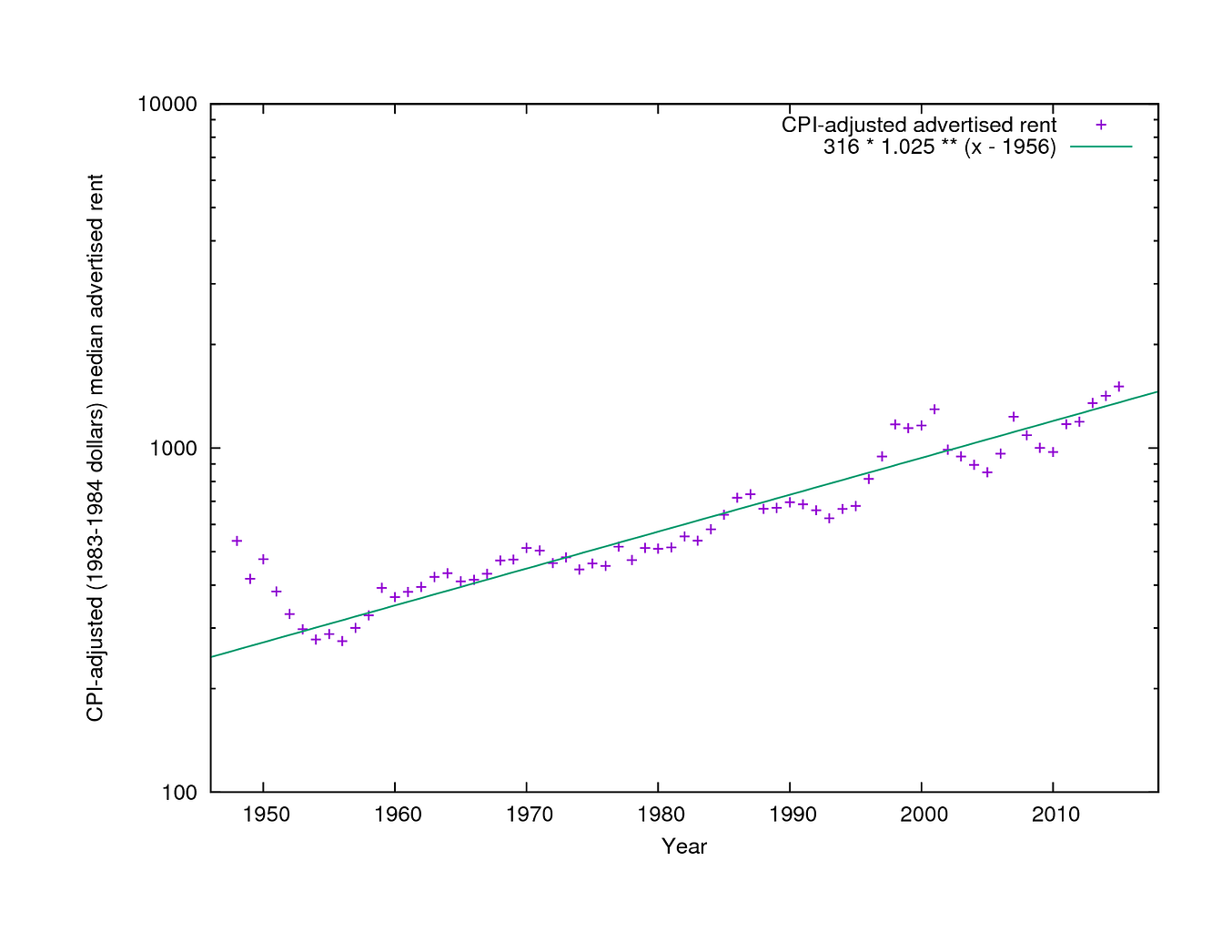
Instead of getting any further into that, this blog post exists to re-emphasize what his new data revealed: this chart
That, my friends, is 70 years of San Francisco housing prices. There are some ups and downs, but for the most part there is a very simple trend: 6.6 percent.
That’s the amount the rent has gone up every year, on average, since 1956. It was true before rent control; it was true after rent control. It wasn’t entirely true during the 2000 tech bubble, but it was still sort of true and it became true again afterward.
6.6 percent is 2.5 percentage points faster than inflation, which doesn’t seem like a lot but when you do it for 60 years in a row it means housing pricesquadruple compared to everything else you have to buy.
That’s bad. But that’s SF today, compared to 1956.
So what caused prices to go up? That’s the really exciting part of Fischer’s discovery. Armed with his data, he more or less answered that question. Continue reading
Visualizing world military spending
Universal basic income to eliminate poverty
Eduardo Porter has a column up with the provocative headline “Why a Universal Basic Income Will Not Solve Poverty,” which intrigued me because my understanding from reading coverage by Vox’s own Dylan Matthews and others was that a UBI most certainly would solve poverty.
Having read Porter, I remain unconvinced. His argument turns out to be something more like “a universal basic income would be expensive” or “a universal basic income is an example of a poorly targeted public policy.” The former is clearly true, and the latter is at least something clearly worth talking about. But Porter’s own numbers make it very clear that a UBI would eliminate poverty in the United States and would do so at a price that, though high, is within the realm of possibility. Continue reading
IMF: Neoliberalism and austerity policies don’t work
Osborne said his austerity programme would give the government more flexibility in the event of a future crisis, but the IMF said taking out this sort of insurance policy would only be worth it if the benefits exceeded the costs.
“It turns out, however, that the cost could be large – much larger than the benefit. The reason is that, to get to a lower debt level, taxes that distort economic behaviour need to be raised temporarily or productive spending needs to be cut – or both. The costs of the tax increases or expenditure cuts required to bring down the debt may be much larger than the reduced crisis risk engendered by the lower debt.”
The economists rejected the notion that austerity could be good for growth by boosting the confidence of the private sector to invest. It said that in practice, “episodes of fiscal consolidation have been followed, on average, by drops rather than by expansions in output. On average, a consolidation of 1% of GDP increases the long-term unemployment rate by 0.6 percentage points.” Continue reading

Sharing And Celebrating The Work And The Activism Of The Amazing Rachel Carson
RACHEL CARSON DAY May 27th
We at Tipping Point, through our work on our From Pink to Prevention campaign, are proud to be marking the birthday of an extraordinary woman –the citizen/scientist Rachel Carson.

Please visit our campaign website, where two new blog posts will take you on the amazing Rachel Carson journey.
Continue reading
Continue reading
 Tipping Point North South