
The richest 1% of the UK population owns more than 20 times the wealth of the poorest fifth, according to Oxfam.
That made Britain one of the most unequal countries in the developed world and contributed to the vote for Brexit, the charity said.
Its analysis found that about 634,000 Britons were worth 20 times as much as the poorest 13 million people. Continue reading
Category Archives: News and Analysis
Poor growth and/or increases in inequality owe as much to global forces as domestic policies
Note two things here. First, there are a lot of dots with very low income growth, low enough to deserve the label “stagnant”. Second, wherever similar-coloured dots are on an upward slope, higher-income groups left their lower-income compatriots behind. Aside from the very lowest deciles (who are often cared for with welfare benefits), that very often seems the case. Again, Lakner and Milanovic looked into this, and wrote: “Some examples with particularly low real growth rates among rich economies include almost the entire lower halves of the income distributions in Austria, Germany, Denmark, Greece and the United States. They all had overall 20-year growth rates of less than 20 per cent which translates, in the best case, as 0.9 per cent per capita annually.”
Continue reading
F-35 testing report contradicts the U.S. Air Force’s rosy pronouncements
Last month the Air Force declared its variant “ready for combat,” and most press reports lauded this as a signal that the program had turned a corner. But a memo issued from the Pentagon’s top testing official, based largely upon the Air Force’s own test data, showed that the declaration was wildly premature.
Michael Gilmore’s latest memorandum is damning. The F-35 program has derailed to the point where it “is actually not on a path toward success, but instead on a path toward failing to deliver the full Block 3F capabilities for which the Department is paying almost $400 billion.”
The 16-page memo, first reported by Tony Capaccio at Bloomberg and then by others, details just how troubled this program is — years behind schedule and failing to deliver even the most basic capabilities taxpayers, and the men and women who will entrust their lives to it, have been told to expect.
The Pentagon’s top testing office warns that the F-35 is in no way ready for combat since it is “not effective and not suitable across the required mission areas and against currently fielded threats.” Continue reading
Top 100 defense companies 2016
Total 2015 defense revenues for the Top 100 companies came in at $356.7 billion, down more than 7 percent from the 2014 Top 100 total of $385.8 billion. The top 25 companies accounted for 73 percent of total defense revenues in the year, and the Top 10 firms accounted for 54 percent of total defense revenues in the year, an improvement from the last two cycles, which saw that percentage drop a point each in 2013 and 2014.
Geographically, 41 of the Top 100 firms are based in the US, which accounted for 60 percent of total defense revenue, up from 54 percent in 2014 – a sign that even as other nations expand their defense industries, American companies remain dominant on the global stage. Europe has 27 companies featured, which increases if Russia’s six major defense companies are included, while the Asia-Pacific region has 17 companies. In contrast, Africa and South America were represented by a single firm each. …
Continue reading
Super Power, Global Power, Regional Power and Local Power
The United States took the top slot as the world’s super power, while Britain took the only Global Power slot, bringing her in second behind America.
Regional powers include France, China, India and Germany, while local powers were those such as Italy, Brazil, and Turkey.
Continue reading
Macroeconomic policy, not technology, undermines workers bargaining power
Well, a big part of the story is that the UK (like the U.S.) has a very weak labor market. This was a result of conscious policy decisions. The Conservative government put in a policy of austerity that had the effect of reducing demand in the UK and slowing the rate of job creation. In this context, of course employers get to call the shots.
Serious people would address the context which has denied workers bargaining power. It is not “technology” as Harris and his elite Trumpians would like to pretend, it is macroeconomic policy. But Harris has no time for talking about macroeconomic policy. He dismisses a plan put forward by Labor Party Leader Jeremy Corbyn to produce full employment as, “either naive or dishonest” adding “but they reflect delusions that run throughout Labour and the left.” Continue reading
UK, the second biggest arms dealer in the world
Britain is now the second biggest arms dealer in the world, official government figures show – with most of the weapons fuelling deadly conflicts in the Middle East.
Since 2010 Britain has also sold arms to 39 of the 51 countries ranked “not free” on the Freedom House “Freedom in the world” report, and 22 of the 30 countries on the UK Government’s own human rights watch list.
Continue reading
The U.S. Army Lost Track of $6.5 Trillion
The Army made headlines in mid-August 2016 when a Defense Department Inspector General report landed with a heavy thud. The 75-page reportdetailed all the ways the Army screwed up its accounting of the Army General Fund in 2015.
According to the report, Army bookkeepers screwed up the budget to the tune of … $6.5 trillion dollars.
U.S. Defense Contractors: Russian Threat Is Great for Business
Retired Army Gen. Richard Cody, a vice president at L-3 Communications, the seventh largest U.S. defense contractor, explained to shareholders in December that the industry was faced with a historic opportunity. Following the end of the Cold War, Cody said, peace had “pretty much broken out all over the world,” with Russia in decline and NATO nations celebrating. “The Wall came down,” he said, and “all defense budgets went south.”
Now, Cody argued, Russia “is resurgent” around the world, putting pressure on U.S. allies. “Nations that belong to NATO are supposed to spend 2 percent of their GDP on defense,” he said, according to a transcript of his remarks. “We know that uptick is coming and so we postured ourselves for it.”
Continue reading
An Economic Bill of Rights for 21st Century: the Universal Basic Income
An Economic Bill of Rights for 21st Century
In the summer of 1967, King announced what was to be the most expansively radical adventure of his life – a national movement called the Poor People’s Campaign, mobilizing Black, White, Hispanic, Native American. It was to demand an annual $30bn federal investment to deliver full employment, guaranteed annual income, 300,000 units of low cost housing per year.
Tragically, Dr. King was assassinated on 4th April 1968, and the April 16 edition of USA Look magazine carried a posthumous article from King titled “Showdown for Nonviolence” — his last statement on the Poor People’s Campaign. The article warns of imminent social collapse and suggests that the Campaign presents government with what may be its last opportunity to achieve peaceful change — through an Economic Bill of Rights. Three weeks after Dr King’s death, the Committee of 100 — set up to lobby on behalf of the campaign – called for just this – an economic bill of rights with five planks to deliver economic justice.
- A meaningful job at a living wage
- A secure and adequate income for all those unable to find or do a job
- Access to land for economic uses:
- Access to capital for poor people and minorities to promote their own businesses:
- Ability for ordinary people to play a truly significant role in the government
Despite the intervening decades since the Poor People’s Campaign, it is true to say that Dr King would recognise the same issues today as he faced then – inequality, corporate power, racism and militarism. Now, we have other factors that also need to be incorporated – climate change, the total capture and consolidation of political power by the financial and business class; the globalisation of the neo-liberal agenda (north and south alike). So, it is imperative for our renewed Economic Bill of Rights to reflect this.
Among the big ideas, the one that will be integral for us to solve the first 2 demands of the 1968 Economic Bill of Rights in the 21st century is the universal basic income. Continue reading
The mission of the F-35
The F-35 Joint Strike Fighter is possibly one of the most useless jets and biggest waste of taxpayer money ever conceived by the US military. In fact, according to Pierre Sprey, one of the three men that created the F-16, the point of this plane is “to spend money.” He clarifies, “that is the mission of the airplane, is for the US Congress to send money to Lockheed [Martin].”
£1bn of weapons flow from Europe to Middle East
Thousands of assault rifles such as AK-47s, mortar shells, rocket launchers, anti-tank weapons and heavy machine guns are being routed through a new arms pipeline from the Balkans to the Arabian peninsula and countries bordering Syria.
The suspicion is that much of the weaponry is being sent into Syria, fuelling the five-year civil war, according to a team of reporters from the Balkan Investigative Reporting Network (BIRN) and the Organised Crime and Corruption Reporting Project (OCCRP).
Arms export data, UN reports, plane tracking, and weapons contracts examined during a year-long investigation reveal how the munitions were sent east from Bosnia, Bulgaria, Croatia, Czech Republic, Montenegro, Slovakia, Serbia and Romania.
Continue reading
The effects of poverty costs the UK £78bn a year
The Joseph Rowntree Foundation (JRF) estimates that the impact and cost of poverty accounts for £1 in every £5 spent on public services.
The biggest chunk of the £78bn figure comes from treating health conditions associated with poverty, which amounts to £29bn, while the costs for schools and police are also significant. A further £9bn is linked to the cost of benefits and lost tax revenues. …
The JRF report, called “counting the cost of UK poverty”, estimates that 25% of healthcare spending is associated with treating conditions connected to poverty.
Continue reading
Trident
Cripin Blunt on Trident
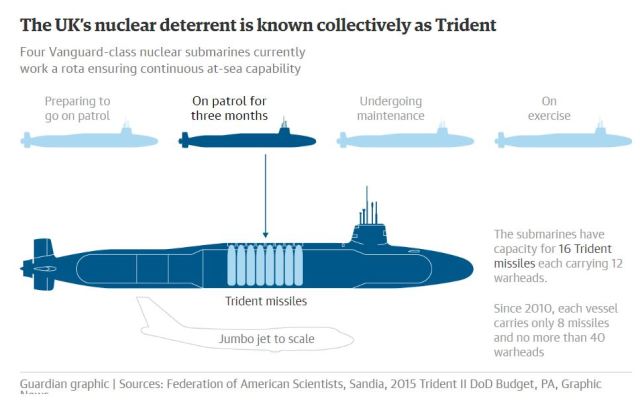
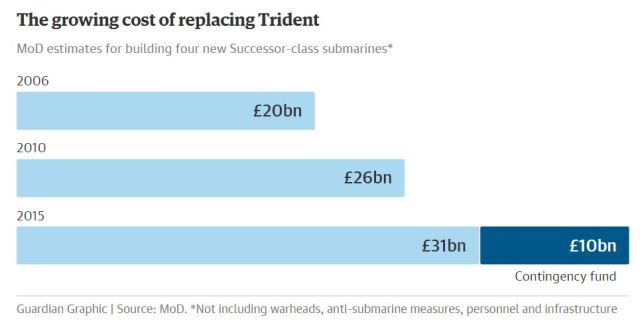
Cripin Blunt, the Conservative chair of the Commons foreign affairs committee, spoke after Angus Robertson in the debate and he said he would not be voting for Trident renewal.
Earlier, in an intervention, he said that his current estimate was that Trident renewal would have a lifetime cost of £179bn.
- Blunt said Trident renewal would be “the most egregious act of self-harm to our conventional defence”.
Underfunded NHS needed £3 billlion “working capital loans” from government last year
The government had to lend cash-strapped hospitals a record £2.825bn in the last financial year so they could pay staff wages, energy bills and for drugs needed to treat patients.
The Department of Health was forced to provide emergency bailouts on an unprecedented scale to two-thirds of hospital trusts in the 2015-16 financial year because they were set to run out of money, the Guardian can reveal.
Continue reading
PFI has sucked NHS funding dry
The NHS has more than 100 PFI hospitals. The original cost of these 100 institutions was around £11.5bn. In the end, they will cost the public purse nearly £80bn. The total UK PFI debt is over £300bn for projects worth only £55bn. This means that nearly £250bn will be spent swelling the coffers of PFI groups.
Continue reading
USA, Militization, Japan
TNI: War Profiteers Are Now Refugee Profiteers
The report (pdf), Border Wars: The Arms Dealers Profiting from Europe’s Refugee Tragedy, released jointly by the European Stop Wapenhandel and Transnational Institute (TNI) on Monday, outlines arms traders’ pursuit of profit in the 21st century’s endless conflicts.
“There is one group of interests that have only benefited from the refugee crisis, and in particular from the European Union’s investment in ‘securing’ its borders,'” the report finds. “They are the military and security companies that provide the equipment to border guards, the surveillance technology to monitor frontiers, and the IT infrastructure to track population movements.”
Continue reading

What Brexit teaches us about communications
- Facts alone are not enough to win the argument
- Relying on expert opinion to build public engagement can sometimes backfire
- Tell a good story
- Identify messages of hope
 Tipping Point North South