The top 10 American corporations profiting from Egypt’s military

Kyle Kim, “Here are the top 10 American corporations profiting from Egypt’s military,” GlobalPost, 16 August 2013

For decades, Egypt has been one of the largest recipients of US foreign military aid, receiving everything from F-16s to teargas grenades.

So who are the companies reaping the benefits?
Continue reading

Joint Chiefs Chairman Dempsey: I worry more about a China that falters economically than …

Tom Risen, “Joint Chiefs Chairman Dempsey: Troops Needed in Afghanistan,” U.S. News & World Report, 18 November 2013

On the subject of China as a possible future threat, Dempsey said there was a chance for good diplomacy with that country and that military competition “doesn’t have to be confrontational.”

“The Chinese have a different view of time than anyone else,” Dempsey said about China’s potential for patient diplomacy. “I worry more about a China that falters economically than I do about them building another aircraft carrier.”
Continue reading

$8.5 trillion missing from the Pentagon

Scot J. Paltrow, “Special Report: The Pentagon’s doctored ledgers conceal epic waste,” Reuters, 18 November 2013

Because of its persistent inability to tally its accounts, the Pentagon is the only federal agency that has not complied with a law that requires annual audits of all government departments. That means that the $8.5 trillion in taxpayer money doled out by Congress to the Pentagon since 1996, the first year it was supposed to be audited, has never been accounted for. That sum exceeds the value of China’s economic output last year. …
Continue reading

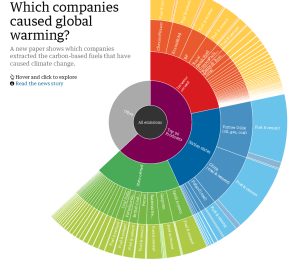
Just 90 companies caused 2/3 of man-made global warming emissions

Which companies caused global warming?

Just 90 companies caused two-thirds of man-made global warming emissions,” Guardian, 20 November 2013

The climate crisis of the 21st century has been caused largely by just 90 companies, which between them produced nearly two-thirds of the greenhouse gas emissions generated since the dawning of the industrial age, new research suggests.

The companies range from investor-owned firms – household names such as Chevron, Exxon and BP – to state-owned and government-run firms. …
Continue reading

What kept Hetty Bower campaigning for peace and justice for over ninety years?

Aimee Vallory, “What kept Hetty Bower campaigning for peace and justice for over ninety years?,” Stop the War Coalition, 20 November 2013

Hetty Bower campaigned for peace and justice for ninety years, from campaigning as a suffragette after the first world war, to marching against the endless “war on terror” in the new millenium. …
Continue reading

US to spend billions ‘modernizing’ nuclear arsenal

Mathieu Rabechault, “US to spend billions ‘modernizing’ nuclear arsenal,” AFP, 7 November 2013

Washington — The United States plans to spend billions to upgrade a decades-old atomic bomb designed to stop a Soviet invasion of Europe, as part of a controversial project to modernize its nuclear arsenal.

Some lawmakers and experts dismiss the effort as a colossal waste of money that could derail arms control talks with Russia. …

Some members of Congress are wary of the price tag, as the estimated cost for modernizing the B61 bomb keeps rising, from an initial $4 billion to $8.1 billion. And a Pentagon panel has projected the cost could reach $10 to $12 billion.

“The case against the B61 life extension is simple: it is unaffordable, unworkable and unnecessary,” said Kingston Reif of the Bulletin of the Atomic Scientists.
Continue reading

Is Pentagon paying for study it can get for free?

Ray Locker, “Is Pentagon paying for study it can get for free?,” USA TODAY, 6 November 2013

Is the Office of Net Assessment, the Pentagon’s futurist think-tank, paying $184,000 to a conservative Washington research group for a study on nuclear deterrence that has already been published and is available for free?
Continue reading

UK’s Attempt to Use ‘Terrorism’ Laws to Suppress Journalism

Trevor Timm, “Will the US State Dept Condemn UK’s Attempt to Use ‘Terrorism’ Laws to Suppress Journalism?,” Freedom of the Press Foundation, 3 November 2013

In a shocking court filing this week, the UK government accused journalist Glenn Greenwald’s partner David Miranda of “terrorism” for allegedly transporting leaked (and heavily encrypted) NSA documents from documentarian Laura Poitras in Germany to Greenwald in Brazil, on a journalistic mission paid for by the Guardian newspaper.

In a statement that should send chills down the spine of every reporter, the government made the unbelievable claim that merely publishing information that has nothing to do with violence still “falls within the definition of terrorism.”

“Additionally the disclosure, or threat of disclosure, is designed to influence a government and is made for the purpose of promoting a political or ideological cause. This therefore falls within the definition of terrorism…”

Continue reading

Let’s put an end to the “war on drugs” that has ruined so many lives

Katrina vanden Heuvel, “Why It’s Always Been Time to Legalize Marijuana,” The Nation, 30 October 2013

“Marijuana is indeed a gateway drug,” quips Sanho Tree of the Institute for Policy Studies. “It’s a gateway drug to the Oval Office!” Indeed. From Bill Clinton’s “I didn’t inhale it” through George W. Bush’s “I was young and foolish” to Barack Obama’s teen years in the Choom Gang (“I inhaled frequently—that was the point”), the last three presidents have more or less owned up to breaking America’s drug laws.
Continue reading

Defense Contractors Profit Despite Sequestration And Shutdown

Hayes Brown, “Defense Contractors Profit Despite Sequestration And Shutdown,” Think Progress, 24 October 2013

Defense contractors have managed to not only stay afloat but also thrive in a climate of government closure and massive cuts to the Pentagon’s budget, continuing to rake in billions upon billions of dollars in profits. Continue reading

The Nearly $1 Trillion National Security Budget

Chris Hellman and Mattea Kramer, “War Pay,” TomDispatch, 22 May 2012

Here, then, is a simple question that, for some curious reason, no one bothers to ask, no less answer: How much are we spending on national security these days? With major wars winding down, has Washington already cut such spending so close to the bone that further reductions would be perilous to our safety?

In fact, with projected cuts added in, the national security budget in fiscal 2013 will be nearly $1 trillion — a staggering enough sum that it’s worth taking a walk through the maze of the national security budget to see just where that money’s lodged.
Continue reading

The militarization of U.S. police forces

Michael Shank and Elizabeth Beavers, “The militarization of U.S. police forces,” Reuters, 22 October 2013

Police departments in Boise and Nampa, Idaho, each acquired an MRAP, as did the force in High Springs, Florida. The offer of war-ready machinery, at practically no cost, has proven hard to resist for local police departments. Increasingly, they are looking like soldiers equipped for battle.

The growing similarity between our domestic police forces and the U.S. military is a result of the Pentagon’s 1033 Program. This allows the Defense Department to donate surplus military equipment and weapons to law enforcement agencies. In addition to the frightening presence of paramilitary weapons in American towns, the program has led to rampant fraud and abuse. …
Continue reading

Drone strikes killing more civilians than U.S. admits

Craig Whitlock, “Drone strikes killing more civilians than U.S. admits, human rights groups say,” The Washington Post, 22 October 2013

Two influential human rights groups say they have freshly documented dozens of civilian deaths in U.S. drone strikes in Pakistan and Yemen, contradicting assertions by the Obama administration that such casualties are rare.
Continue reading

Big Win for Defense Industry

Cora Currier, “In Big Win for Defense Industry, Obama Rolls Back Limits on Arms Exports,” ProPublica, 14 October 2013

The United States is loosening controls over military exports, in a shift that former U.S. officials and human rights advocates say could increase the flow of American-made military parts to the world’s conflicts and make it harder to enforce arms sanctions.

Come tomorrow, thousands of parts of military aircraft, such as propeller blades, brake pads and tires will be able to be sent to almost any country in the world, with minimal oversight – even to some countries subject to U.N. arms embargos. U.S. companies will also face fewer checks than in the past when selling some military aircraft to dozens of countries. …
Continue reading