
TPNS PARTICIPATION AT COP29
As many predicted, on the main issue of climate finance for global south countries, COP29 was indeed the failure many dreaded. Rich nations held to their position that they were unable to reach the public funding levels needed and – as feared – ended up relying on private finance and loans to shore up their paltry and insulting $300bn in order to reach the $1trillion plus annually needed. A far cry from the necessary and just $5tr annually called for by global civil society.
On phasing out fossil fuels, again, the full on commitment that was needed was not to be found. The oil lobby and Saudi Arabia led the charge to row back on Dubai COP28 commitment. This, combined with the finance failure, led to deep disappointment and anger on the part of not just civil society but many regional groupings and governments as well.
 However, on the topic of military emissions and – vitally – military spending – it was clear that both are now widely recognised as important elements of the mitigation as well as the climate finance debates. Wider global civil society is now including military spending as part of its overall climate finance demands at COP; a number of states also linked military spending to climate finance.
It was very encouraging to see the relevance of public military spending to the climate finance demands made loud and clear at this COP2 and for TPNS to play its part in this issue ‘breaking out’ inside the official COP space. Deborah Burton attended the first week on behalf of TPNS and her attendance was supported by Movement for the Abolition of War.
TPNS PUBLICATIONS FOR COP29
In advance of COP29 we prepared two publications which were shared widely across UNFCCC Focal Points; relevant UN Dept staff; INGOs. We hope they made a positive contribution to raising awareness and action on (i) the indivisibility of military emissions and spending and (ii) the need to include military spending in the climate finance negotiations.
COP29 Briefing: Why public military spending matters to climate finance discussions https://transformdefence.org/publication/cop29-why-public-military-spending-matters-to-climate-finance-discussions/
UNGA September Report: Summit for the Future-Climate Finance, Climate Change and the Global Military https://transformdefence.org/publication/summit-of-the-future/
OFFICIAL SIDE EVENT
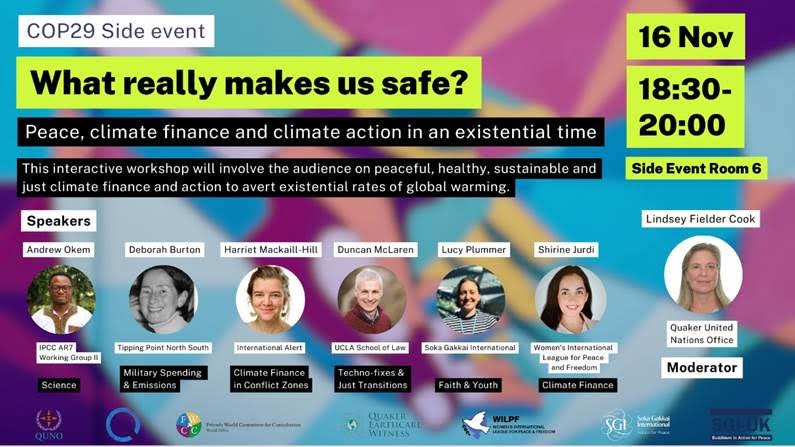
What really makes us safe? Peace, Climate finance and climate action
TPNS was invited to join a panel to explore the issue of ‘safety’ in the face of climate breakdown. Deborah joined speakers from the IPCC, International Alert, UCLA and co-host of the event, Soka Gokkai.
More links
https://quno.org/timeline/2024/11/quno-cop29
& PRESS CONFERENCES
The COP of Peace: Peace, climate, demilitarisation https://peaceboat.org/english/news/cop29_demilitarize_climatejustice
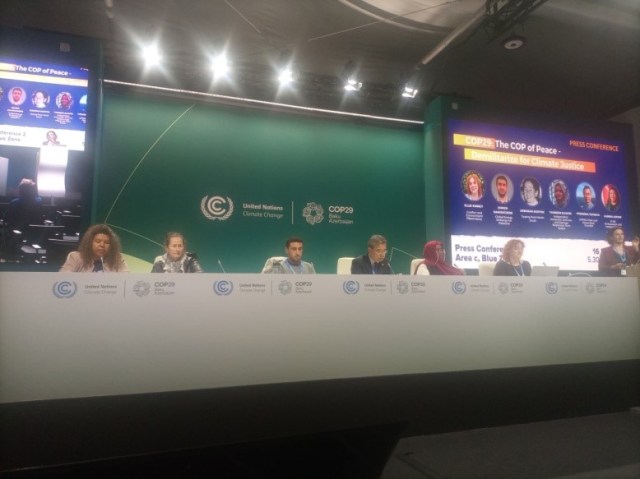 Speakers: Tasneem Elfatih, Researcher and Climate activist from Sudan, Hamza Hamouchene, Researcher and activist with Global Energy Embargo for Palestine (GEEP), Ellie Kinney, Advocacy Coordinator for Climate, Conflict and Environment Observatory (CEOBS), Deborah Burton, Co-founder and Director, Tipping Point North South, Yoshioka Tatsuya, Chair, Global Partnership for the Prevention of Armed Conflict (GPPAC), Karina Lester, ICAN Ambassador Australia and First Nations Representative. Moderator Karen Hallows, Peaceboat.
Interfaith Press Conference
Lindsey Fielder Cook Quaker UN Office, makes reference to military emissions and spending.
Lindsey Fielder Cook video here.
Side Event Presentation and Press Conference contribution here.
BLUE ZONE ACTIONS
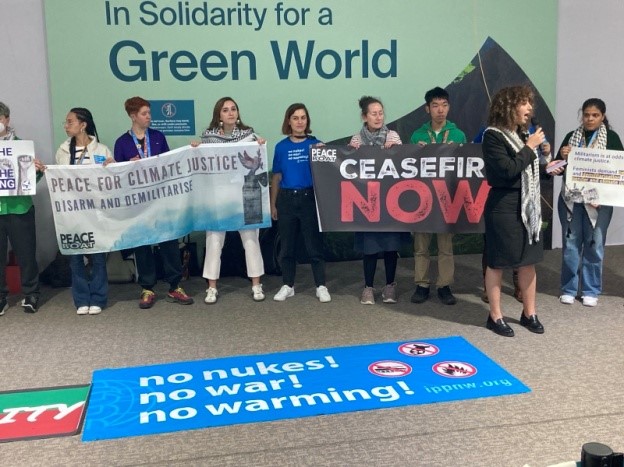 Peace and Demilitarisation action with speakers from Palestine and Sudan
Organised by the peace and demilitarisation working group.
And the first COP Degrowth action also took place inside the Blue Zone. TPNS provided background info on military and degrowth.
COP29 OPEN LETTERS – SIGNATORY
Climate Justice Coalition Open Letter to COP29 Presidency on the urgent need to address climate and militarism. With refs to TPNS military spending stats. Letter here.
Climate Action Network finance letter addressed to the G77+China. https://climatenetwork.org/2024/11/23/cop29-ncqg-letters/
“The collective civil society constituencies and members present at COP29, and with broader global civil society behind us, wholeheartedly support you in rejecting the current negotiating text” regarding the climate finance goal.
PALESTINE
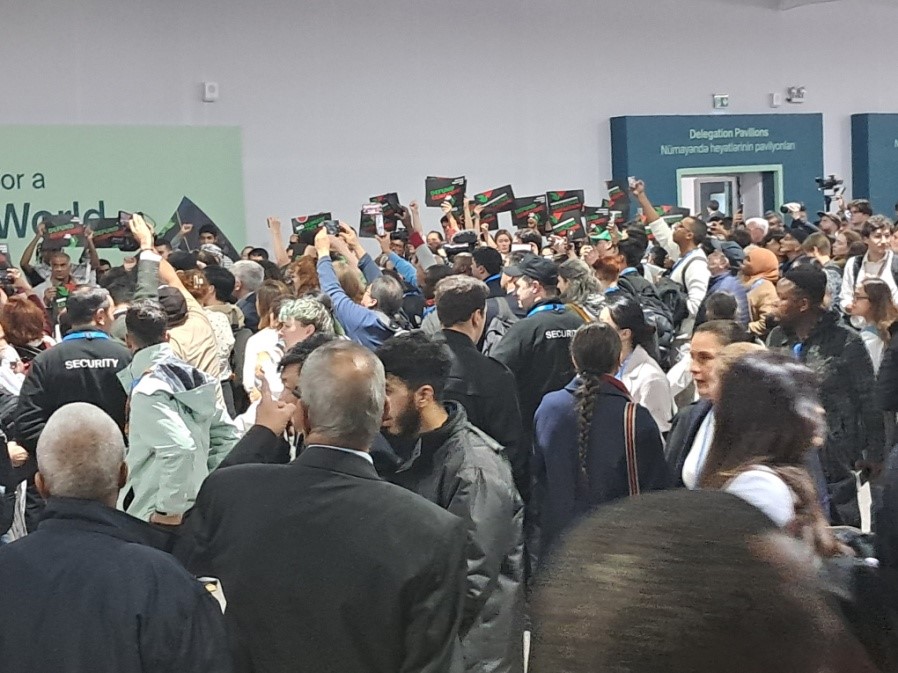 Action Call and Press Gathering: Stop Fuelling Genocide
There were many actions inside the Blue Zone on the Genocide in Gaza. Many called for an energy embargo on Israel drawing the link between fossil fuel and the enabling of the genocide. TPNS took part in several of those actions.
PROGRESS ON MILITARY EMISSIONS
COP29 TRUCE TEXT ACKNOWLEDGES EMISSIONS
The host country Azerbaijan recognised military emissions in its truce statement. This was a big step forward: COP29 acknowledged the impact of conflict-related GHG emissions.
Conflicts increase greenhouse gas emissions and ravage the environment, polluting soil, water and air. The devastation of ecosystems and pollution caused by conflicts worsen climate change and undermine our efforts to safeguard the planet.
IPCC RECAP MEETING
 Deborah had a recap meeting with our colleague Axel Michaelowa (report author of TPNS commissioned report) concerning our call for military emissions inclusion in the next IPCC Special Report on Cities. Plan of action made for next steps in order to present to the AR7 Special Report planning group.
UNFCCC SUBMISSION TO SCIENTIFIC & TECHNICAL BODY
TPNS was able to share its proposal for a submission to UNFCCC Scientific and Technical Body for elaboration of rules concerning military emissions with various individuals and parties for future follow-up.
PROGRESS ON MILITARY SPENDING
CIVIL SOCIETY
During the course of this year (2024) the escalation of wider civil society calls on public finance for climate vulnerable countries has – vitally – included military spending in its calculations. This is in no small part due to the horror of Gaza, following on from the war in Ukraine, both leading to a new arms race, at this time of climate chaos
Climate Action International has included military spending in their materials throughout the year and including COP29. TPNS materials widely used in their Global Week of Action https://transformdefence.org/2024/09/19/.-week-of-action-for-climate-finance-and-a-fossil-free-future/

At COP, Tasneem Essop, executive director of Climate Action Network, voiced the demand for a $5 trillion “down payment” on this debt. “They found the money for military spending. They found the money to subsidise the fossil fuel industry. To come here and say that they do not have money is absolutely untruthful’
CAN INTL submission to UNFCCC on the new climate goal (NCGQ) included military spending https://climatenetwork.org/wp-content/uploads/2024/08/Climate-Action-Network_NCQG_August-2024.docx.pdf
Oil Change International included military spending in their briefing (covered here in the Guardian with ref to military spending) https://www.oilchange.org/wp-content/uploads/2024/09/Fact-Sheet-We-can-pay-for-it-1.pdf
Fossil Fuel Non Proliferation Treaty
https://fossilfueltreaty.org/cop29
Fossil Fuels and Conflict. Fossil fuels are the lifeblood of powering conflicts and military activity worldwide as militaries are dependent on fossil fuels as an energy source. The global militaries’ reliance on fossil fuels creates a loop that not only drives emissions but also diverts financial resources from critical climate action. From 2013 to 2021, the wealthiest countries spent an enormous $9.45 trillion on military budgets, compared to just $243.9 billion on international climate finance. We needed to see finance in the trillions of dollars per year – commensurate with the needs of developing countries in facing the onslaught of the climate crisis and transitioning away from the deadly threat of fossil fuels – but developed countries repeatedly refused to commit significant public resources as they have long promised. They have money to fund wars, bombs, and genocides, but when it comes to addressing the climate crisis, all they can deliver are broken promises – plus USD378 billion per year towards the continued expansion of the very source of the crisis: fossil fuel production.
Taxing the Arms Industry
As we reported from Bonn Climate Conference in June, the inclusion of the arms industry in the Arab Group/G77 proposal for taxes to contribute to public finance for the global south remained in their proposal. The Sales tax idea was not a primary topic of discussion at COP29, but climate-related taxes and other revenue-raising approaches were considered as part of the debate on international climate finance. https://transformdefence.org/2024/06/29/saudi-arabia-arab-group-g77china-proposal-for-a-sales-tax-on-developed-nations-defence-industries-as-part-of-a-climate-finance-package/
STATES
At COP29 military spending vs climate finance was increasingly being referenced by governments. Colombia and Brazil have both made comparisons, as well as:
Mexico has said it will spend 1% of its military budget on climate finance
Panama “Global military spending stands at $2.5 trillion (£1.9trn) annually,” Panamian climate envoy Juan Carlos Monterrey Gomez told delegates at the faltering annual talks sponsored by the United Nations.“For some, $2.5trn dollars to kill each other, it’s not enough, but $1trn to save lives is unreasonable.”“Causing our own extinction is the most ridiculous thing. At least the dinosaurs had an asteroid. What is our excuse?” https://morningstaronline.co.uk/article/rich-countries-slammed-cop29-spending-more-wars-and-weapons-preventing-climate-change
Nepal In his address, President Paudel also articulated the following: Redirecting resources from military spending toward climate adaptation and mitigation is crucial for safeguarding civilization and securing a habitable planet. https://thehimalayantimes.com/nepal/prez-paudel-calls-for-redirecting-military-spending-to-climate-action-at-cop29
AOSIS: Alliance of Small Island States. During our meeting with AOSIS chair he indicated the relevance of the inclusion of military spending for climate finance. This follows on from his comments at the AOSIS press conference at the UN Summit for the Future.
In a Press Conference at UNGA on Sept 23 AOSIS Chair, Fatumanava III Dr. Paolelei Luteru referred to military spending in his statement on the NCQG. https://www.aosis.org/aosis-sept-23rd-press-conference-ncqg/
“It is also incredibly disheartening to hear of leaders from developed countries now changing their tune and amending their climate finance commitments to climate “ambitions” . We certainly understand the hardship of economic budget restraints. Yet it is a very bitter pill to swallow when we see bigger countries somehow conjuring endless streams of money to finance military conflicts with no end in sight.Last year, 2023, saw the world military expenditure increase for the ninth consecutive year, reaching a total of $2,443 billion. Funds for military conflicts and aggressions? Available at the ready. Yet funds to save lives and livelihoods from the climate crisis are continuously delayed. I do not need to remind you of the long overdue delivery of the $100 billion goal – and how grossly inadequate it has proven to be”.
COP29 MEDIA SUMMARY
REUTERS COP29 FINANCE SUMMARY MILITARY MIGHT In 2023, governments around the globe spent $6.7 billion a day on military expenditure, according to the Stockholm International Peace Research Institute. That means the $300 billion annual climate finance target equates to 45 days of global military spending. https://www.reuters.com/business/environment/cop29-how-does-300-billion-stack-up-2024-11-24/
DEMOCRACY NOW “A Great Swindle”: Activists Slam Draft Climate Plan https://www.democracynow.org/2024/11/22/cop29_deal?jwsource=em
GUARDIAN Rich and poor countries concluded a trillion-dollar deal on the climate crisis in the early hours of Sunday morning, after marathon talks and days of bitter recriminations ended in what campaigners said was a “betrayal”.
Under the target the developing world should receive at least $1.3tn (£1tn) a year in funds to help them shift to a low-carbon economy and cope with the impacts of extreme weather by 2035. But only $300bn of that will come primarily in the form they are most in need of – grants and low-interest loans from the developed world. The rest will have to come from private investors and a range of potential new sources of money, such as possible levies on fossil fuels and frequent flyers, which have yet to be agreed https://www.theguardian.com/environment/2024/nov/23/cop29-agrees-13tn-climate-finance-deal-but-campaigners-brand-it-a-betrayal
INSIDE CLIMATE NEWS How COP29 Came Close to Collapse, as Developed and Developing Nations Clashed Under the Weak Azerbaijanis. Climate analyst Alden Meyer says the annual climate talks did little to alter the world’s path to warming at 2.5 to 3 degrees Celsius, which would result in “truly terrifying impacts.” Yet, without the 2015 Paris Agreement, warming might be heading toward 4 or 5 degrees.
https://insideclimatenews.org/news/30112024/cop29-developed-and-developing-nations-clashed/
COMMON DREAMS https://www.commondreams.org/opinion/military-industrial-complex-climate-change
NEW ARAB https://www.newarab.com/features/war-and-military-emissions-are-elephant-room-cop29
FINAL WORD
 It truly feels we are making headway on the inter-related matters of under-reported military emissions and the insane military budgets that both enable this, whilst also robbing funds from climate finance.
As MLK said, the arc of history is long, but it bends towards justice. We all wish it didn’t take so long and with so much attendant loss and suffering.
 Tipping Point North South