Endocrine disruptors: The secret history of a scandal

This is one of the best kept secrets in Europe. It is locked up in the maze of corridors in the European Commission, in a guarded room that only about 40 accredited officials have the right to enter. And then only with paper and pen. Smartphones are not allowed.

This is a stricter safety protocol than even for the Transatlantic Trade and Investment Partnership (or TTIP) between the European Union and the United States: If members of the European Parliament want to access TTIP documents they can enter the reading room without anyone checking the contents of their pockets.

The secret is a report of about 250 pages. Its title, in the jargon of the Commission, is “Impact Assessment.”
Continue reading

Share of economic growth enjoyed by workers is at its lowest since the second world war

And the longer the slump goes on, the more the public tumbles to the fact that not only has growth been feebler, but ordinary workers have enjoyed much less of its benefits. Last year the rich countries’ thinktank, the OECD, made aremarkable concession. It acknowledged that the share of UK economic growth enjoyed by workers is now at its lowest since the second world war. Even more remarkably, it said the same or worse applied to workers across the capitalist west.

Continue reading

Negative Interest Rates

“Negative interest rate” is a phrase seemingly designed to confuse all but the experts. Instead of paying interest on commercial banks’ “excess” reserves held by the central bank, the central bank taxes these deposits. The idea is to impel the banks to reduce their unspent balances and increase their lending or investments. In the case of the European Central Bank, there is a technical reason: to increase the supply of high-class bonds for President Mario Draghi’s ongoing program of quantitative easing. Continue reading

Election 2015 and Corbyn

In 1950 UK wide turnout was 84 per cent. In 1997 it was 71 per cent but it fell to 59 per cent in 2001. It crept up to 66 per cent in 2015, but only 24 per cent of the electorate voted for the Conservatives, 20 per cent for Labour, 22 per cent for other parties and 34 per cent didn’t vote. Some 7.5 million eligible adults no longer bother to register to vote and registration is being made harder as people more often have to rent privately, move rented home more frequently, and have to register individually at every move. A growing number of people are not eligible to vote at Westminster elections because they were born elsewhere in Europe. The true proportions of adults living in the UK who voted for either Labour or Conservative in the general election of May 2015 will be far less than 40 per cent. It may be as low as a third when all those not allowed to vote are included.

In 1950 only 25 per cent of the electorate did not vote for either the Conservatives or Labour. Furthermore, almost everyone who could be registered to vote was registered. We still had identity cards. Now a majority, 56 per cent of the electorate, do not give the two main parties their vote, as do millions of others who are not registered to vote but could be. The majority of UK voters were dissatisfied with the status quo in May 2015. The UK electoral stage is now set for other possibilities. Continue reading

Housing Bubble: 3 factors that determines the rent prices

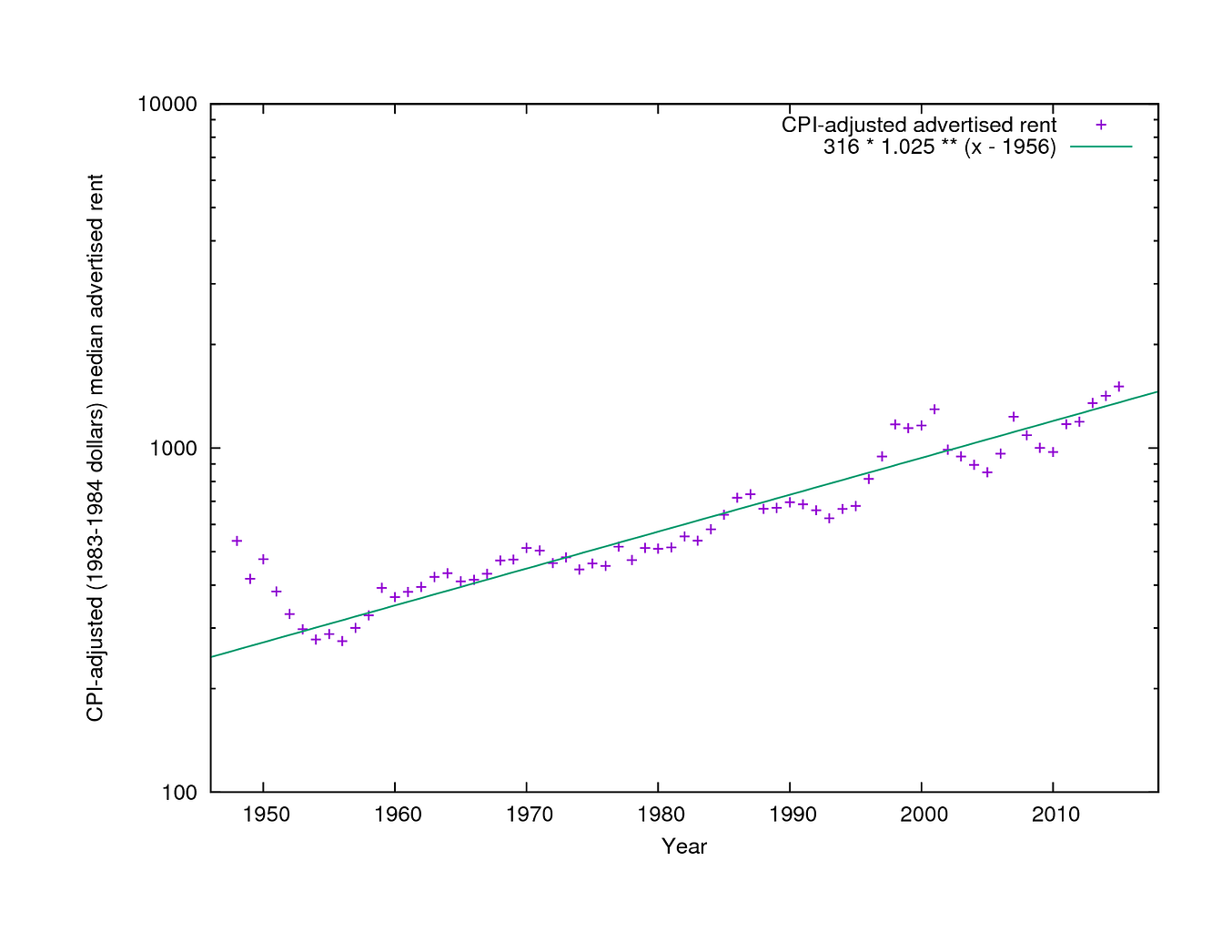
Instead of getting any further into that, this blog post exists to re-emphasize what his new data revealed: this chart

That, my friends, is 70 years of San Francisco housing prices. There are some ups and downs, but for the most part there is a very simple trend: 6.6 percent.

That’s the amount the rent has gone up every year, on average, since 1956. It was true before rent control; it was true after rent control. It wasn’t entirely true during the 2000 tech bubble, but it was still sort of true and it became true again afterward.

6.6 percent is 2.5 percentage points faster than inflation, which doesn’t seem like a lot but when you do it for 60 years in a row it means housing pricesquadruple compared to everything else you have to buy.

That’s bad. But that’s SF today, compared to 1956.

So what caused prices to go up? That’s the really exciting part of Fischer’s discovery. Armed with his data, he more or less answered that question. Continue reading

Universal basic income to eliminate poverty

Eduardo Porter has a column up with the provocative headline “Why a Universal Basic Income Will Not Solve Poverty,” which intrigued me because my understanding from reading coverage by Vox’s own Dylan Matthews and others was that a UBI most certainly would solve poverty.

Having read Porter, I remain unconvinced. His argument turns out to be something more like “a universal basic income would be expensive” or “a universal basic income is an example of a poorly targeted public policy.” The former is clearly true, and the latter is at least something clearly worth talking about. But Porter’s own numbers make it very clear that a UBI would eliminate poverty in the United States and would do so at a price that, though high, is within the realm of possibility. Continue reading

Pension fund for academics funded by Cancer Research UK invested in tobacco

Scientists funded by Cancer Research UK who spend their lives hunting for cures for the disease are among thousands of academics whose pensions are invested in the tobacco industry, the Guardian can reveal.

The latest annual report for the university staff’s pension fund shows it had £211m invested in British American Tobacco in the year to 31 March 2015 – its fifth biggest listed equities holding.
Continue reading

IMF: Neoliberalism and austerity policies don’t work

Osborne said his austerity programme would give the government more flexibility in the event of a future crisis, but the IMF said taking out this sort of insurance policy would only be worth it if the benefits exceeded the costs.

“It turns out, however, that the cost could be large – much larger than the benefit. The reason is that, to get to a lower debt level, taxes that distort economic behaviour need to be raised temporarily or productive spending needs to be cut – or both. The costs of the tax increases or expenditure cuts required to bring down the debt may be much larger than the reduced crisis risk engendered by the lower debt.”

The economists rejected the notion that austerity could be good for growth by boosting the confidence of the private sector to invest. It said that in practice, “episodes of fiscal consolidation have been followed, on average, by drops rather than by expansions in output. On average, a consolidation of 1% of GDP increases the long-term unemployment rate by 0.6 percentage points.” Continue reading

Karl Polanyi has a lot to say about today’s politics and economy.

The vast majority of Sanders’s supporters are not Marxists clamoring for a dictatorship of the proletariat or the nationalization of industry. Most are, probably without knowing it, secret followers of Karl Polanyi. Polanyi’s classic, The Great Transformation, was published in 1944—the same year that FDR promised a “Second Bill of Rights” guaranteeing employment, housing, social security, medical care, and education to all Americans. Today, Polanyian arguments are once again in the air. Since his ideas seem to be everywhere but he is rarely mentioned, a (re-)introduction to his thinking, and its relevance to politics in 2016, is in order. …

Polanyi’s work dismantles this argument in two important ways. The first is to show that markets are planned everywhere they exist. Economic organization is always the result of the state. “Laissez-faire,” he writes, “was planned. . . . [The] laissez-faire economy was the product of deliberate state action.”

Polanyi says that the economy is “embedded” in society—part of social relations—not apart from them. He believes that a pure free market society is a utopian project, and impossible to realize, because people will resist the process of being turned into commodities. In fact, he calls labor a “fictitious commodity,” along with land and money. And this process of turning fictitious commodities into market commodities can only be carried out by the state.

But I’m involved in markets for land, money, and labor all the time!

Yes, but Polanyi argues that none of these things were created for the purpose of being a commodity to be exchanged. As Polanyi writes:

Labor is only another name for a human activity which goes with life itself, which in its turn is not produced for sale but for entirely different reasons, nor can that activity be detached from the rest of life, be stored or mobilized; land is only another name for nature, which is not produced by man; actual money, finally, is merely a token of purchasing power which, as a rule, is not produced at all, but comes into being through the mechanism of banking or state finance.

As Polanyi writes:

To allow the market mechanism to be the sole director of the fate of human beings and their natural environment . . . would result in the demolition of society. For the alleged commodity “labor power” cannot be shoved about, used indiscriminately, or even left unused without affecting the human being who happens to be [its] bearer.
. . . In disposing of a man’s labor power the system would, incidentally, dispose of the physical, psychological, and moral entity “man” attached to the tag. Robbed of the protective covering of cultural institutions, human beings would perish from the effects of social exposure [and] social dislocation. . . . Nature would be reduced to its elements, neighborhoods and landscapes defiled,
. . . the power to produce food and raw materials destroyed. Finally, the market administration of purchasing power would periodically liquidate business enterprise, for shortages and surfeits of money would prove as disastrous to business as floods and droughts were in primitive society.

Polanyi says that a market society is impossible to achieve, in any case, because people resist being turned into commodities. When they are exposed to too much of the market—when markets try to “disembed” from society—people resist, demanding protection from excessive commodification. Lives are more than commodities for those who are living them. This is what Polanyi describes as the “double movement”—the drive for laissez-faire inevitably produces a protective countermovement that insists on shelter from the damaging effects of the market. Welfare and different forms of social insurance are canonical products of this resistance; Polanyi believed fascism was another possible response. …

Gøsta Esping-Andersen made a different use of Polanyi in his groundbreaking The Three Worlds of Welfare Capitalism, published in 1990. He found that the right way to understand the differences between the welfare states of the United States, Sweden, and France isn’t necessarily to look at how much money they spend, but at how much they decommodify labor. Decommodification, for him, means that “a service is rendered as a matter of right, and when a person can maintain a livelihood without reliance on the market.” The United States actually spends a lot on welfare, but mostly for people who already have jobs—in the source of income boosts, tax-free benefit packages, and the like—so this spending does little to decommodify labor. …

Sanders here offers a straightforward defense of decommodification—the idea that some things do not belong in the marketplace—that is at odds with the kind of politics that the leadership of the Democratic Party has offered more or less since Carter and the narrow policy “wonk” focus that tends to dominate coverage. …

Whether or not Sanders has read Polanyi—similar language about economic and social rights was also present in FDR’s New Deal, which Sanders argues is the basis of his brand of socialism—Polanyi’s particular definition of socialism sounds like one Sanders would share:

Socialism is, essentially, the tendency inherent in an industrial civilization to transcend the self-regulating market by consciously subordinating it to a democratic society. It is the solution natural to industrial workers who see no reason why production should not be regulated directly and why markets should be more than a useful but subordinate trait in a free society. From the point of view of the community as a whole, socialism is merely the continuation of that endeavor to make society a distinctively human relationship of persons.

Karl Polanyi for President
https://www.dissentmagazine.org/online_articles/karl-polanyi-explainer-great-transformation-bernie-sanders


Sectoral balances and Clinton’s budget surplus

A sectoral balances analysis starts with the recognition that the U.S. economy, like any national economy, is roughly comprised of three sectors. There’s the government sector: the federal government, the Federal Reserve, and the state and local governments. There’s the private domestic sector: individuals, households, businesses, the banks, all the major industries, etc. And then there’s the foreign sector: i.e. the rest of the world, or every entity outside the U.S. national border that we trade with.

Each of these three sectors are in a state of surplus or deficit at any given moment. The government is either taxing more than it spends (surplus) or spending more than it taxes (deficit). Households and businesses in the private domestic sector are either saving more than they’re spending (surplus) or vice versa (deficit). And the rest of the world is either exporting more to America than it imports (surplus), or importing from the U.S. more than it exports (deficit). (Perhaps confusingly, the foreign sector balance is the inverse of the U.S. trade balance; i.e. a surplus in the foreign sector actually means a U.S. trade deficit.)

Continue reading

“I want us to surpass even the Attlee government for radical reform”

Mr Corbyn called it “a new economics”. Mr McDonnell described his aim as being no less than the “fundamental business of reforming capitalism”.

So today was big on vision, but short on new detail. Perhaps no surprise with the next general election, in all likelihood, not until 2020.

No one can doubt their ambition: “I want us to surpass even the Attlee government for radical reform,” the shadow chancellor said, a reference to the administration that founded the NHS.

Continue reading

Britain needs to start making things again

At the end of 2015, inflation-adjusted income per capita in the UK was only 0.2% higher than its 2007 peak. This translates into an annual growth rate of 0.025% per year. How pathetic this performance is can be put into perspective by recalling that Japan’s per capita income during its so-called “lost two decades” between 1990 and 2010 grew at 1% a year. …

Unfortunately manufacturing had been so weakened since the 1980s that it didn’t have a hope of staging any such revival. Even with a massive devaluation, the UK’s trade balance in manufacturing goods (that is, manufacturing exports minus imports) as a proportion of GDP has hardly budged. The weakness of manufacturing is the main reason for the UK’s ever-growing deficit, which stood at 5.2% of GDP in 2015. Continue reading

The super-rich inevitably pops the housing bubble

The bigger the bubble, the longer the hangover.

But what would happen if they did actually go? As Danny Dorling, the Oxford professor of geography, notes, the ultra-moneyed classes do abandon cities – “at a time of their choosing”. Long Island was once so rich as to be the setting for the Great Gatsby – until the crash of 1929. Now the grand houses remain but the big-money holidays at the Hamptons. (For more data, look at Dorling’s new book A Better Politics, free online here.) The other thing we know is that cities that get too high on speculation face a long, long hangover.
Continue reading

The UN is not paying its peacekeepers

The United Nations owes countries that send troops to serve under its baby-blue banner a huge debt — a literal one.

As of March 31, 2016, the world body owed troop-contributing countries a total of $827 million in back-compensation, Under-Secretary-General for Management Yukio Takasu told Indian reporters on May 4.

The way the U.N. peacekeeping systems works is this — member states donate funds to the United Nations and the world body then passes a portion of that money onward to countries that offer up their troops to peace missions.

Continue reading