
This would be a sound argument if it didn’t miss the point. UBI isn’t really about welfare spending: It’s about tax policy.
UBI is an unconditional cash transfer, which means that you get money from the government to spend however you want. That’s an unusual government spending program. In the US, besides Social Security, the government usually either spends money on a service (like health care or education) or gives conditional cash in the form of things like food stamps.
But the government also spends a lot of money each year on cash transfers through “tax expenditures,” which is the money the government doesn’t collect in taxes because of exclusions in the tax code. Except for the Earned Income Tax Credit, those expenditures almost always help the rich more than the poor. By replacing them with UBI, we would create a more progressive system. That, not the elimination of all government programs, should be the starting place for debates about UBI. Continue reading
Author Archives: Lin
Modest but sensible UBI schemes do not make the state any bigger than it already is in most rich countries
The people of Switzerland rejected a proposal for a universal basic income in a referendum last weekend. As Leonid Bershidsky writes, the right conclusion to draw is that the proposal — of paying every citizen a regular amount of money without a work (or any other) requirement — was pitched too high, too soon, and in a place least likely to need it. As he also writes, the wrong conclusion is to bury the idea. …
Claims about the supposed economic unfeasibility of UBI, however, have an unfortunate tendency to intellectual fogginess. …
The relevant reference to the right level of UBI is surely households’ disposable income — the amount they have left on average after taxes and transfers to cover their material standard of living. To be guaranteed 50 per cent of this surely qualifies as reasonable, perhaps too reasonable. But in the UK, for example, “disposable income” (what households have to spend) is less than two-thirds of national income (what the nation has to spend if it does not borrow from other countries). So paying 50 per cent of current disposable income to every citizen would, on its own, cost about 33 per cent of national income. Continue reading
The case for Universal Basic Income
But, after a Conservative government ended the project, in 1979, Mincome was buried. Decades later, Evelyn Forget, an economist at the University of Manitoba, dug up the numbers. And what she found was that life in Dauphin improved markedly. Hospitalization rates fell. More teen-agers stayed in school. And researchers who looked at Mincome’s impact on work rates discovered that they had barely dropped at all. The program had worked about as well as anyone could have hoped.
Mincome was a prototype of an idea that came to the fore in the sixties, and that is now popular again among economists and policy folks: a basic income guarantee. There are many versions of the idea, but the most interesting is what’s called a universal basic income: every year, every adult citizen in the U.S. would receive a stipend—ten thousand dollars is a number often mentioned. (Children would receive a smaller allowance.)
One striking thing about guaranteeing a basic income is that it’s always had support both on the left and on the right—albeit for different reasons. Martin Luther King embraced the idea, but so did the right-wing economist Milton Friedman, while the Nixon Administration even tried to get a basic-income guarantee through Congress. These days, among younger thinkers on the left, the U.B.I. is seen as a means to ending poverty, combatting rising inequality, and liberating workers from the burden of crappy jobs. For thinkers on the right, the U.B.I. seems like a simpler, and more libertarian, alternative to the thicket of anti-poverty and social-welfare programs. Continue reading
How to tackle idleness: progressive taxation and basic income
Our recommendations here are radical: we are committed to strong, progressive taxation. That means we believe that as income rises the proportion of the total income that a person pays in tax should rise as well. It is a principle of tax justice, usually described as vertical equity, that few would wish to dispute. However, the UK tax system does not deliver vertical equity in a great many cases. It is our opinion that this is best addressed by a complete redesign of the Income Tax, National Insurance and benefits systems: nothing less will do if we are to tackle institutional impediments to idleness.
Continue reading
The decline of Britain; EU
Because we had survived the war intact we did not realise fully the motives or strength of the European search for unity. We underestimated the recovery powers of the continental countries and the great boost that could be given to their industrial development by membership of a common market. We overlooked one of the prime lessons of our own history, that we had been able to spearhead the industrial revolution in the eighteenth century, not because of our size—we only had a third of the population of France—but because, at a time when the countries of the continent were fragmented by internal tolls and tariff barriers, we were the biggest single market in Europe. We did not perceive fully how the Commonwealth would evolve and the reduced political and economic role that we would have in it. (For instance, we were taken aback when, in 1957, our proposal for a British-Canadian free trade area was turned down by Ottawa.) Continuing for long to believe that we had a unique part to play on the world scene because of our participation in Churchill’s three interlocking circles, we were concerned that too close a relationship with Europe would weaken our influence in the other two circles, those of the Commonwealth and America. Continue reading
The (American) coporate take-over of Britain and EU
By comparison with the British system, however, this noxious sewer is a crystal spring. Every stream of corporate effluent with which the EU poisons political life has a more malodorous counterpart in the UK. The new Deregulation Act, a meta-law of astonishing scope, scarcely known and scarcely debated, insists that all regulators must now “have regard to the desirability of promoting economic growth”. Rare wildlife, wheelchair ramps, speed limits, children’s lungs: all must establish their contribution to GDP. What else, after all, are they for?
The sale of the Land Registry makes no sense
So the Land Registry is a natural monopoly and, as goes the Competition and Market Authority’s main argument, these kinds of services should be publically owned. Handing a monopoly over to a private company in search of profit risks harming consumers – the new owners may simply charge a higher price for the service, or in this case put the data, the Land Registry’s most valuable asset, behind a paywall.
The Law Society says that the Land Registry plays a central role in ensuring property rights in England and Wales, and so we need to ensure that it maintains its integrity and is free from any conflict of interest. Continue reading
Tax Justice: Millionaires Less Mobile than the Rest of Us
Stanford University researchers teamed with officials at the Treasury Department to examine every tax return reporting more than $1 million in earnings in at least one year between 1999 and 2011. They found that while 2.9 percent of the general population moves to a different state in a given year, just 2.4 percent of millionaires do so. Even more striking is that for the most “persistent millionaires” (those earning over $1 million in at least 8 years of the researchers’ sample), the migration rate is just 1.9 percent per year. As the researchers explain: “millionaires are not searching for economic opportunity—they have found it.” …
In other words, Florida is only one of the nine states without broad-based income taxes that seems to possess any kind of special allure for high-income taxpayers. Given that reality, the study notes that “It is difficult to know whether the Florida effect is driven by tax avoidance, unique geography, or some especially appealing combination of the two.” In any case, this study refutes the notion that repealing state income taxes can transform a state into a magnet for high-income taxpayers: it’s simply not playing out that way in eight of the nine states without such a tax. …
This research, of course, should all but kill the thesis that you just have to cut taxes on rich folk for fear they’ll flee to more hospitable climes. But this thesis is just too convenient for too many wealthy people, and it’s been successfully put out of its misery many times before – then sprung back to life the next time around. This isn’t the last we’ve seen of it.
New Research Shows Millionaires Less Mobile than the Rest of Us
http://www.taxjustice.net/2016/05/27/new-research-shows-millionaires-less-mobile-than-the-rest-of-us/
Global nuclear weapons 2016
At the start of 2016 nine states—the United States, Russia, the United Kingdom, France, China, India, Pakistan, Israel and North Korea—possessed approximately 4,120 operationally deployed nuclear weapons. If all nuclear warheads are counted, these states together possessed a total of approximately 15,395 nuclear weapons compared with 15,850 in early 2015 (see table 1).
Continue reading

John McDonnell: Time to end the new age of the robber barons
We have a chance now to build Another Europe in which we work with socialists across the EU to end austerity and take on those who attack workers’ rights and avoid taxes.
This is not anti-business. It’s anti-freeloader. If we allow these practices to continue they will undermine the foundations on which all genuine wealth creation is built. It will create an environment that benefits rent-seekers over wealth creators. It is time we brought an end to the new age of the robber barons. The health of our economy demands it.
Big increases in small arms trade
But from 2012 to 2013, the global small arms trade jumped to a total of USD 6 billion worth of small arms, an increase of 17 per cent/ $1 billion in only one year, according to the report titled “Trade Update 2016: Transfers and Transparency”
The United States was, by far, both the largest exporter and importer. It exported $1.1 billion, while only two other countries – Italy and Germany – surpassed the $500 million mark in exports.
Transfers of small arms to the U.S. accounted for 42 per cent of all imports.
Sixteen exporters surpassed $100 million in 2013, the largest number since the survey began in 2001.
And although this is the most comprehensive data set on small arms transfers, these numbers are most likely much higher, since 40% of information on imports and exports were concealed by states, said Senior Researcher for the Small Arms Survey, Nicolas Florquin. Continue reading
Health workers say stop arms sales to Saudi!
The Medact Arms Control Group:
Open letter to the Secretary of State of Business, Innovation and Skills (BIS), Sajid Javid. BIS are in charge of licensing arms sales.
STOP FUELLING THE YEMEN CONFLICT
End all UK arms sales to Saudi Arabia
It is now over a year since the recent outbreak of armed conflict in Yemen began, forcing 2.4 million people to flee their homes, and leaving over 22 million people in need of humanitarian support. The conflict has killed over six thousand people, and left the health care system on its knees.
Humanitarian agencies are struggling to respond and the country stands on the brink of famine. A senior representative of Médecins Sans Frontières (MSF) has described the current level of humanitarian assistance in Yemen as a “drop in the ocean.”
Continue reading
Endocrine disruptors: The secret history of a scandal

This is one of the best kept secrets in Europe. It is locked up in the maze of corridors in the European Commission, in a guarded room that only about 40 accredited officials have the right to enter. And then only with paper and pen. Smartphones are not allowed.
This is a stricter safety protocol than even for the Transatlantic Trade and Investment Partnership (or TTIP) between the European Union and the United States: If members of the European Parliament want to access TTIP documents they can enter the reading room without anyone checking the contents of their pockets.
The secret is a report of about 250 pages. Its title, in the jargon of the Commission, is “Impact Assessment.”
Continue reading
The UK co-operative economy 2016
Share of economic growth enjoyed by workers is at its lowest since the second world war
And the longer the slump goes on, the more the public tumbles to the fact that not only has growth been feebler, but ordinary workers have enjoyed much less of its benefits. Last year the rich countries’ thinktank, the OECD, made aremarkable concession. It acknowledged that the share of UK economic growth enjoyed by workers is now at its lowest since the second world war. Even more remarkably, it said the same or worse applied to workers across the capitalist west.
Negative Interest Rates
“Negative interest rate” is a phrase seemingly designed to confuse all but the experts. Instead of paying interest on commercial banks’ “excess” reserves held by the central bank, the central bank taxes these deposits. The idea is to impel the banks to reduce their unspent balances and increase their lending or investments. In the case of the European Central Bank, there is a technical reason: to increase the supply of high-class bonds for President Mario Draghi’s ongoing program of quantitative easing. Continue reading
Election 2015 and Corbyn
In 1950 UK wide turnout was 84 per cent. In 1997 it was 71 per cent but it fell to 59 per cent in 2001. It crept up to 66 per cent in 2015, but only 24 per cent of the electorate voted for the Conservatives, 20 per cent for Labour, 22 per cent for other parties and 34 per cent didn’t vote. Some 7.5 million eligible adults no longer bother to register to vote and registration is being made harder as people more often have to rent privately, move rented home more frequently, and have to register individually at every move. A growing number of people are not eligible to vote at Westminster elections because they were born elsewhere in Europe. The true proportions of adults living in the UK who voted for either Labour or Conservative in the general election of May 2015 will be far less than 40 per cent. It may be as low as a third when all those not allowed to vote are included.
In 1950 only 25 per cent of the electorate did not vote for either the Conservatives or Labour. Furthermore, almost everyone who could be registered to vote was registered. We still had identity cards. Now a majority, 56 per cent of the electorate, do not give the two main parties their vote, as do millions of others who are not registered to vote but could be. The majority of UK voters were dissatisfied with the status quo in May 2015. The UK electoral stage is now set for other possibilities. Continue reading
Housing Bubble: 3 factors that determines the rent prices
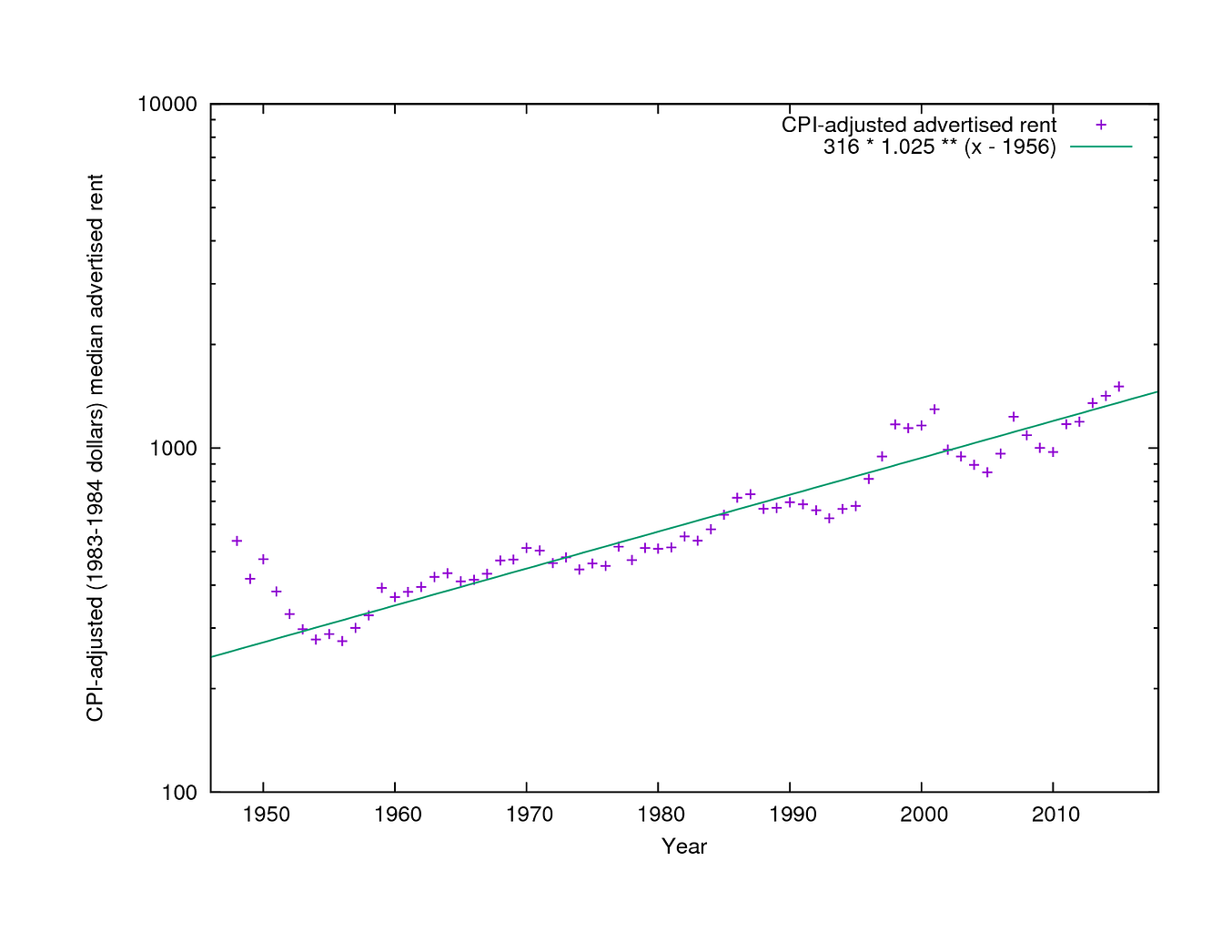
Instead of getting any further into that, this blog post exists to re-emphasize what his new data revealed: this chart
That, my friends, is 70 years of San Francisco housing prices. There are some ups and downs, but for the most part there is a very simple trend: 6.6 percent.
That’s the amount the rent has gone up every year, on average, since 1956. It was true before rent control; it was true after rent control. It wasn’t entirely true during the 2000 tech bubble, but it was still sort of true and it became true again afterward.
6.6 percent is 2.5 percentage points faster than inflation, which doesn’t seem like a lot but when you do it for 60 years in a row it means housing pricesquadruple compared to everything else you have to buy.
That’s bad. But that’s SF today, compared to 1956.
So what caused prices to go up? That’s the really exciting part of Fischer’s discovery. Armed with his data, he more or less answered that question. Continue reading
 Tipping Point North South