
One of the few people in the world who has a well-informed insider’s perspective who is also happy to speak out about it is Brooke Harrington of Copenhagen Business School, who took the remarkable step of actually obtaining a professional qualification in wealth management to pursue her studies. As she told our Taxcast recently:
“Tax avoidance was really only the tip of the iceberg. I didn’t realise how much bigger the problem is. Really what wealth managers do extend much more generally to law avoidance. And that creates problems of legitimacy for whole governments: it’s bad enough that people think they are getting shafted because the rich aren’t paying their fair share of taxes: it’s quite another matter when you say there is one law for the rich and one for everyone else and they are not the same: that is the sort of thing that can potentially topple governments.”
Author Archives: Lin
Worker Cooperatives Are More Productive
The term “co-op” evokes images of collective farming or crunchy craft breweries. But Virginie Perotin of Leeds University Business Schoolsynthesized research on “labor-managed firms” in Western Europe, the United States and Latin America, and found that, aside from the holistic social benefits of worker autonomy, giving workers a direct stake in managing production enables a business to operate more effectively. On balance, Perotin concludes, “worker cooperatives are more productive than conventional businesses, with staff working ‘better and smarter’ and production organized more efficiently.” Continue reading
Bernie Sanders’ economic plan
Good piece.
But the critics are missing the big picture, which is simple: The United States economy currently spends 17.1 percent of GDP on healthcare, while the UK, Australia, Canada, Germany, Japan, and France spend between 9.1 and 11.7 percent, respectively. All of these countries perform better than the United States, according to standard public-health measures such as average life expectancy. Within the context of the current US economy, the difference between spending 10 versus 17 percent of GDP on healthcare amounts to $1.3 trillion. That $1.3 trillion mark-up in US healthcare spending flows mainly into the coffers of big insurance and pharmaceutical companies. Do Sanders’s critics truly believe that it is impossible to devise a system whose administrative features roughly approximate those in Germany, Japan, the UK, France, Australia, or Canada? They have not advanced any serious arguments to support such a claim. Indeed, many of Sanders’s critics themselves have been proponents of single-payer prior to Sanders’s having incorporated it into his platform. Continue reading
Estate Tax
One aspect of the mystery remains, however. Not every member of the super-rich elite supported repeal. There were some who hated the idea, including William Gates Sr (father of Bill), Steven Rockefeller, George Soros and Warren Buffet. What is more, the Democratic Party was squarely against the proposal, and wanted to prevent it. Given that the alliance that had been formed to push repeal through was so obviously flaky, and vulnerable to the skilful exploitation of the differences between its members, why didn’t the opposition do more to break it up? The answer is a mix of complacency, incompetence and ideological slippage. Continue reading
The News For Idiots: The Panama Papers
US Defense Secretary: TTP is all about US interests
TTP should be ratified because of its economic and strategic benefits, and because we must recognize what the alternative to TPP really is: a regional economy with standards that don’t serve American interests, and one that’s carved up by lop-sided, coercively negotiated, lower-standard deals. That’s why I’ve said that TPP is as strategically important to the rebalance as an aircraft carrier, and I strongly urge Congress to approve TPP this year.
Militarily, the Department of Defense is operationalizing the next phase of the rebalance, and cementing it for the long term.
The implications of th Panama Papers
The Panama Papers show “the weakness at this stage of the international community,” Robertson argued. “That community has finally a few years ago set up an international court to deal with atrocities. We have quite a good organization in Vienna that inspects potential nuclear developments. We have taken some action against trafficking in humans and drugs. But we haven’t really tackled international tax avoidance. We haven’t tackled the secret movement of the money of the wealthy for various often nefarious, sometimes legitimate purposes. And that’s the real problem.”
Continue reading
We can afford a universal basic income
The Tax Justice Network estimates the global elite are sitting on $21–32tn of untaxed assets. Clearly, only a portion of that is owed to the US or any other nation in taxes – the highest tax bracket in the US is 39.6% of income. But consider that a small universal income of $2,000 a year to every adult in the US – enough to keep some people from missing a mortgage payment or skimping on food or medicine – would cost only around $563bn each year.
A larger income, to ensure that no American fell into absolute abject poverty – say, $12,000 a year – would cost around $3.6tn. That is a big number, but one that once again seems far more reasonable when considered through the lens of the Panama Papers and the scandal of global tax evasion. Because the truth is that we have all been robbed, systematically, by the world’s wealthiest people, for decades. They have used those stolen dollars to build yet more wealth for themselves, and all the while we have been arguing with ourselves over what to do with the leftover pennies.
NHS doctors’ open letter
After five years of a government which pledged to protect the NHS, this election campaign makes it timely to assess its stewardship, since 2010, of England’s most precious institution. Our verdict, as doctors working in and for the NHS, is that history will judge that this administration’s record is characterised by broken promises, reductions in necessary funding, and destructive legislation, which leaves health services weaker, more fragmented, and less able to perform their vital role than at any time in the NHS’s history.
In short, the coalition has failed to keep its NHS pledges.
The 2012 Health and Social Care Act is already leading to the rapid and unwanted expansion of the role of commercial companies in the NHS. Lansley’s Act is denationalising healthcare because the abolition of the duty to provide an NHS throughout England abdicates government responsibility for universal services to ad hoc bodies (such as clinical commissioning groups) and competitive markets controlled by private-sector-dominated quangos.
In particular, the squeeze on services is hitting patients. People may be unaware that under the coalition, dozens of Accident & Emergency departments and maternity units have been closed or earmarked for closure or downgrading. In addition, 51 NHS walk-in centres have been closed or downgraded in this time, and more than 60 ambulance stations have shut and more than 100 general practices are at risk of closure.
The core infrastructure of the NHS is also being eroded with the closure of hospitals and thousands of NHS beds since 2010.
Mental health and primary care are faring no better – with both in disarray due to funding cuts and multiple reorganisations driven by ideology, not what works. Public health has been wrenched out of the NHS, where it held the ring for coordinated and equitable services for so long.
In September 2014, the Royal College of General Practitioners said that the wait to see a GP is a “national crisis”.
In England the waiting list to see a specialist stands at 3 million people, and in December 2014 NHS England estimated that nearly 250,000 more patients were waiting for treatment across England who are not on the official waiting list.
Throughout England, patients have been left queueing in ambulances and NHS trusts have resorted to erecting tents in hospital car parks to deal with unmet need.
A&E target waiting times have not been met for a year, and are at the worst levels for more than a decade; and elderly, vulnerable patients are marooned in hospital because our colleagues in social care have no money or staff to provide much-needed services at home.
Funding reductions for local authorities (in some places reductions as high as 40%) have undermined the viability of many local authority social care services across England. This has resulted in more patients arriving at A&E and more patients trapped in hospital as the necessary social care support needed to ensure their safe discharge is no longer there.
The NHS is withering away, and if things carry on as they are then in future people will be denied care they once had under the NHS and have to pay more for health services. Privatisation not only threatens coordinated services but also jeopardises training of our future healthcare providers and medical research, particularly that of public health.
Given the obvious pressures on the NHS over the last five years, and growing public concern that health services now facing a very uncertain future, we are left with little doubt that the current government’s policies have undermined and weakened the NHS.
The way forward is clear: abolish all the damaging sections of the Health and Social Care Act 2012 that fragment care and push the NHS towards a market-driven, “out-for-tender” mentality where care is provided by the lowest bidder. Reversing this costly and inefficient market bureaucracy alone will save significant sums. Above all, the secretary of state’s duty to provide an NHS throughout England must be reinstated, as in Scotland and Wales.
As medical and public health professionals our primary concern is for all patients.
We invite voters to consider carefully how the NHS has fared over the last five years, and to use their vote to ensure that the NHS in England is reinstated.
Continue reading
The King’s Fund: Tackling the growing crisis in the NHS
The King’s Fund has identified three big challenges for the NHS in England:
Costs of tax evasion/avoidance
According to The Hidden Wealth of Nations, a recent book by University of California, Berkeley economist Gabriel Zucman, the answer is that tax evasion costs governments approximately $200 billion per year.
Zucman also estimates that tax avoidance by U.S. corporations — which, unlike tax evasion, is generally carried out in the open and is technically legal — costs governments an additional $130 billion per year. (European and Asian corporations have the same incentives to avoid taxes, but there is not enough data to estimate its scale.) …
Zucman’s estimates on tax evasion and avoidance are straightforward.
First, he conservatively calculates that, as of 2014, at least $7.6 trillion of the world’s financial wealth — or about 8 percent of the world’s total financial wealth of $95.5 trillion — was “missing.”
His reasoning is that the world’s assets should be an exact mirror image of its liabilities, but are not. If the U.S. sells $1,000 in government bonds to a foreigner, that $1,000 liability for the U.S. should show up as $1,000 in assets for the foreigner’s country. However, countries’ national balance sheets record much more in liabilities than assets.
Here’s the Price Countries Pay for Tax Evasion Exposed in Panama Papers Jon Schwarz
https://theintercept.com/2016/04/05/heres-the-price-countries-pay-for-tax-evasion-exposed-in-panama-papers/
SIPRI: Global military spending is on the rise
The world heaped more than $1.6 trillion on military programs and personnel in 2015, roughly 1 percent more than in 2014, a SIPRI analyst declared at the nonpartisan Stimson Center in Washington, D.C. on April 5. The increase follows four years of decline, which was preceded by 12 years of steady increases.
So the brief falloff is over, and the familiar routine is back. Continue reading
Bernie Sanders | The Young Turks Interview
“Were your eyes stitched closed?”
Senator Elizabeth Warren at Banking Hearing on Consumer Finance Regulations
$2.5 trillion at risk if global temperature increase 2.5°C by 2100
An average $2.5 trillion (£1.76trn) of the world’s financial assets would be at risk from climate change impacts if global temperatures are left to increase by 2.5°C by 2100, warns a new study by the Grantham Research Institute on Climate Change and the Environment at the London School of Economics. Continue reading
UK arms sales to oppressive regimes
More than £3bn of British-made weaponry was licensed for export last year to 21 of the Foreign Office’s 30 “human rights priority countries” – those identified by the government as being where “the worst, or greatest number of, human rights violations take place”, or “where we judge that the UK can make a real difference”. Listed countries that last year bought British arms and military equipment include:
■ Saudi Arabia, which has been accused of perpetrating war crimes in Yemen.
■ Bahrain, which used troops to quell protests following the Arab spring.
■ Burundi, which is being investigated by the UN for human rights violations.
■ The Maldives, which in 2015 jailed its former president, Mohamed Nasheed, for 13 years following what critics said was a politically motivated show trial.
Continue reading
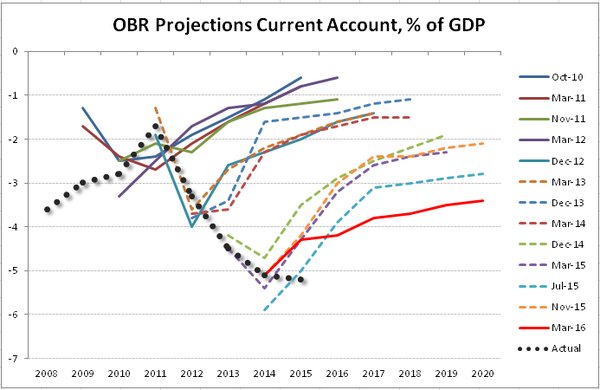
UK’s ever worsening current account since 2010
Wilkerson: USA is “the death merchant of the world”
“Was Bill Clinton’s expansion of NATO — after George H. W. Bush and [his Secretary of State] James Baker had assured Gorbachev and then Yeltsin that we wouldn’t go an inch further east — was this for Lockheed Martin, and Raytheon, and Boeing, and others, to increase their network of potential weapon sales?” Wilkerson asked.
“You bet it was,” he answered.
“Is there a penchant on behalf of the Congress to bless the use of force more often than not because of the constituencies they have and the money they get from the defense contractors?” Wilkerson continued.
Again, he answered his own question: “You bet.” Continue reading
Austerity and the Housing Bubble
The reason for this that everyone focuses on, understandably, is stagnant housing supply. However, housing can also be seen as an asset. Just as low real interest rates boost the stock market because a given stream of expected future dividends looks more attractive, much the same is true of housing (where dividends become rents). Stock prices can rise because expected future profitability increases, but they can also rise because expected real interest rates fall. With housing increasingly used as an asset for the wealthy, or even as a way of saving for retirement, house prices will behave in a similar way. A shortage of housing supply relative to demand raises rents, but even if rents stayed the same falling expected real interest rates raise house prices because those rents become more valuable compared to the falling returns from alternative forms of wealth.
Continue reading
Less oversigh or more delays for expensive F-35’s upgrades
“This modernization effort is like a new program with estimated costs of about $3 billion over the next six years,” Michael Sullivan, director of acquisition and sourcing management issues at GAO, told the House Armed Services Committee on March 23. “That price alone would qualify it as a major defense acquisition program in it own right and it should be managed as such.”
Continue reading
 Tipping Point North South