
One of Britain’s most respected thinktanks, the Resolution Foundation, has been digging through the government’s own figures and given me exclusive access to its analysis for the capital. Perhaps its single biggest finding is this: the proportion of Londoners who own a home with a mortgage has been sliding since the early 90s – and has now dipped below the number who rent privately. In John Major’s time, less than 20% of all Londoners rented privately, now that is in the mid-30s, and marching up to 40%.
In other words, the idea that Generation Rent is the one with the problem is for the birds: London is becoming a city of renters. Nor is that trend likely to reverse. The consultancy PricewaterhouseCoopers predicts that, in less than 10 years, 60% of the capital will be renting from a private landlord or a housing association. Continue reading
Author Archives: Lin
“The brains and blood” of F-35s is not ‘critical’/working
Last summer, F-35 program officer Lt. Gen. Christopher Bogdan said the F-35’s logistics system was “the brains and blood of operating this weapons system.”
Despite many fixes, the aircraft’s Autonomic Logistics Information System (ALIS) is so flawed that government auditors believe the computer system may not be deployable. These problems may also delay the Air Force’s declaration of Initial Operational Capability. And now, in a surprising twist, Bogdan is saying ALIS is not really critical after all, insisting the F-35 can fly without it for 30 days. Continue reading
Inequality in the USA
Although America has the largest economy in the world, real wages have not gone up since 1972 because most workers have experienced stagnating incomes for decades. Across the country middle-income Americans face a precarious economic future. Median income has fallen in over 80% of America’s counties since 2000, a trend that is accelerating. Even mortality rates reflect growing income inequality. Poor and rural Americans now die at rates well above that of wealthy and urban Americans. Continue reading
The 5% and the Universal Basic Income
The idea of universal basic income is rapidly gaining traction among people who are worried about (or looking forward to, depending on your view) an ever-more automated future (where workers are replaced by robots and computers) and rising inequality in our society gets ever more acute. However, the idea of a basic income goes back centuries – from Thomas More, Johannes Ludovicus Vives, Marquis de Condorcet, to Thomas Paine and John Stuart Mill, they have all argued a basic income, in its various forms, as a way to solve some social ills and improve social welfare, resulting in a more civilised and equal society.[i]
The danger that we would be underwriting the failures is trivial compared with the benefits the guaranteed annual income would provide us. It would provide dignity for every citizen and choice for every citizen.
Margaret Mead
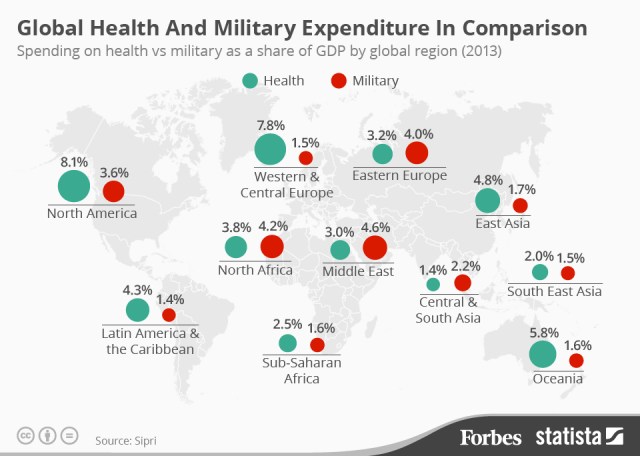
Health vs military spending as a share of GDP
The UK housing crisis
Danny Glover: He’s With Us | Bernie Sanders
Bernie and Mark Ruffalo
The US military is smaller than it was on 9/11, but costs 50% more

A basic income approach to development
As it turns out, that assumption was wrong. Across many contexts and continents, experimental tests show that the poor don’t stop trying when they are given money, and they don’t get drunk. Instead, they make productive use of the funds,feeding their families, sending their children to school, and investing in businessesand their own futures. Even a short-term infusion of capital has been shown tosignificantly improve long-term living standards, improve psychological well-being, and even add one year of life. Continue reading
American Poverty
Recently, the Brookings Institution published a report looking at the same idea but giving it a different name. The paper, builds on research from the British economist William Beveridge, who in 1942 proposed five types of poverty: squalor, ignorance, want, idleness, and disease. In modern terms, these could be defined as poverty related to housing, education, income, employment, and healthcare, respectively. Analyzing the 2014 American Community Survey, the paper’s co-authors, Richard Reeves, Edward Rodrigue, and Elizabeth Kneebone, found that half of Americans experience at least one of these types of poverty, and around 25 percent suffer from at least two. Continue reading
Neoliberalism
Neoliberalism sees competition as the defining characteristic of human relations. It redefines citizens as consumers, whose democratic choices are best exercised by buying and selling, a process that rewards merit and punishes inefficiency. It maintains that “the market” delivers benefits that could never be achieved by planning.
Attempts to limit competition are treated as inimical to liberty. Tax and regulation should be minimised, public services should be privatised. The organisation of labour and collective bargaining by trade unions are portrayed as market distortions that impede the formation of a natural hierarchy of winners and losers. Inequality is recast as virtuous: a reward for utility and a generator of wealth, which trickles down to enrich everyone. Efforts to create a more equal society are both counterproductive and morally corrosive. The market ensures that everyone gets what they deserve. Continue reading
American corporations received 27 times more from the governement than they paid in taxes
Oxfam America took a close look at the way large, profitable companies use offshore tax havens and other methods to slash their corporate tax rates in the US rather than pay taxes where the majority of their business takes place.
The report, “Broken at the Top,” found that the 50 largest companies in the US have $1.4 trillion hidden in tax havens while at the same time receiving trillions of dollars in tax payer-funded loans and subsidies. The tax practices of these corporate behemoths cost Americans an estimated $111 billion per year and cost developing countries another $100 billion a year.
Apple, the world’s second-largest company, was the company with the greatest amount stored abroad — $181 billion in three subsidiaries. Next in Oxfam’s league table was General Electric, with $119 billion stored in 118 tax haven subsidiaries, followed by Microsoft which had $108 billion kept overseas. Continue reading
UK Court dismisses charges against arms fair protesters
Great news.
District judge Angus Hamilton, sitting at Stratford magistrates court, said the defence had presented clear and credible evidence that illegal activity had been conducted at the Defence Systems and Equipment International (DSEI) arms fair in previous years, and that police arresting the activists had failed to investigate to ensure it was not happening again.
Placing sand in the wheels of globalization.
The time has come to embrace a different logic, that of “exchange of policy space.” Poor and rich countries alike need to carve out greater space for pursuing their respective objectives. The former need to restructure their economies and promote new industries, and the latter must address domestic concerns over inequality and distributive justice. This requires placing some sand in the wheels of globalization.
The best way to bring about such institutional re-engineering would be to rewrite multilateral rules. For example, the “safeguards” clause of the WTO could be broadened to allow the imposition of trade restrictions (subject to procedural disciplines) in instances where imports demonstrably conflict with domestic social norms. (I discuss the specifics in my book The Globalization Paradox.) Similarly, trade agreements could incorporate a “development box” to provide poor countries with the autonomy they need to pursue economic diversification.
TPP, New Balance and the Pentagon
New Balance is renewing its opposition to the far-reaching Pacific Rim trade deal, saying the Obama administration reneged on a promise to give the sneaker maker a fair shot at military business if it stopped bad-mouthing the agreement. Continue reading
74% Of Billionaire Wealth From Rent-Seeking
[Didier Jacobs] recently explored this issue in my paper Extreme Wealth Is Not Merited, and found that American industries that produce more billionaire wealth than average relative to their size share one of three characteristics:
- They depend heavily on the state whether through government procurement, licenses, or subsidies, and are therefore prone to rent-seeking. This category includes for instance oil, gas and mining, gambling, or forestry.
- They are plagued by market failures such as imperfect information, like finance, or by the combination of intellectual property and so-called “network externalities”, which create monopolies like those that pervade the IT industry and industries prone to fads like fashion and music.
- The billionaire wealth they have generated is largely inherited.
Building on that finding, I calculate that the billionaire wealth generated by these industries in excess of what other industries (considered here as competitive industries) generate represents 74% of America’s billionaire wealth. Continue reading
Last Hours: Methane
Sleepwalking into the 6th Mass Extinction.
More than 1 year old, but the situation has only got worse, much worse.
F35: Better Ways to Spend a Trillion Dollars
The Pentagon’s waste and why we should do something about it
Please go on to read the whole article, link at the end.
From spending $150 million on private villas for a handful of personnel in Afghanistan to blowing $2.7 billion on an air surveillance balloon that doesn’t work, the latest revelations of waste at the Pentagon are just the most recent howlers in a long line of similar stories stretching back at least five decades. Other hot-off-the-presses examples would include the Army’s purchase of helicopter gears worth $500 each for $8,000 each and the accumulation of billions of dollars’ worth of weapons components that will never be used. And then there’s the one that would have to be everyone’s favorite Pentagon waste story: the spending of $50,000 to investigate the bomb-detecting capabilities of African elephants. (And here’s a shock: they didn’t turn out to be that great!) The elephant research, of course, represents chump change in the Pentagon’s wastage sweepstakes and in the context of its $600-billion-plus budget, but think of it as indicative of the absurd lengths the Department of Defense will go to when what’s at stake is throwing away taxpayer dollars. Continue reading
 Tipping Point North South