
Eduardo Porter has a column up with the provocative headline “Why a Universal Basic Income Will Not Solve Poverty,” which intrigued me because my understanding from reading coverage by Vox’s own Dylan Matthews and others was that a UBI most certainly would solve poverty.
Having read Porter, I remain unconvinced. His argument turns out to be something more like “a universal basic income would be expensive” or “a universal basic income is an example of a poorly targeted public policy.” The former is clearly true, and the latter is at least something clearly worth talking about. But Porter’s own numbers make it very clear that a UBI would eliminate poverty in the United States and would do so at a price that, though high, is within the realm of possibility. Continue reading
Author Archives: Lin
Pension fund for academics funded by Cancer Research UK invested in tobacco
Scientists funded by Cancer Research UK who spend their lives hunting for cures for the disease are among thousands of academics whose pensions are invested in the tobacco industry, the Guardian can reveal.
The latest annual report for the university staff’s pension fund shows it had £211m invested in British American Tobacco in the year to 31 March 2015 – its fifth biggest listed equities holding.
Continue reading
IMF: Neoliberalism and austerity policies don’t work
Osborne said his austerity programme would give the government more flexibility in the event of a future crisis, but the IMF said taking out this sort of insurance policy would only be worth it if the benefits exceeded the costs.
“It turns out, however, that the cost could be large – much larger than the benefit. The reason is that, to get to a lower debt level, taxes that distort economic behaviour need to be raised temporarily or productive spending needs to be cut – or both. The costs of the tax increases or expenditure cuts required to bring down the debt may be much larger than the reduced crisis risk engendered by the lower debt.”
The economists rejected the notion that austerity could be good for growth by boosting the confidence of the private sector to invest. It said that in practice, “episodes of fiscal consolidation have been followed, on average, by drops rather than by expansions in output. On average, a consolidation of 1% of GDP increases the long-term unemployment rate by 0.6 percentage points.” Continue reading
Karl Polanyi has a lot to say about today’s politics and economy.
The vast majority of Sanders’s supporters are not Marxists clamoring for a dictatorship of the proletariat or the nationalization of industry. Most are, probably without knowing it, secret followers of Karl Polanyi. Polanyi’s classic, The Great Transformation, was published in 1944—the same year that FDR promised a “Second Bill of Rights” guaranteeing employment, housing, social security, medical care, and education to all Americans. Today, Polanyian arguments are once again in the air. Since his ideas seem to be everywhere but he is rarely mentioned, a (re-)introduction to his thinking, and its relevance to politics in 2016, is in order. …
Polanyi’s work dismantles this argument in two important ways. The first is to show that markets are planned everywhere they exist. Economic organization is always the result of the state. “Laissez-faire,” he writes, “was planned. . . . [The] laissez-faire economy was the product of deliberate state action.”
Polanyi says that the economy is “embedded” in society—part of social relations—not apart from them. He believes that a pure free market society is a utopian project, and impossible to realize, because people will resist the process of being turned into commodities. In fact, he calls labor a “fictitious commodity,” along with land and money. And this process of turning fictitious commodities into market commodities can only be carried out by the state.
But I’m involved in markets for land, money, and labor all the time!
Yes, but Polanyi argues that none of these things were created for the purpose of being a commodity to be exchanged. As Polanyi writes:
Labor is only another name for a human activity which goes with life itself, which in its turn is not produced for sale but for entirely different reasons, nor can that activity be detached from the rest of life, be stored or mobilized; land is only another name for nature, which is not produced by man; actual money, finally, is merely a token of purchasing power which, as a rule, is not produced at all, but comes into being through the mechanism of banking or state finance.
…
As Polanyi writes:
To allow the market mechanism to be the sole director of the fate of human beings and their natural environment . . . would result in the demolition of society. For the alleged commodity “labor power” cannot be shoved about, used indiscriminately, or even left unused without affecting the human being who happens to be [its] bearer.
. . . In disposing of a man’s labor power the system would, incidentally, dispose of the physical, psychological, and moral entity “man” attached to the tag. Robbed of the protective covering of cultural institutions, human beings would perish from the effects of social exposure [and] social dislocation. . . . Nature would be reduced to its elements, neighborhoods and landscapes defiled,
. . . the power to produce food and raw materials destroyed. Finally, the market administration of purchasing power would periodically liquidate business enterprise, for shortages and surfeits of money would prove as disastrous to business as floods and droughts were in primitive society.Polanyi says that a market society is impossible to achieve, in any case, because people resist being turned into commodities. When they are exposed to too much of the market—when markets try to “disembed” from society—people resist, demanding protection from excessive commodification. Lives are more than commodities for those who are living them. This is what Polanyi describes as the “double movement”—the drive for laissez-faire inevitably produces a protective countermovement that insists on shelter from the damaging effects of the market. Welfare and different forms of social insurance are canonical products of this resistance; Polanyi believed fascism was another possible response. …
Gøsta Esping-Andersen made a different use of Polanyi in his groundbreaking The Three Worlds of Welfare Capitalism, published in 1990. He found that the right way to understand the differences between the welfare states of the United States, Sweden, and France isn’t necessarily to look at how much money they spend, but at how much they decommodify labor. Decommodification, for him, means that “a service is rendered as a matter of right, and when a person can maintain a livelihood without reliance on the market.” The United States actually spends a lot on welfare, but mostly for people who already have jobs—in the source of income boosts, tax-free benefit packages, and the like—so this spending does little to decommodify labor. …
Sanders here offers a straightforward defense of decommodification—the idea that some things do not belong in the marketplace—that is at odds with the kind of politics that the leadership of the Democratic Party has offered more or less since Carter and the narrow policy “wonk” focus that tends to dominate coverage. …
Whether or not Sanders has read Polanyi—similar language about economic and social rights was also present in FDR’s New Deal, which Sanders argues is the basis of his brand of socialism—Polanyi’s particular definition of socialism sounds like one Sanders would share:
Socialism is, essentially, the tendency inherent in an industrial civilization to transcend the self-regulating market by consciously subordinating it to a democratic society. It is the solution natural to industrial workers who see no reason why production should not be regulated directly and why markets should be more than a useful but subordinate trait in a free society. From the point of view of the community as a whole, socialism is merely the continuation of that endeavor to make society a distinctively human relationship of persons.
Karl Polanyi for President
https://www.dissentmagazine.org/online_articles/karl-polanyi-explainer-great-transformation-bernie-sanders
Britain is most corrupt country on Earth
He has spent more than a decade exposing the murderous criminal underworld of the Italian Mafia, but journalist Roberto Saviano believes that Britain is the most corrupt country in the world. Continue reading
Sectoral balances and Clinton’s budget surplus
A sectoral balances analysis starts with the recognition that the U.S. economy, like any national economy, is roughly comprised of three sectors. There’s the government sector: the federal government, the Federal Reserve, and the state and local governments. There’s the private domestic sector: individuals, households, businesses, the banks, all the major industries, etc. And then there’s the foreign sector: i.e. the rest of the world, or every entity outside the U.S. national border that we trade with.
Each of these three sectors are in a state of surplus or deficit at any given moment. The government is either taxing more than it spends (surplus) or spending more than it taxes (deficit). Households and businesses in the private domestic sector are either saving more than they’re spending (surplus) or vice versa (deficit). And the rest of the world is either exporting more to America than it imports (surplus), or importing from the U.S. more than it exports (deficit). (Perhaps confusingly, the foreign sector balance is the inverse of the U.S. trade balance; i.e. a surplus in the foreign sector actually means a U.S. trade deficit.)
“Jeremy Corbyn is the best thing to happen to the Labour Party since Clement Atlee.”
“I want us to surpass even the Attlee government for radical reform”
Mr Corbyn called it “a new economics”. Mr McDonnell described his aim as being no less than the “fundamental business of reforming capitalism”.
So today was big on vision, but short on new detail. Perhaps no surprise with the next general election, in all likelihood, not until 2020.
No one can doubt their ambition: “I want us to surpass even the Attlee government for radical reform,” the shadow chancellor said, a reference to the administration that founded the NHS.
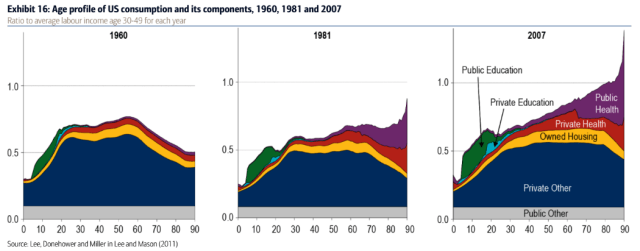
The consumption boom in the USA is all about healthcare
Britain needs to start making things again
At the end of 2015, inflation-adjusted income per capita in the UK was only 0.2% higher than its 2007 peak. This translates into an annual growth rate of 0.025% per year. How pathetic this performance is can be put into perspective by recalling that Japan’s per capita income during its so-called “lost two decades” between 1990 and 2010 grew at 1% a year. …
Unfortunately manufacturing had been so weakened since the 1980s that it didn’t have a hope of staging any such revival. Even with a massive devaluation, the UK’s trade balance in manufacturing goods (that is, manufacturing exports minus imports) as a proportion of GDP has hardly budged. The weakness of manufacturing is the main reason for the UK’s ever-growing deficit, which stood at 5.2% of GDP in 2015. Continue reading
The super-rich inevitably pops the housing bubble
The bigger the bubble, the longer the hangover.
But what would happen if they did actually go? As Danny Dorling, the Oxford professor of geography, notes, the ultra-moneyed classes do abandon cities – “at a time of their choosing”. Long Island was once so rich as to be the setting for the Great Gatsby – until the crash of 1929. Now the grand houses remain but the big-money holidays at the Hamptons. (For more data, look at Dorling’s new book A Better Politics, free online here.) The other thing we know is that cities that get too high on speculation face a long, long hangover.
Continue reading
The UN is not paying its peacekeepers
The United Nations owes countries that send troops to serve under its baby-blue banner a huge debt — a literal one.
As of March 31, 2016, the world body owed troop-contributing countries a total of $827 million in back-compensation, Under-Secretary-General for Management Yukio Takasu told Indian reporters on May 4.
The way the U.N. peacekeeping systems works is this — member states donate funds to the United Nations and the world body then passes a portion of that money onward to countries that offer up their troops to peace missions.
How to dismantle the welfare state
Can we really have sunk so far that we are prepared to abandon all this without a fight? I don’t think so. So here are the five tactics the government are using. Now you can spot them, and challenge them where you find it.
1. Never let a serious crisis go to waste
2. Launch a scapegoating campaign
3. Don’t talk about government subsidies and corporate welfare
4. Tell the people that we can’t afford welfare
5. Avoid common sense
Military and the Climate Change
Sara Flounders’ remarkable 2009 article on the Copenhagen climate meeting tied together the military and climate change, but delinking of the two persists. She wrote that “with more than 15,000 participants from 192 countries, including more than 100 heads of state, as well as 100,000 demonstrators in the streets – it is important to ask: How is it possible that the worst polluter of carbon dioxide and other toxic emissions on the planet is not a focus of any conference discussion or proposed restrictions? …the Pentagon has a blanket exemption in all international climate agreements.”
Overall, environmentalists pay little attention to the military, and the anti-war movement does not address the climate. Both squander precious time. At a slow pace, industrialized countries have been “transitioning” to clean energy since the 1960s, without any specified and enforceable time frame. Renewables remain a very small part of the energy mix and will not remedy the carbon-intensive military or industrial agriculture. Transition fuels like natural gas and biofuels have proven to be disastrous to human communities and to the climate. By contrast is the fast pace rapidly rising temperature, accelerating greenhouse gas concentration (due to amplifying feedbacks), increased military spending including nuclear weapons, and new weapons/surveillance/pacification technology.[1] At some point recently, the climate goal shifted from elimination of greenhouse gases to mitigation. Continue reading
Basic Income, Bullshit Jobs, Poverty and Military Spending
To begin with, basic income would give us all genuine freedom. Nowadays, numerous people are forced to spend their entire working lives doing jobs they consider to be pointless. Jobs like telemarketer, HR manager, social media strategist, PR advisor, and a whole host of administrative positions at hospitals, universities, and government offices. “Bullshit jobs,” the anthropologist David Graeber calls them. They’re the jobs that even the people doing them admit are, in essence, superfluous.
And we’re not talking about just a handful of people here. In a survey of 12,000 professionals by the Harvard Business Review, half said they felt their job had no “meaning and significance,” and an equal number were unable to relate to their company’s mission. Another recent poll among Brits revealed that as many as 37% think they have a bullshit job. Continue reading
Corruption in military aid programs
One issue that is ripe for attention is the effect corruption has on military aid programs. Providers of such assistance need to take more care to ensure that their partners are not subverting the purpose of these programs by engaging in corrupt practices.
U.S. military aid programs are a case in point. According to data compiled by the Security Assistance Monitor, this year the United States is providing over $8 billion in arms and training to 50 of the 63 nations that Transparency International has identified as being at “high” or “critical” risk of corruption in their defense sectors. …
Widespread corruption poses other serious challenges to providers of military assistance. There is a danger that tilting aid too heavily toward the defense sector can strengthen it at the expensive of civilian institutions, undermining civilian control of the military. There is a significant risk that this may be occurring among key recipients of U.S. security assistance. The Security Assistance Monitor’sassessment of dependence on U.S. military aid demonstrates that, for 2014, U.S. military aid accounted anywhere from 15% to 20% of defense expenditures of recipient countries like Egypt, Pakistan, and Burundi; over 50% in Liberia; and over 90% in Afghanistan. …
Corruption in defense assistance programs is about more than just a diversion of funds. It is also a threat to local, regional, and global security. Any effort to reduce global corruption must make cleaning up corruption in military aid programs a top priority.
Corruption in Military Aid Undermines Global Security
http://lobelog.com/corruption-in-military-aid-undermines-global-security/
Basic Incone is a necessity
He argues for a new view of minimum basic income, not as a safety net to save people who may fall, but a foundation on which people can stand to rise up as productive citizens. His presentation includes the new technological context that for the first time in history, smart machines will eliminate far more jobs than they create. This then, according to Varoufakis, necessitates a basic income for all citizens.
What is really significant about this presentation is the creation of an alternative view of wealth creation which he brings about through reframing the concept of how most people think about wealth.
Continue reading
British railways – a privatisation scam
The economic historian Robert Millward points out that the popular notion of nationalisation in Europe as a 1940s phenomenon, driven by the perceived failures of capitalism in the 1930s and the successes of the planned economy in wartime, ignores the earlier history of state direction of the universal networks. Gladstone wanted to nationalise the railways in 1844. Even earlier, at their genesis, the railways were dependent on the state to force private landowners to yield right of way to the iron road. The problem of the publicly owned British railways after 1948 wasn’t that they were publicly owned, but that they were expected to do so many things for so many people, often for less than they actually cost, that it was no longer possible to be sure exactly what they were doing with their share of the nation’s resources, or why. What was clear was that they kept failing to meet one of their key targets, which was to break even.
Continue reading
A multi-party politics can’t fit into a two party system.
The days of a meaningful mandate under FPTP have gone. Even a new New Labour project is impossible to assemble against the backdrop of an economic system that’s isn’t working for a growing majority. The vast bulk of the party has decided irrevocably to turn away from the politics of compromise beyond purpose. But a single Big Tent of the left is equally impossible. The social, cultural, regional and nation tensions are too great for one party to hope for a monopoly of the progressive vote. Continue reading
Trident to cost £205bn in total, 6% of defence budget a year
The total cost of replacing the Trident nuclear missile system will come to at least £205bn, far more than previously estimated, according to figures drawn up by the Campaign for Nuclear Disarmament (CND).
It has calculated the total on the basis of official figures, answers to parliamentary questions and previous costs of items including nuclear warheads and decommissioning nuclear reactors. It says it has not taken into account that past Ministry of Defence projects have frequently gone well over budget. …
The most expensive item would be the cumulative running costs, estimated by the government to be about 6% of the total defence budget. Crispin Blunt, Tory chair of the Commons foreign affairs committee, has calculated, on the basis of parliamentary answers, that a new Trident system would cost £167bn over a 30-year lifespan.
Replacing Trident will cost at least £205bn, campaigners say
http://www.theguardian.com/uk-news/2016/may/12/replacing-trident-will-cost-at-least-205-billion-campaign-for-nuclear-disarmament
 Tipping Point North South